COB vs SMD LED Display: What Is the Difference?
COB LED and SMD LED are two major LED display technologies. COB LED offers higher durability and better protection, while SMD LED provides flexibility and lower cost. COB is commonly used in fine-pitch indoor displays, while SMD is widely used in both indoor and outdoor applications.
When choosing an LED display, one of the key decisions lies in the packaging technology. SMD vs COB: How do you choose the best option? While SMD LEDs are widely used and well-established, COB LEDs are gaining attention with their innovative advantages.
Let’s dive deep into a full comparison to help you decide whether to choose COB or SMD LED displays.
Table of Contents
1. Introduction to LED Package Technology
LED package is the process of encasing LED chips to protect them and improve their performance. Different packaging methods affect the LED’s brightness, heat dissipation, durability, and visual quality.
The most common LED packaging types include:
(1) DIP (Dual In-line Package)
An older technology where LED chips are inserted into holes on a PCB.
DIP LEDs are large, durable, and mostly used for outdoor displays.
(2) SMD (Surface-Mounted Device)
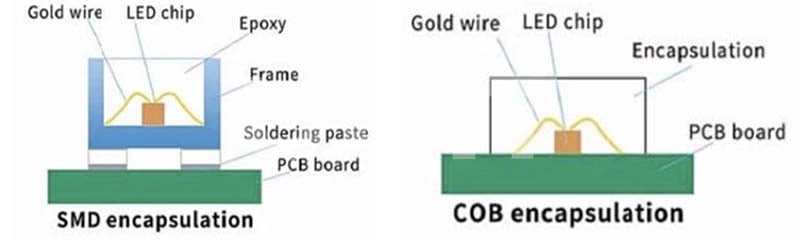
In this method, the red, green, and blue chips are packaged into a small unit and mounted directly on the PCB surface.
SMD LEDs offer better brightness, a wide viewing angle, and are widely used in both indoor and outdoor screens.
(3) COB (Chip-on-Board)
COB LED display directly mounts multiple LED chips onto the PCB and encapsulates them in resin.
This results in a smooth, seamless light surface with improved heat dissipation and high durability, ideal for fine-pitch and high-end indoor displays.
(4) Mini LED & Micro LED
These are newer forms of COB packaging, using smaller chips for ultra-high-definition displays.
They offer improved contrast, deeper blacks, and are increasingly used in premium products like TVs and XR stages.
Each packaging type has its advantages and is suited for different applications depending on cost, environment, and visual requirements.
2. COB LED vs SMD: What Is the Difference?
When choosing an LED display solution, understanding the difference between COB LED and SMD LED technology is essential. Both are widely used in modern LED displays, but they differ in packaging structure, durability, display performance, and application scenarios.
- Definition & Packaging Process
SMD LED
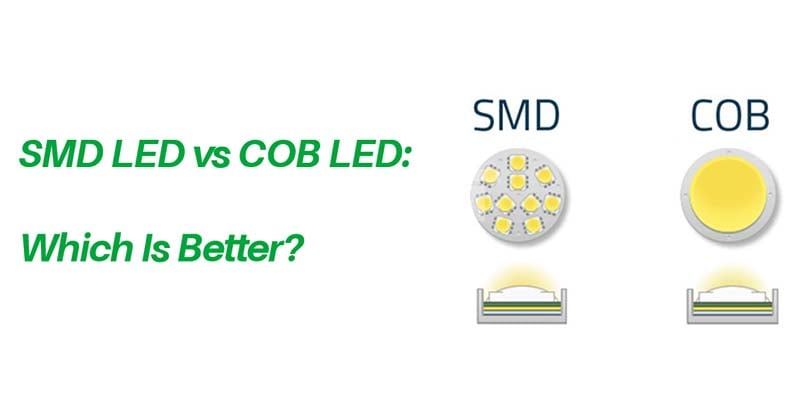
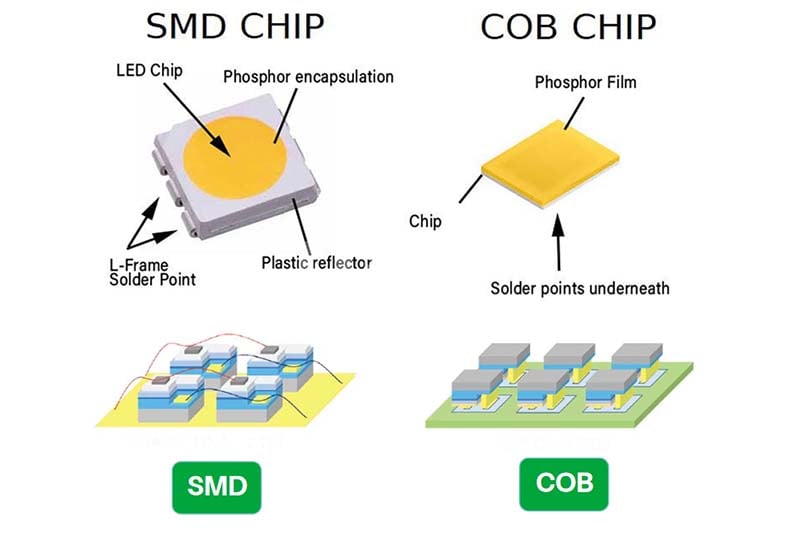
SMD (Surface-Mounted Device) LEDs package the red, green, and blue diodes into a small plastic casing and then mount them directly onto a PCB using surface-mount technology.
This allows for mass production and flexible design.
COB LED
COB (Chip-on-Board) LEDs mount multiple LED chips directly onto the PCB and encapsulate them in epoxy or resin.
This results in a compact, seamless light source with enhanced protection and heat management.
- Display Performance
SMD LED Display
SMD LED display uses point light sources, which can produce pixel separation at close viewing distances.
This may result in visible pixelation and less uniform brightness when viewed up close.
However, SMD displays still offer bright and colorful visuals and perform well for medium- to long-distance viewing, making them ideal for pixel pitches of P1.2 and above.
COB LED Display
COB LED display adopts a surface light source, offering soft, uniform light with excellent contrast and color performance.
Because of this, COB is ideal for close-up and high-resolution displays (P0.9, P0.6, even P0.4), with wider viewing angles and moiré suppression.
It provides a better visual experience and is gentler on the eyes, especially for applications in control rooms, studios, and conference centers.
https://youtu.be/2pDiPaTuF4Uhttps://youtu.be/_-2dkXX85vg
SMD vs COB LED Display
- Protection and Durability
SMD
LED SMD screens are exposed and soldered onto the PCB surface.
This makes them vulnerable to external damage, such as knocks or moisture intrusion.
Their IP protection rating is generally lower unless external protection is added.
COB
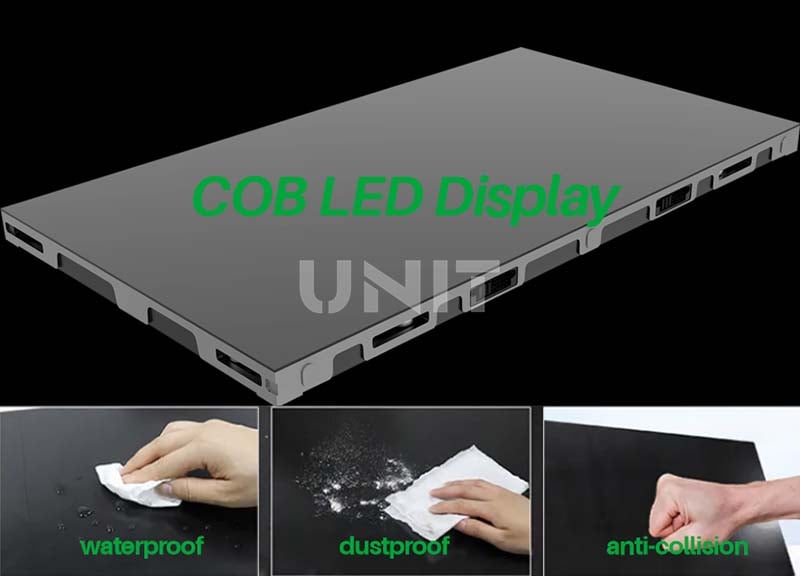
In contrast, COB LEDs are fully sealed and embedded in epoxy resin, making them shock-resistant, waterproof, dustproof, and anti-collision.
In fact, their impact resistance is up to 5 times stronger than SMD displays. So, they are more suitable for high-traffic or rugged environments.
- Heat Dissipation
SMD Heat Management
SMD LED panel devices dissipate heat through contact with the PCB and through the casing.
However, added protective layers may limit airflow and increase thermal resistance.
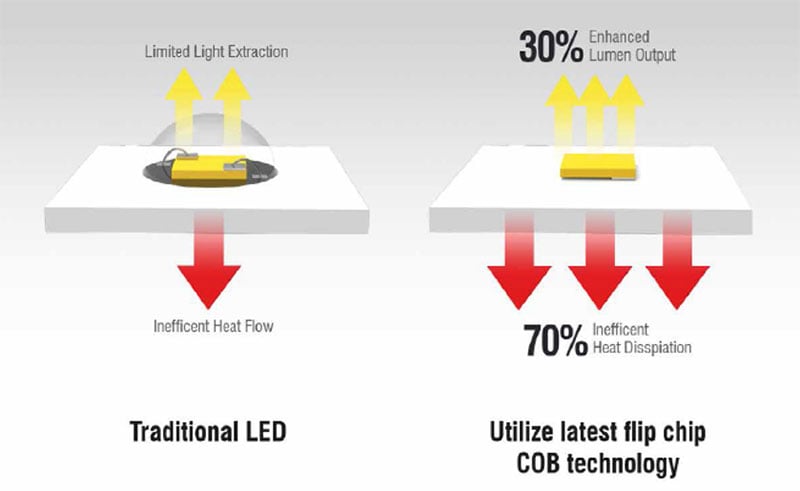
COB Cooling Efficiency
The chips are directly bonded to the PCB with thermal glue, allowing heat to flow efficiently to the substrate.
Low thermal resistance improves display lifespan and maintains stable brightness and color fidelity, even in high-temperature environments or during extended operation.
- Maintenance and Repair
SMD: Easier to Repair
One key advantage of SMD LED is ease of maintenance.
Individual SMD LEDs can be replaced using standard rework tools, making repairs quick and cost-effective.
COB: Professional Repair Required
COB displays are more complex. Because the chips are embedded beneath protective resin, individual repairs can be difficult.
Most COB LED screens must be sent back to the manufacturer for repair, raising maintenance costs and downtime.
- Production Cost and Manufacturing Complexity
SMD: Cost-Effective and Mature
SMD technology is mature, with an established supply chain and high-yield production process.
It supports automated mass production, which keeps costs low.
As a result, SMD displays are highly competitive in terms of price and remain the mainstream choice for many large-format and outdoor applications.
COB: High-End, Higher Cost
COB offers better integration and supports ultra-fine pixel pitch, but comes with higher manufacturing complexity.
The process requires cleanroom environments, precision coating, and tight quality control, leading to higher production costs.
On average, COB displays cost 10–20% more than SMD displays with equivalent specifications.
- Pixel Pitch Limitations
SMD
SMD displays typically cannot go below P1.2 due to limitations in component size and spacing.
COB
COB displays can achieve ultra-fine pitch like P0.9, P0.6, and even P0.4.
Ideal for 4K or 8K resolutions on relatively small screens.
3. SMD vs COB LED Display: Side-by-Side Comparison
| Parameter | SMD LED Display | COB LED Display |
|---|---|---|
| Pixel Pitch Range | P1.2 – P10 and above Mass production mainstream |
P0.4 – P1.5 Ultra-fine pitch capable |
| Brightness | 800 – 5,000 nits (indoor) 5,000 – 10,000+ nits (outdoor) |
600 – 3,000 nits (indoor) Less suited for high-brightness outdoor |
| Contrast Ratio | 1,000:1 – 5,000:1 (standard) Up to 10,000:1 (premium indoor) |
5,000:1 – 25,000:1+ Black epoxy surface = superior blacks |
| Viewing Angle | H: 140° – 160° / V: 120° – 140° | H: 160° – 170° / V: 150° – 160° Wider, more consistent |
| Lifespan | 50,000 – 80,000 hours | 80,000 – 100,000 hours Longer due to sealed encapsulation |
| Failure Rate (ppm) | 200 – 500 ppm (lamp-out risk) | < 50 ppm 5–10× more reliable |
| Protection Level | IP40 – IP65 (with added enclosure) Exposed lamp beads are vulnerable |
IP65 – IP68 (inherent) Shock-proof, dustproof, waterproof |
| Impact Resistance | Standard (lamp beads can be knocked off) | 5× stronger than SMD (fully embedded chips) |
| Heat Dissipation | Via PCB and casing; requires heat sink for dense pitches | Direct chip-to-PCB contact; thermally conductive epoxy layer reduces hotspots |
| Pre-shipment Calibration | LED binning allows selective sorting Better consistency pre-calibration |
Full-screen calibration required No individual LED sorting is possible |
| Repairability | Individual lamp bead is replaceable Lower maintenance cost per repair |
Entire module replacement required Higher unit repair cost |
| Anti-Moiré | Visible moiré is possible at close range (camera filming) | Excellent moiré suppression Ideal for XR/broadcast studios |
| Eye Comfort | Point light source; may cause glare at close viewing | Surface light source; softer, gentler on eyes Better for long-duration viewing |
| Production Complexity | Electroplating → Patching → Reflow Soldering → PCB Mount Multi-step process |
Direct chip bonding → Epoxy encapsulation Fewer process steps; higher per-unit precision |
| Unit Price | Lower— mature supply chain, mass market | 20–40% higher than equivalent SMD pitch Premium product segment |
| Best For | Outdoor billboards, rental screens, retail signage, large indoor venues (P1.2+) | Control rooms, broadcast studios, XR stages, conference rooms, high-end showrooms (P0.9 and below) |
4. SMD vs COB LED: Application Scenarios
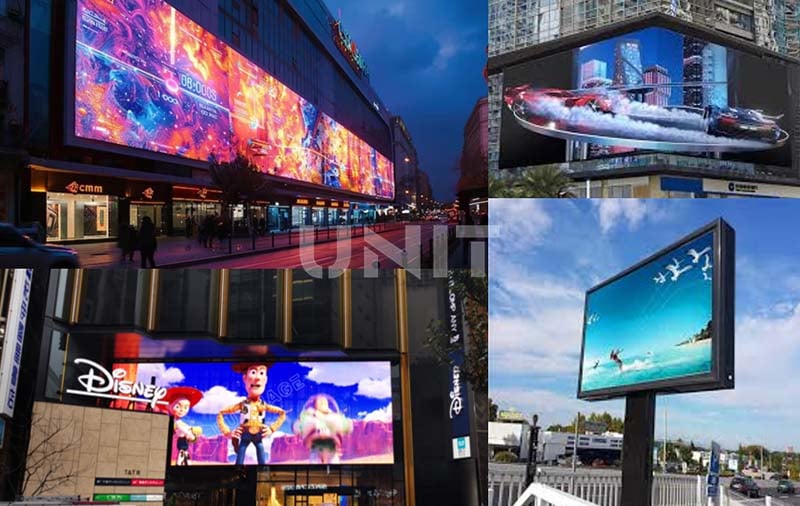
- SMD LED Display Screen
SMD packaging has relatively mature technology and cost advantages. It is widely used in fields with low requirements for refined display and low installation and maintenance costs.
For example: outdoor advertising, large commercial display screens, stage rental screens, etc.
① Commercial Advertising
In public places with large traffic, such as shopping malls, airports, and subway stations, SMD-packaged LED display screens can display advertising content in a larger size and moderate resolution to attract the attention of passers-by.
For example, common large outdoor advertising screens and hanging advertising screens in indoor atria mostly use SMD packaging technology.
② Conference and Exhibition
SMD-packaged display screens are often used for stage background screens and information release screens at various exhibitions and conference sites.
It can provide clear images and text displays to meet the basic display needs of conference displays, product releases, and other activities.
Moreover, SMD packaging is easy to maintain and replace lamp beads, and can quickly handle possible problems during frequent use and transportation.
③ Stadiums
The audience display screens of large stadiums, such as football fields and basketball courts, usually choose SMD packaging technology.
On the one hand, the SMD packaged display can achieve a larger dot pitch to meet the needs of viewing from a long distance.
On the other hand, its good heat dissipation performance can ensure stable operation during long-term use, and cope with long-term high-load use scenarios such as sports events.
④ Outdoor Media
SMD packaging technology is also widely used in outdoor LED display applications such as urban landscape lighting and highway LED billboards.
The brightness of the display is required to be high in these scenarios, and outdoor SMD LED lamp beads can provide sufficient brightness.
At the same time, it is highly adaptable to different ambient temperatures and can work normally under various harsh weather conditions outdoors.
- COB LED Display Screen
COB LED display screen is mainly used in places with high requirements for display effects and protection performance.
Such as high-end conference rooms, command centers, studios, high-end retail displays, etc.
① Commercial Display
In the conference room scene, the indoor COB LED display provides a clear and stable picture display.
Seamless splicing technology eliminates the gap between the pictures and avoids visual interference.
Create a smooth visual environment for conference communication.
② Education Field
Smart teaching large screen replaces traditional projectors and whiteboards.
Its high-definition display and delicate picture quality can help students better understand knowledge.
In training centers and corporate conference rooms, it can also be used to play training materials and meeting content to improve the efficiency and quality of information transmission.

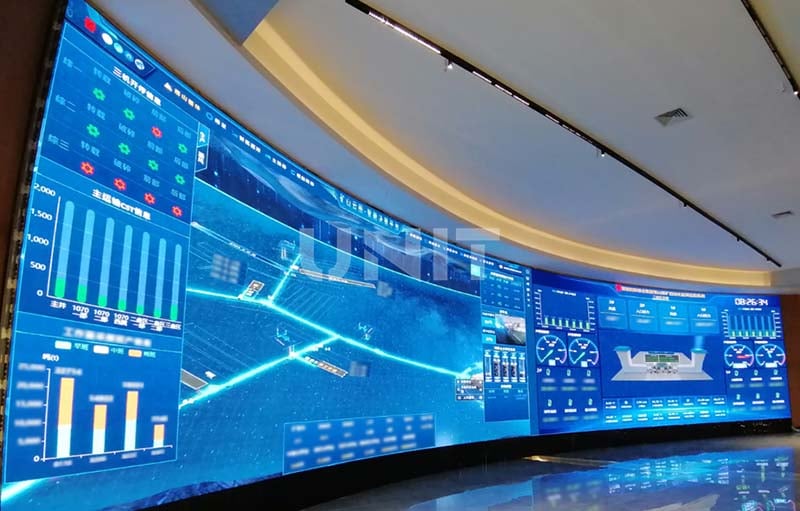
③ Traffic and Security Monitoring
In transportation hubs such as airports, railway stations, and subway stations, COB LED displays provide passengers with clear flight and train information, as well as guidance instructions in complex environments.
In security monitoring centers, COB displays are used to centrally display video images from various monitoring points.
Its high resolution and seamless splicing capabilities ensure the clarity and continuity of the monitoring images.
④ Sports and Entertainment
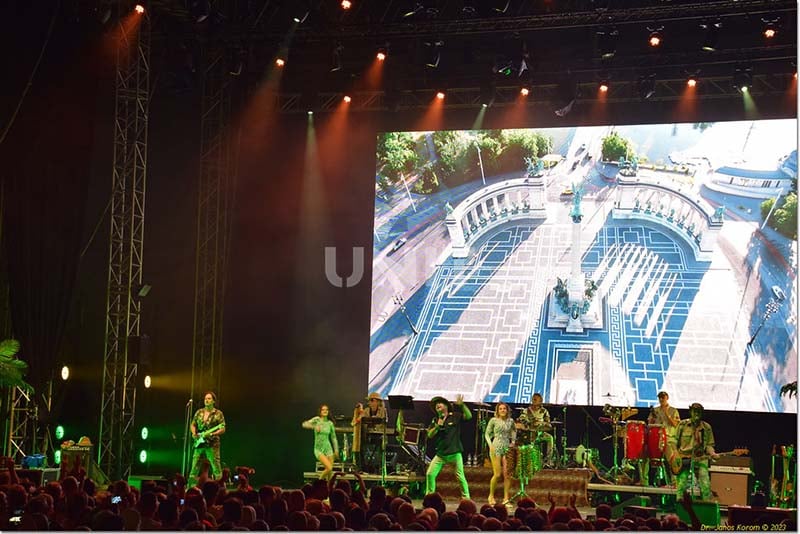
In sports venues such as football fields and basketball courts, COB displays are used to play game images and score information in real time, providing spectators with an immersive viewing experience.
In entertainment venues such as concerts and music festivals, LED COB displays are used to play performance information and background images to enhance the atmosphere on site.
⑤ Smart Cities and Public Information Display
In public places in cities, such as squares and parks, COB displays are used to publish public information, such as weather and news, to provide convenience for citizens.
Combined with Internet of Things technology, it can also be used in intelligent traffic indication systems to display road conditions, bus arrival information, etc., in real time.
5. LED vs SMD Light – Clearing Up a Common Confusion
Many people ask, “What is the difference between LED and SMD light?”
Technically, SMD is a type of LED, specifically referring to how the LED is packaged and mounted.
While “LED” is a broad term, SMD, COB, DIP are all subtypes.
So, comparing “LED vs SMD light” is really a question of packaging method, not light source type.
6. SMD vs COB: Which Is Better?
There’s no universal answer. Your best choice depends on your priorities:
|
Factor |
SMD |
COB |
|
Display Quality |
Moderate |
Excellent |
|
Viewing Distance |
Mid to Long |
Close & Long |
|
Durability |
Basic |
High |
|
Heat Dissipation |
Average |
Excellent |
|
Maintenance |
Easy |
Complex |
|
Cost |
Lower |
Higher |
|
Pixel Pitch |
>P1.2 |
<P1.0 |
|
Best For |
Outdoor Ads, Stage Screens |
Studios, Control Rooms, Retail |

If you have high requirements for display effects, harsh operating environments, high resolution and small pitch, and sufficient budget, COB packaging technology is a better choice.
Suitable for high-end conference centers, TV studios, security monitoring centers and other places.
If you pay attention to cost, have requirements for maintenance convenience, and do not have particularly demanding requirements for display effects and protection, SMD packaging technology is more suitable.
Commonly used in outdoor advertising large screens, general commercial display screens, etc.
7. SMD or COB: Which LED Display is Right for Your Project?
🎬
Broadcast Studio & XR Stage
Camera-facing LED walls demand zero moiré and exceptional color accuracy. COB’s surface light source eliminates the grain effect seen with SMD when captured on camera.
✓ Recommend: COB (P0.9 or finer)
🖥️
Control Room & Command Center
Operators view screens for 8–12 hours daily. COB’s soft surface light source significantly reduces eye fatigue, and its high contrast ratio ensures critical data visibility at all ambient light levels.
✓ Recommend: COB (P1.2 or finer)
🏛️
Premium Showroom & Museum
Close-up viewing distance and zero visible pixels are non-negotiable. COB LED seamless surface and deep blacks ensure artwork-quality visuals with no “screen door” effect.
✓ Recommend: COB (P0.6–P0.9)
🏟️
Stadium & Arena
Long viewing distance (15–100m+), high ambient light, and large-format requirements favor SMD’s high brightness ceiling and competitive cost-per-sqm at P4–P10 pitches.
✓ Recommend: SMD (P4–P10)
🎪
Rental & Live Events
Frequent assembly and disassembly increase physical contact risk. SMD panels with individual lamp replaceability keep maintenance fast and cost-effective on-site.
✓ Recommend: SMD (P2.6–P3.9)
🏬
Retail & Mall Signage
Budget-conscious, medium viewing distance (3–8m), high brightness for daylight conditions. SMD P1.5–P2 hits the sweet spot for image quality versus investment.
✓ Recommend: SMD (P1.5–P2.5)
🏢
Corporate Lobby & Conference
Viewing distance of 2–5m with varied content (presentations, video, data). Either technology works well — COB offers a premium look; SMD delivers better value for general use.
⚖ Either: COB (premium) / SMD (P1.2–P1.5)
🌧️
Semi-Outdoor / High-Traffic
Exposure to dust, humidity, or frequent physical contact. COB’s inherent IP65+ protection and 5× impact resistance make it a safer long-term investment.
✓ Recommend: COB or GOB-SMD
8. Future Outlook: Is COB the Future of LED Displays?
While SMD still dominates the market due to cost advantages and wide application compatibility, COB is increasingly seen as the future of high-end LED displays.
(1) Mini LED and Micro LED Evolution
With the rise of Mini LED and Micro LED technologies, COB has a strategic edge due to its high integration and precision packaging capabilities.
These cutting-edge display formats, known for their ultra-fine pitches and exceptional clarity, rely heavily on COB advancements.
As Mini and Micro LEDs become more mainstream, COB’s role in their production will be even more critical, pushing the boundaries of what LED screens can achieve.
As manufacturing costs decrease and production yields improve, COB is expected to become more affordable and widely adopted, especially in 8K displays, virtual production, and immersive AR/VR environments.
(2) Challenges Remain
Despite its advantages, COB manufacturing is still relatively complex and costly. Repairing damaged sections can also be more difficult compared to traditional SMD displays.
Nevertheless, as production techniques improve and costs gradually decrease, COB LED panel is expected to become more accessible, paving the way for wider adoption across multiple industries.
In conclusion, while there are still hurdles to overcome, the superior visual performance, durability, and innovation potential of COB LED technology strongly suggest that it will play a central role in the future of LED displays.
9. UNIT Indoor COB LED Display Recommend
At UNIT LED, we specialize in providing high-quality SMD LED displays with a wide variety of pixel pitches and product types, including rental LED screens, fixed LED displays, transparent LED screens, and flexible LED displays.
We also offer advanced indoor small-pitch COB LED display solutions, ensuring exceptional image quality, durability, and performance for diverse application needs.
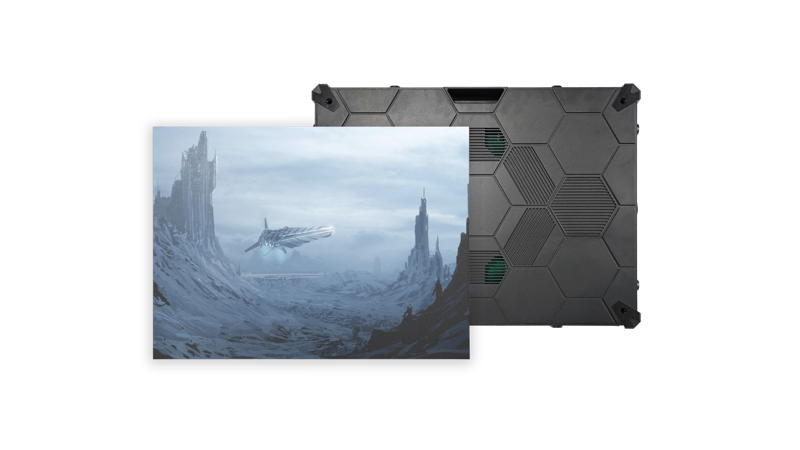
MA640 Series
- COB pixel picth: P1.538mm, P1.86mm
- 640*480mm 4:3 LED Cabinet
- Indoor frontal service LED display screen
- Seamless splicing & HD visuals
- Soft connection cabinet design
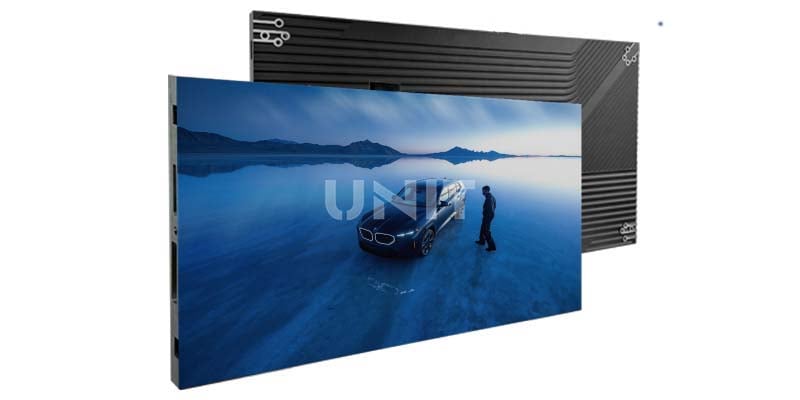
MA600 Series
- COB pixel picth: P0.93, 1.25, P1.56mm
- 600×337.5mm 16:9 LED Cabinet
- High refresh rate to 3840Hz
- 150*168.75mm small size LED module
- Hard connection cabinet design
10. FAQs
Q1. Is COB LED better than SMD for indoor displays?
It depends on your application.
For fine-pitch indoor displays at P0.9 or below, such as control rooms, broadcast studios, and premium conference rooms, COB is generally superior. Due to its seamless surface light source, higher contrast ratio (5,000:1–25,000:1), wider viewing angle, and superior eye comfort for long-duration viewing.
For general indoor applications at P1.2 and above, SMD remains the cost-effective mainstream choice, offering excellent brightness, color performance, and individual lamp replaceability that keeps maintenance costs low.
.elementskit-card END
Q2. Can COB LED be repaired if a pixel fails?
This is one of COB’s key limitations. Because all LED chips are encapsulated together under a single resin layer, individual pixels cannot be replaced. The entire module must be swapped out when damage occurs.
By contrast, SMD displays allow individual lamp bead replacement, which is faster and cheaper per repair event. For high-traffic environments where physical damage is likely, we recommend considering GOB (Glue-on-Board) SMD as an alternative. It combines SMD’s repairability with COB-level physical protection.
.elementskit-card END
Q3. What pixel pitch is COB LED available in?
COB LED displays are available from as fine as PO.4 up to approximately P1.5. The most common commercial COB LED display pixel pitches are PO.6, PO.7, PO.9, P1.O, P1.2, and P1.5.
.elementskit-card END
Q4. Which is better for outdoor LED displays: SMD or COB?
For traditional outdoor advertising and billboard applications, SMD remains the dominant choice. Because of its ability to reach
brightness levels of 5,000-10,000+ nits needed for direct sunlight visibility.
.elementskit-card END
Q5. What is the difference between COB, GOB, and MIP LED technology?
These three technologies each take a different approach to improving on standard SMD:
COB (Chip-on-Board) bonds LED chips directly onto the PCB without a pre-formed package, creating a seamless surface – excellent for fine pitch and protection, but not individually repairable.
GOB (Glue-on-Board) applies a transparent protective glue layer over standard SMD modules – it retains SMD’s repairability while adding COB-level impact and moisture protection, without the fine-pitch
capability.
MIP (Micro LED in Package) pre-packages Micro LED chips before PCB mounting. Combining the fine-pitch capability of COB (<P1.0) with the individual replaceability of SMD, it represents the most promising next-generation direction for ultra-fine-pitch displays.
.elementskit-card END
11. Conclusion
Understanding the difference between SMD vs COB LED screen technologies is essential when choosing an LED display. Each has its strengths, and the right choice will depend on your budget, usage environment, desired resolution, and maintenance expectations.
For commercial and outdoor use, SMD is tried, tested, and cost-effective. For indoor, high-resolution applications, COB is more refined, robust, and visually superior.
Whether you’re building a massive outdoor billboard or a precision control room display, choosing the right LED packaging technology will ensure optimal performance, longevity, and return on investment.
Do you know how to choose SMD vs COB LED display now?