LED Screen Size Explained: A Complete Buyer’s Guide (2026)
Whether you’re installing a big display for a concert or a small one for a retail shop, you will not miss LED screen size.
Too small, and your message gets lost; too big, and you might be overpaying for unused space.
But how do you determine the ideal size of an LED screen? Should you use standard dimensions or a custom setup? How do screen sizes convert between millimeters, inches, and feet?
In this guide, we’ll explain everything you need to know about LED screen sizes. Let’s dive in!
Table of Contents
1. What is LED Screen Size?
LED screen size refers to the physical dimensions of the display, typically measured by its width and height.
It’s important to distinguish this from pixel pitch, which refers to the distance between individual LEDs that affect resolution.
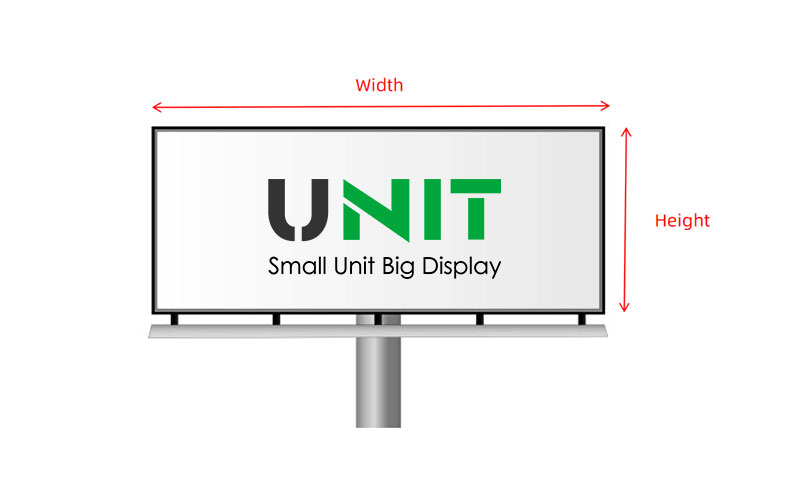
Wikipedia explains that the size of a screen is usually described by the length of the diagonal, which is the distance between the diagonal lines, usually in inches.
References: https://en.wikipedia.org/wiki/Display_size
For example, 55 inches, 75 inches, or custom sizes for larger installations.
The size determines how much content can be displayed at once and how visible the screen will be from various distances.
For example, a larger LED display might be used for outdoor advertising. However, a smaller display may be used in a conference room or for retail signage.
Understanding the size of an LED screen is essential for choosing the right display based on the space and viewing needs of the intended audience.
2. Different LED Display Sizes and Their Applications
LED screens have revolutionized visual displays across various industries, offering vibrant colors and high-resolution imagery.
Understanding the different sizes of LED screens is crucial for selecting the right display for your needs.
2.1 Large LED Display Size
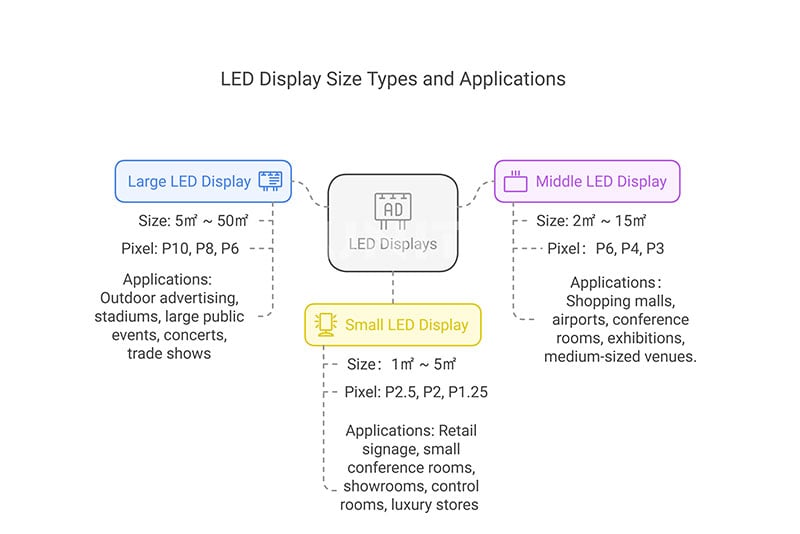
Large LED displays are typically used for high-visibility applications, such as outdoor advertising, sports arenas, and large public events.
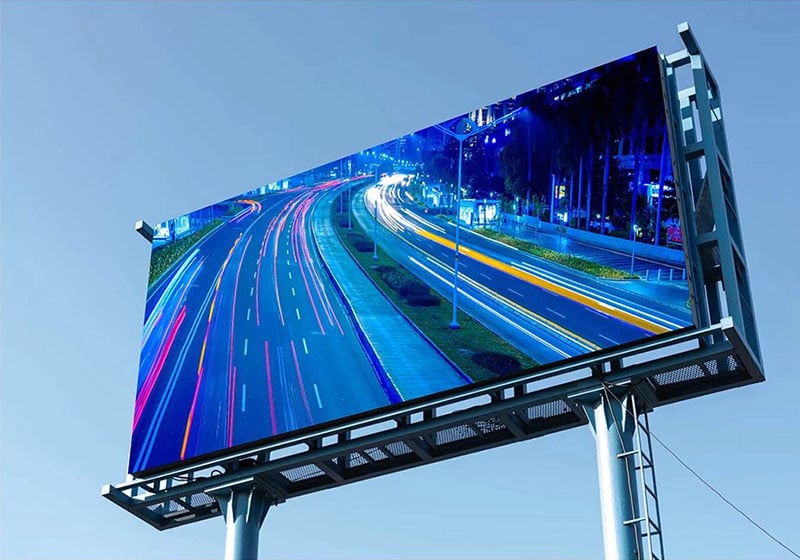
These displays are designed to be viewed from a significant distance, which is why they tend to be larger in both height and width.
The outdoor P10 LED display is suitable for large outdoor billboards, stadiums, and outdoor events.
2.2 Middle LED Screen Size
Middle-sized LED screens are versatile and typically used in environments that require good resolution and visibility from moderate distances.
These screens are commonly seen in medium-sized venues like shopping malls, airports, and conference rooms.
Common pixel pitches: P6mm, P5mm, P4mm
2.3 Small LED Display Size
Small LED displays are designed for close-up viewing, making them ideal for indoor applications where space is limited, and high resolution is necessary.
These displays are often used in retail signage, small conference rooms, and other environments where viewers are at a short distance.
Common pixel pitches: P2.5mm, P2mm, P1.25mm
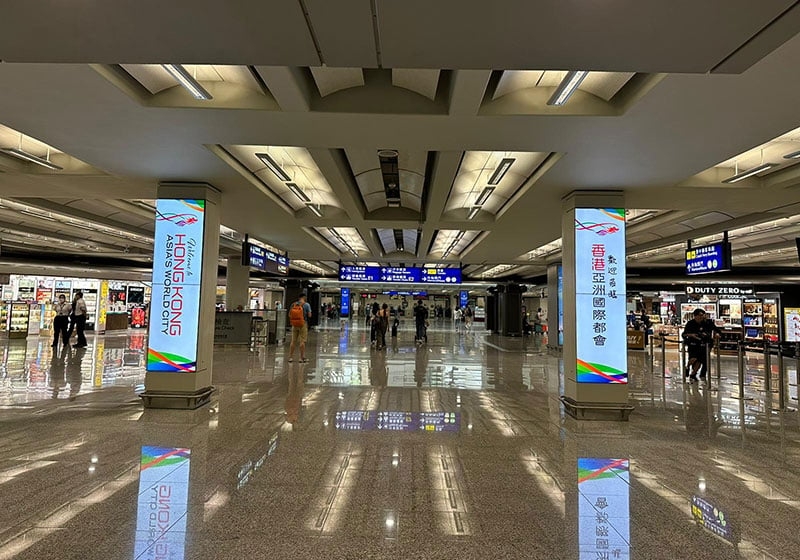
Below is a picture of the three screens to help you quickly understand the different LED display sizes.
3. Factors Influencing LED Screen Size Selection
Selecting the right LED screen size is crucial for ensuring optimal visibility, performance, and functionality.
Several factors should be considered when choosing the size of an LED screen for a specific application.
Here are the key factors influencing LED display screen size selection:
3.1 Space Availability
Another critical consideration is the physical space where the LED display video wall will be installed.
It’s important to select a screen size that fits the area without overwhelming the space or being too small for its purpose.
For Indoor Environments:
It typically offers more flexibility in terms of screen size. But a small LED display with high resolution is the first choice for confined spaces.
For Outdoor Environments:
A large LED display ensures visibility from a distance, especially in high-traffic areas.
3.2 Viewing Distance
The viewing distance plays a major role in determining the appropriate size of an LED screen.
A screen that is too small for a long viewing distance may make it difficult for viewers to see content.
However, a screen too large for a short viewing distance may result in pixelation or discomfort.
For Long Viewing Distances:
Such as outdoor billboards or large events, a larger LED display is ideal.
For Close-up Viewing:
Such as in a retail store or small conference room, choose a smaller screen with a higher resolution.
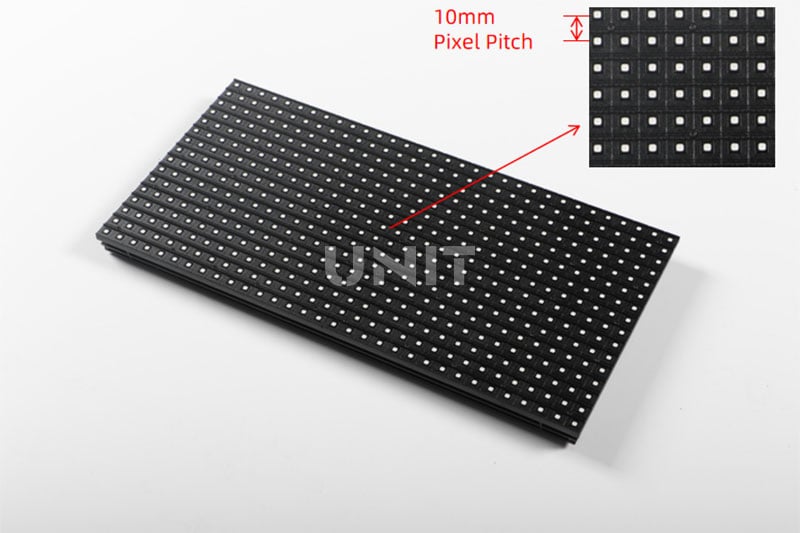
3.3 Resolution and Pixel Pitch
LED screen resolution is directly related to the pixel pitch, which affects the clarity of the content.
As the screen size increases, a higher resolution may be needed to maintain sharpness and avoid pixelation.
3.4 Content Type
The type of content displayed also influences the LED display screen size.
LED video screens used for video content, advertisements, or dynamic displays may need to be larger to effectively capture attention and provide clear visuals.
For static content, such as informational signage or stock market tickers, small LED screen sizes can still deliver clear messaging.
3.5 Budget
The budget available for purchasing and installing an LED display can also limit the size selection.
Big LED displays are more expensive due to higher manufacturing and installation costs.
Huge LED display screens tend to have a higher initial cost. But They are good long-term investments for high-visibility applications.
Smaller LED screens may be more affordable. However, they are not suitable for large-scale outdoor installations or large venues.
3.6 Purpose of Use
The intended purpose of the LED screen is to determine the optimal size.
Screens used for specific events, advertising, or professional use (such as control rooms) require different considerations.
By evaluating these factors, you can make an informed decision on the right LED screen size for your needs.
4. Standard LED Screen Sizes
When selecting an LED screen, understanding the standard sizes of the modules, cabinets, and screens can help guide your choice.
Below, we break down the most commonly used sizes in the market. Including LED module sizes, LED cabinet sizes, and typical sizes for indoor and outdoor applications.
4.1 LED Module Size
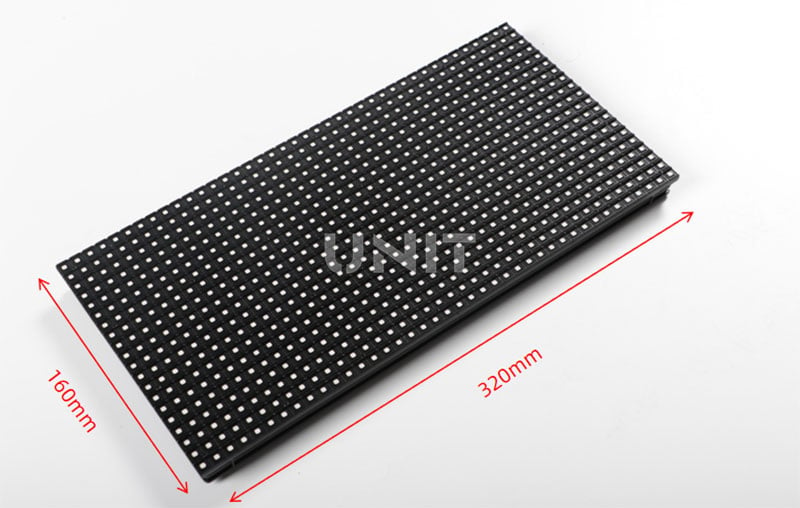
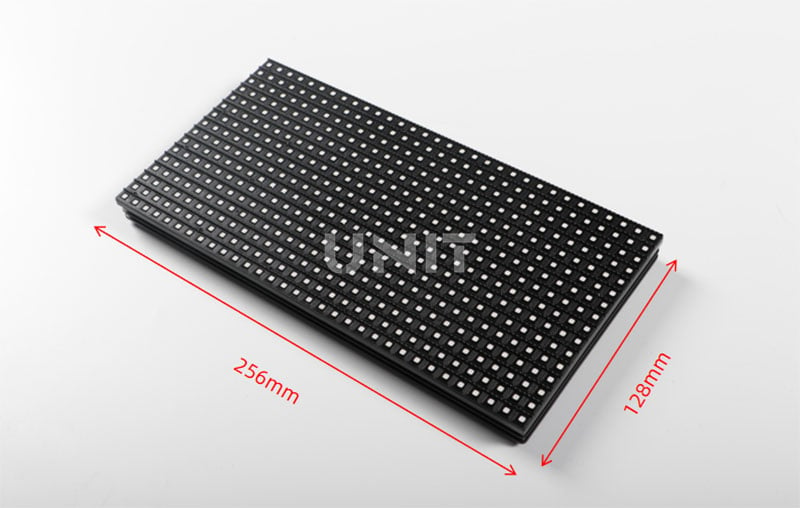
Outdoor P8mm LED Display Module
LED modules are the building blocks of an LED display. And their size can influence the overall size of the screen.
The size of the LED module is typically standardized in the industry. Each module contains a fixed number of LEDs arranged in a grid.
The following table lists the standard module sizes and their corresponding pixel pitches.
|
LED Module Size (mm) |
Pixel Pitch(mm) – Indoor |
Pixel Pith(mm) – Outdoor |
|
320*160mm |
P1.25, P1.958, P1.667, P1.839, P1.86, P2, P2.5, P3.076, P4, P5 |
P2.5, P3.076, p3.33, P4, P5, P6.67, P8, P10 |
|
250*250mm |
P2.604, P2.976, P3.91, P4.81 |
P2.976, P3.91, P4.81 |
|
240*240mm |
P1.875, P2.5 |
/ |
|
160*160mm |
P2.5, P5 |
P2.5, P3.33, P5, P10 |
|
192*192mm |
P3 |
P3, P6 |
These module sizes offer flexibility in creating different LED display dimensions.
Other special LED module sizes:128*128mm,160*80mm, 256*128mm, 256*256mm, and so on.
It is worth noting that for some products of special sizes, some LED display manufacturers require a minimum order quantity.
4.2 LED Cabinet Size
LED cabinets are the frames that house the LED modules and power supply.
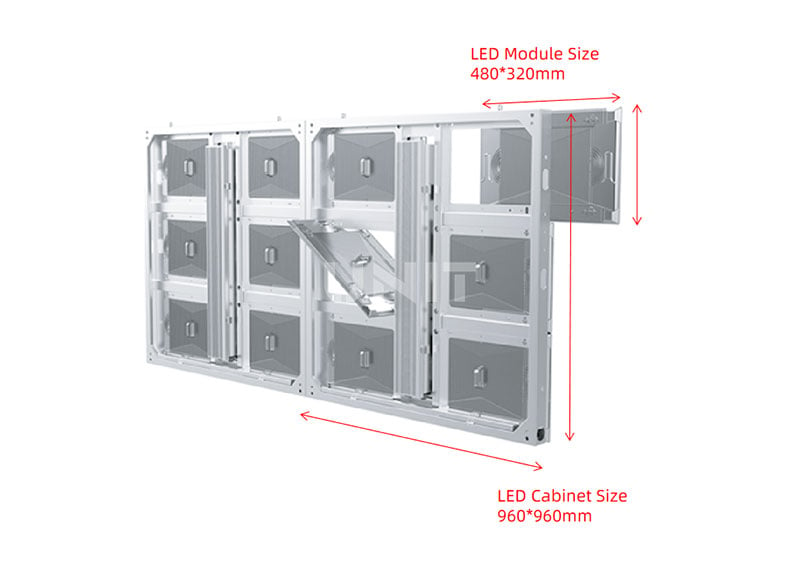
Standard cabinet sizes are essential for assembly, allowing for ease of customization and scalability.
Common LED Cabinet Sizes:
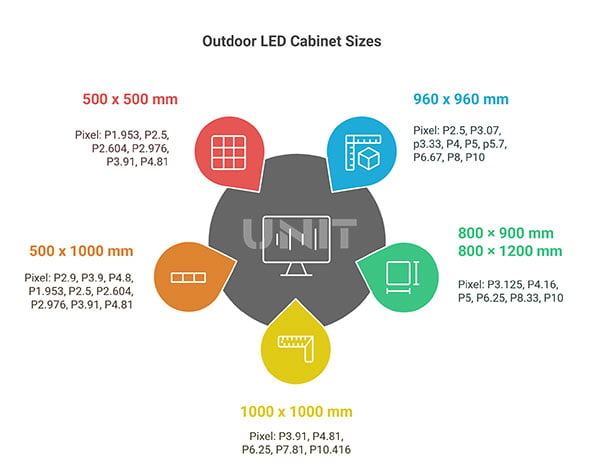
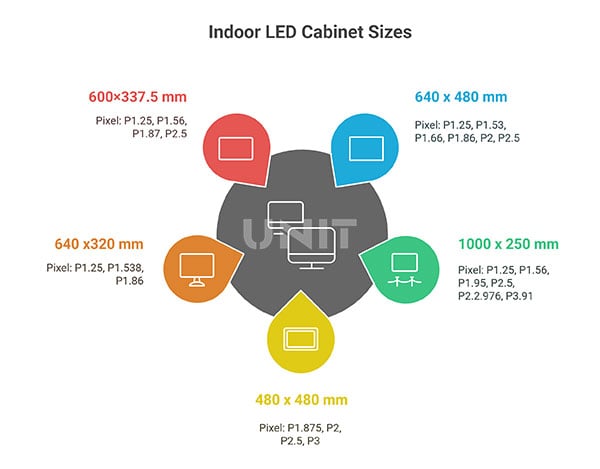
Note: Cabinet sizes often align with the LED module size. For example, 500*500mm or 500*1000mm rental LED displays use 250*250mm modules.
Cabinet size is important because it affects the final LED screen size, installation speed, maintenance method, and transportation cost. For example, rental LED displays often use 500mm × 500mm or 500mm × 1000mm cabinets because they are easy to stack, transport, and install for temporary events. Fixed indoor and outdoor LED screens may use different cabinet sizes depending on the wall structure and service access.
For more details about cabinet structure, you can also read our LED display cabinet guide. If your project is for events, concerts, stages, or exhibitions, a rental LED display may be easier to configure with standard cabinet sizes.
4.3 Custom Size LED Screen
Custom size LED screens are often required for specific projects that don’t fit within the standard screen sizes.
Custom screens are usually created by combining multiple cabinets and modules to fit unique dimensions.
These screens can be made to match any specific space or design requirement.
4.4 Indoor LED Screen Size
Common Indoor LED Screen Sizes:
|
Screen Size |
Common Pixel Pitch |
Applications |
|
1m x 1m to 3m x 3m |
P4, P3, P2.5 |
Suitable for small to medium-sized indoor environments, including retail displays and conference rooms. |
|
4m x 3m to 6m x 4m |
P4, P3, P2.5 |
Larger indoor environments, such as malls, event spaces, and stadiums. |
4.5 Outdoor LED Screen Size
Common Outdoor LED Screen Sizes:
|
Screen Size |
Common Pixel Pitch |
Applications |
|
3m x 2m to 10m x 6m |
P10, P8, P6 |
Large outdoor advertising, billboards, sports arenas, and outdoor events. |
|
10m x 6m to 20m x 12m |
P10, P8, P6 |
High-visibility billboards, stadium displays, and transportation hubs. |
5. How to Measure LED Display Size?
Calculating the size of an LED screen involves determining its total display area, which can be done in several ways depending on the desired dimensions or format.
Here are the most common methods for calculating LED screen size:
5.1 By Width and Height (Standard Rectangular Method)
The most straightforward method for calculating the LED screen size is to multiply the width by the height of the screen.
This will give you the total display area in square meters or square feet.
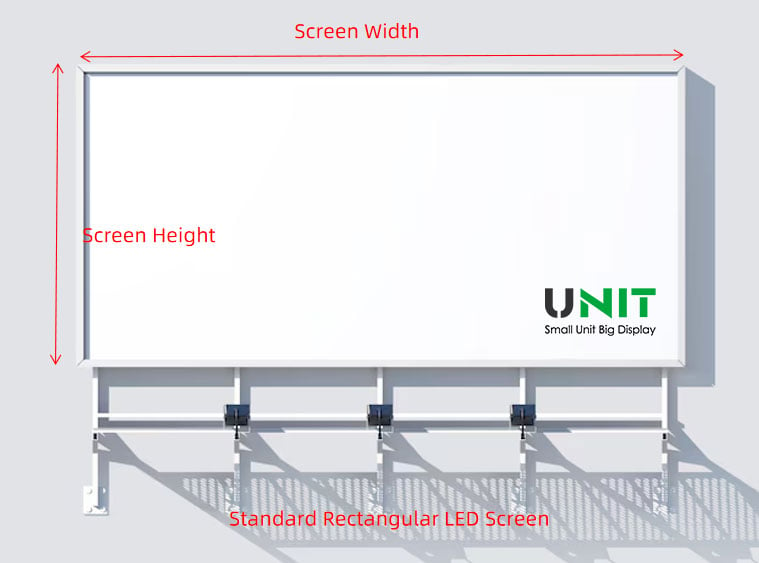
Formula: Screen Area = Width × Height
Example: If the screen has a width of 4 meters and a height of 3 meters, the total screen area will be:
Screen Area=4m×3m=12㎡
This is a simple and effective method for calculating the LED display screen size when the dimensions are given directly.
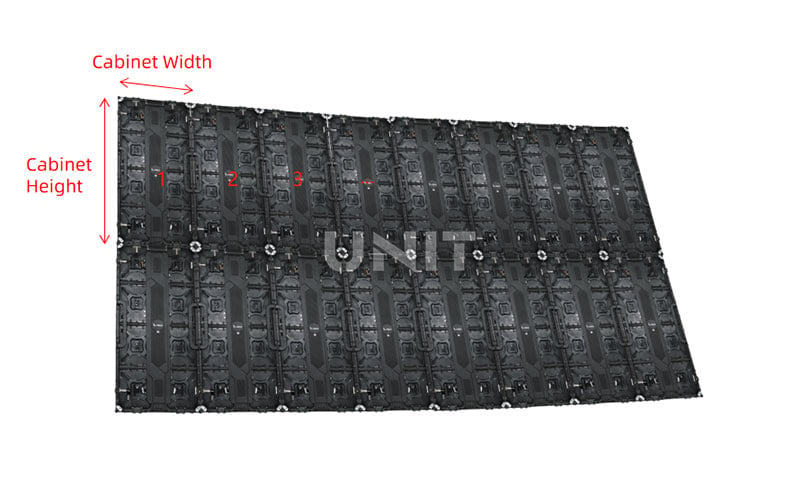
5.2 By Cabinet Size and Number of Cabinets
When using modular LED screens, the screen is usually made up of multiple LED cabinets.
To calculate the total size, you need to know:
(1) The size of the individual cabinet
(2) The number of cabinets
Formula: Screen Area=Cabinet Width×Cabinet Height×Number of Cabinets
Example:
If each LED cabinet is 500mm x 500mm (0.5m x 0.5m), and you use a 4×3 grid of cabinets, the calculation would be:
(1) Area of each cabinet: Cabinet Area=0.5m×0.5m=0.25m
(2) Total number of cabinets in the grid = 4 cabinets x 3 cabinets = 12 cabinets
(3) Total screen area: Screen Area=0.25㎡×12=3㎡
So, the total area of the screen would be 3㎡.
5.3 By Pixel Pitch and Pixel Count
For more technical calculations, you can determine the LED screen size based on its pixel pitch (the distance between pixels) and the total number of pixels (horizontal x vertical).
Example:
Let’s assume the screen has a pixel pitch of P8 (8mm), with 1920 pixels horizontally and 1080 pixels vertically.
Calculate the width of the screen: Width=1920×8mm=15360mm=15.36meters
Calculate the height of the screen: Height=1080×8mm=8640mm=8.64meters
Now calculate the total screen area:
Screen size=15.36m×8.64m=132.3㎡
5.4 For Non-Rectangular Screens (Curved/Custom Shapes)
For non-rectangular or curved screens, the calculation can be more complex and often depends on the specific geometry of the screen.
You might need to calculate the area based on arc length, radius, or custom dimensions.
The methodology typically involves calculating the area of the shape (e.g., sector, arc, etc.) and applying it to the screen’s geometry.
Example (Curved Screen):
If you have a curved LED screen with a radius of 10 meters and an arc length of 5 meters, the area of the curved section can be calculated based on the specific curve formula.
However, in most cases, LED screen manufacturers provide exact measurements for curved or custom shapes.
5.1 LED Screen Size Calculator: Simple Formulas for Buyers
You can estimate LED screen size with a few simple formulas before asking for a quotation. This helps you communicate more clearly with suppliers and compare different LED display solutions.
| What You Know | Formula | Example |
|---|---|---|
| Width and height | Screen area = Width × Height | 4m × 3m = 12㎡ |
| Cabinet size and cabinet quantity | Total size = Cabinet size × Cabinet layout | 500mm × 500mm cabinets in 8 × 4 layout = 4m × 2m |
| Pixel pitch and pixel count | Physical size = Pixel count × Pixel pitch | 1920 pixels × P2.5 = 4800mm width |
| Screen size and pixel pitch | Resolution = Physical size ÷ Pixel pitch | 3840mm ÷ P2 = 1920 pixels |
These formulas are useful for early planning. For production, the final LED screen size should also match module size, cabinet size, power design, control system capacity, and installation structure.
6. LED Screen Sizes in Different Units
LED screens come in various sizes, and depending on the region and industry standards, measurements may be expressed in different units.
Converting between these units ensures compatibility with project requirements and accurate screen sizing.
Below, we explore LED screen sizes in millimeters (mm), centimeters (cm), meters (m), feet, inches, and pixels to provide a comprehensive understanding.
6.1 LED Screen Sizes in Millimeters (mm)
Millimeters are the most commonly used unit in the LED display industry, especially when specifying LED cabinet sizes and module dimensions.
LED modules and cabinets are typically designed in millimeter increments. So, most LED screen configurations are first measured in mm before converting to other units.
Common LED Screen Sizes in mm:
|
LED Module Size Examples |
LED Cabinet Size Examples |
|
320mm × 160mm |
500mm × 500mm |
|
250mm × 250mm |
640mm × 480mm |
|
192mm × 192mm |
960mm × 960mm |
6.2 LED Screen Sizes in Centimeters (cm)
For general display size specifications, centimeters may also be used. Converting from mm to cm is straightforward:
Size in cm = (Size in mm)÷10
Examples:
A 960mm × 960mm LED cabinet is 96cm × 96cm.
A 1920mm × 1080mm LED screen is 192cm × 108cm.
So, the Standard LED display cabinet sizes in cm will be like this:
|
Size (cm) |
Pixel Pitch (mm) |
|
96 cm x 96 cm |
P2.5, P3.07, p3.33, P4, P5, p5.7, P6.67, P8, P10 |
|
80 cm × 90 cm 80 cm × 120 cm |
P3.125, P4.16, P5, P6.25, P8.33, P10 |
|
60 cm ×33.75 cm |
P1.25, P1.56, P1.87, P2.5 |
|
64 cm x32 cm |
P1.25, P1.538, P1.86 |
|
64 cm x 48 cm |
P1.25, P1.53, P1.66, P1.86, P2, P2.5 |
|
48 cmx 48 cm |
P1.875, P2, P2.5, P3 |
|
100 cm x 250 cm |
P1.25, P1.56, P1.95, P2.5, P2.2.976, P3.91 |
|
50 cm x 50 cm |
P1.953, P2.5, P2.604, P2.976, P3.91, P4.81 |
|
50 cm x 100 cm |
P2.9, P3.9, P4.8, P1.953, P2.5, P2.604, P2.976, P3.91, P4.81 |
|
100 cm x 100 cm |
P3.91, P4.81, P6.25, P7.81, P10.416 |
6.3 LED Screen Sizes in Meters (m)
Large LED display screens are often measured in meters.
Especially when discussing billboard screens, outdoor LED walls, and stadium displays.
Size in meters = (Size in mm)÷1000
Examples:
A 9600mm × 5400mm LED screen is 9.6m × 5.4m.
A 3840mm × 2160mm LED screen is 3.84m × 2.16m.
Meters are useful for specifying big LED screens for stage, stadiums, and building façade displays.
6.4 LED Screen Sizes in Feet
In some regions, particularly North America and the UK, LED screen sizes are commonly measured in feet.
The conversion from meters to feet is:
Size in feet = Size in meters × 3.281
Examples:
A 4m × 3m LED screen = 13.1ft × 9.8ft
A 6m × 3.5m LED screen = 19.7ft × 11.5ft
A 12m × 6m outdoor billboard = 39.4ft × 19.7ft
Feet is frequently used in advertising billboards, event rental screens, and big LED screens for stage.
6.5 LED Screen Size in Inches
While inches are mostly used for TVs and consumer displays, they can also be applied to small LED displays such as indoor video walls and retail signage.
Size in inches = (Size in mm) ÷ 25.4
Examples:
A 1920mm × 1080mm LED screen = 75.6″ × 42.5″
A 3840mm × 2160mm LED screen = 151.2″ × 85.0″
Larger LED walls in inches often fall under digital signage or retail LED screen sizes. Such as smart all-in-one LED display.
Below is a table listing the common all-in-one LED display sizes in inches:
| Screen Size (Inches) | Aspect Ratio | Common Resolution (Pixels) | Application Scenarios |
| 108″ | 16:9 | 1920 × 1080 (Full HD) | Small conference rooms, retail signage |
| 135″ | 16:9 | 1920 × 1080 (Full HD) | Medium-sized conference rooms, boardrooms |
| 150″ | 16:9 | 1920 × 1080 or 3840 × 2160 | Large meeting rooms, lecture halls |
| 165″ | 16:9 | 1920 × 1080 or 3840 × 2160 | Auditoriums, corporate events |
| 180″ | 16:9 | 3840 × 2160 (4K) | High-end conference rooms, luxury retail displays |
| 200″ | 16:9 | 3840 × 2160 (4K) | Event stages, hotel lobbies, large presentations |
| 220″ | 16:9 | 3840 × 2160 (4K) | Exhibition halls, command centers |
6.6 LED Screen Size in Pixels
Unlike physical dimensions, LED screen size in pixels depends on the pixel pitch (P). The total resolution is calculated as:
Screen Width in Pixels = (Screen Width in mm)÷Pixel Pitch
Screen Height in Pixels = (Screen Height in mm)÷Pixel Pitch
Example Calculation:
A 3840mm × 2160mm LED screen with P4 (4mm pixel pitch) has:
Width: 3840mm÷4mm=960 pixels
Height: 2160mm÷4mm=540 pixels
Total LED screen resolution: 960 × 540 pixels
For an outdoor billboard with P10 (10mm pixel pitch) and a size of 9600mm × 5400mm:
Width: 9600mm÷10mm=960 pixels
Height: 5400mm÷10mm=540 pixels
Total LED display screen resolution: 960 × 540 pixels
Pixel-based sizing is crucial for content clarity, especially for high-definition advertising and large LED displays.
Common resolutions and corresponding pixels are as follows:
|
LED Screen Resolution |
LED screen Size in Pixels (W x H) |
|
720P (HD) |
1280 x 720 pixels |
|
1080P (FHD) |
1920 x 1080 pixels |
|
2K (QHD) |
2560 x 1440 pixels |
|
4K (UHD) |
3840 x 2160 pixels |
|
8K |
7680 x 4320 pixels |
LED screen sizes can be expressed in various units, and each has its significance:
mm & cm → Best for module and cabinet dimensions
m & ft → Used for large-scale installations
inches → Common in retail displays
pixels → Essential for determining resolution and clarity
Understanding these unit conversions helps in selecting the right big LED screen for stage, small LED display, and outdoor advertising screens.
7. LED Screen Size Ratio
LED screens come in various aspect ratios, which determine how content appears on the display.
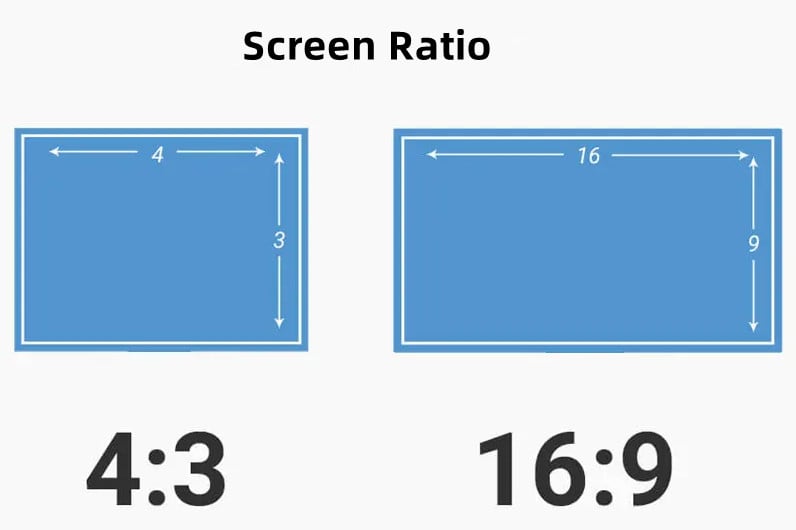
The screen aspect ratio is the proportional relationship between the width and height of a screen.
Selecting the right aspect ratio ensures images and videos are displayed correctly without distortion or black bars.
7.1 4:3 LED Screen Size Ratio
The 4:3 LED screen size aspect ratio is a more traditional format, commonly used in older screens, government institutions, and educational displays.
Though less common today, some professional applications still require 4:3 screens for specific presentation formats.
7.2 16:9 LED Screen Size Ratio
The 16:9 screen aspect ratio is the industry standard for modern LED displays, televisions, and projectors.
This widescreen format is widely used because it provides high-definition (HD) and ultra-high-definition (4K, 8K) resolutions.
Examples of 16:9 LED Screen Sizes:
|
Screen Width (m) |
Screen Height (m) |
Screen Size (inches) |
|
2.88m |
1.62m |
135″ |
|
3.2m |
1.8m |
150″ |
|
3.84m |
2.16m |
165″ |
|
4.8m |
2.7m |
200″ |
7.3 LED Screen Aspect Ratio Calculation
To determine an LED screen’s aspect ratio, use the formula:
Aspect Ratio = Screen Width÷Screen Height
For example, if an LED screen has a width of 4 meters and a height of 2.25 meters, the aspect ratio is: 4÷2.25=16:9
Example Calculations for Different Aspect Ratios
|
Screen Width (m) |
Screen Height (m) |
Aspect Ratio |
|
4m |
2.25m |
16:9 |
|
3m |
2.25m |
4:3 |
|
5m |
5m |
1:1 |
|
8m |
2.25m |
32:9 |
8. How to Choose LED Screen Size Step by Step?
The easiest way to choose LED screen size is to start from the site, not from the product catalog. A screen that looks perfect in one project may be too large, too small, or too low-resolution in another space.
- Measure the installation area. Confirm the maximum available width, height, wall structure, ceiling height, and maintenance space.
- Confirm the closest and farthest viewing distance. This helps determine both screen size and pixel pitch.
- Decide the content ratio. Choose 16:9 for videos and presentations, 4:3 for some traditional presentation formats, 1:1 for square creative displays, or a custom ratio for architectural spaces.
- Choose a suitable pixel pitch. Fine pixel pitch is better for close indoor viewing, while larger pixel pitch is suitable for outdoor and long-distance viewing.
- Match the cabinet layout. The final screen size should be achievable with standard LED cabinets or modules to reduce cost and installation complexity.
- Check resolution and content clarity. Make sure text, logos, videos, and images remain clear from the expected viewing position.
If you are not sure where to start, share your wall size, viewing distance, indoor or outdoor location, and target content type with the LED display supplier. They can recommend a more accurate screen size, cabinet layout, and pixel pitch combination.
9. LED Screen Size FAQs
Q1. What is the standard LED screen size?
There is no single standard LED screen size for every project. LED screens are usually built from modules and cabinets, so the final size depends on module size, cabinet size, pixel pitch, installation space, and content ratio.
Q2. How do I calculate LED screen size?
If you know the physical width and height, multiply them to get the screen area. If you know the cabinet size and cabinet quantity, multiply cabinet width, cabinet height, and total cabinet number. If you know the pixel pitch and pixel count, multiply pixel count by pixel pitch to get physical width and height.
Q3. What size LED screen do I need for a conference room?
For conference rooms, the right LED screen size depends on room size, viewing distance, seating layout, and content type. Many indoor projects use smaller pixel pitches such as P1.25, P1.56, P1.86, P2, or P2.5 to keep text and presentations clear at close viewing distances.
Q4. Is LED screen size the same as resolution?
No. LED screen size means the physical width, height, or area of the display. Resolution means the number of pixels on the screen. Two LED screens can have the same physical size but different resolutions if they use different pixel pitches.
Q5. How does pixel pitch affect LED screen size?
Pixel pitch affects how many pixels can fit into a given screen size. A smaller pixel pitch can provide higher resolution in the same physical area, while a larger pixel pitch is usually used for bigger screens and longer viewing distances.
Q6. What is the best LED screen size for outdoor advertising?
For outdoor advertising, the best LED screen size depends on road distance, traffic speed, installation height, and viewing angle. Common outdoor billboard sizes range from 6m × 3m to 20m × 10m or larger. Long-distance viewing usually works better with larger screen sizes and pixel pitches such as P6, P8, or P10.
Q7. What is the best LED screen size for a stage?
For stage events, many LED backdrops start from about 6m × 3m and can become much larger for concerts, exhibitions, and live shows. The final size should match the stage width, audience distance, camera shooting requirements, and content ratio.
Q8. How do I choose LED screen size for a conference room?
For a conference room, start with the seating distance and wall size. A 16:9 LED screen is usually recommended for presentations and video meetings. Fine pixel pitch options such as P1.25, P1.56, P1.86, or P2 can help keep text and charts clear at close viewing distances.
There is no single standard LED screen size for every project. LED screens are usually built from modules and cabinets, so the final size depends on module size, cabinet size, pixel pitch, installation space, and content ratio.
If you know the physical width and height, multiply them to get the screen area. If you know the cabinet size and cabinet quantity, multiply cabinet width, cabinet height, and total cabinet number. If you know the pixel pitch and pixel count, multiply pixel count by pixel pitch to get physical width and height.
For conference rooms, the right LED screen size depends on room size, viewing distance, seating layout, and content type. Many indoor projects use smaller pixel pitches such as P1.25, P1.56, P1.86, P2, or P2.5 to keep text and presentations clear at close viewing distances.
No. LED screen size means the physical width, height, or area of the display. Resolution means the number of pixels on the screen. Two LED screens can have the same physical size but different resolutions if they use different pixel pitches.
Pixel pitch affects how many pixels can fit into a given screen size. A smaller pixel pitch can provide higher resolution in the same physical area, while a larger pixel pitch is usually used for bigger screens and longer viewing distances.
For outdoor advertising, the best LED screen size depends on road distance, traffic speed, installation height, and viewing angle. Common outdoor billboard sizes range from 6m × 3m to 20m × 10m or larger. Long-distance viewing usually works better with larger screen sizes and pixel pitches such as P6, P8, or P10.
For stage events, many LED backdrops start from about 6m × 3m and can become much larger for concerts, exhibitions, and live shows. The final size should match the stage width, audience distance, camera shooting requirements, and content ratio.
For a conference room, start with the seating distance and wall size. A 16:9 LED screen is usually recommended for presentations and video meetings. Fine pixel pitch options such as P1.25, P1.56, P1.86, or P2 can help keep text and charts clear at close viewing distances.
10. Conclusion
Whether you’re designing a massive outdoor billboard or a compact indoor LED screen, size plays a crucial role in visibility, impact, and cost-effectiveness.
Understanding LED module sizes, cabinet dimensions, aspect ratios, and unit conversions helps ensure that your display fits its intended purpose perfectly.
Before making your final choice, consider factors like viewing distance, content type, and installation space.
A well-chosen LED display screen size doesn’t just look good—it delivers the best possible visual experience while maximizing your investment.
So, what’s the perfect LED screen size for your needs? Now, you have the knowledge to decide!