Jumbotron Price: How Much Does A Jumbotron Cost in 2026?
The short answer is that jumbotron price can range from the low five figures for small indoor LED setups to several million dollars for a custom stadium system. That wide gap is exactly why buyers often get confused.
In real projects, a “jumbotron” is not a single standard product. It is a combination of display size, pixel pitch, structure, control system, installation conditions, and long-term service. If you are budgeting for a venue, the smart way to read jumbotron price is not as one number, but as a full project cost tied to venue size, viewing distance, content goals, and structural reality.
Table of Contents
1. What Is A Jumbotron?
A jumbotron is best understood as a giant venue video display used to show live action, replays, graphics, ads, and event content to large crowds. In everyday language, people use the word loosely, but in buying decisions, the term matters because it shapes budget expectations.
A small gym video wall, a center-hung arena display, and a giant outdoor end-zone board may all be called a jumbotron, even though their cost and engineering requirements are very different.
https://www.youtube.com/watch?v=X75zWnv63Ts&list=PLUgmg_7JffCNTi1UkBOxNAs4RZNaC32cg&index=11
Large Stadium Jumbotron of Unit LED
1.1 What People Mean By “Jumbotron”
Most people mean “a very large stadium video screen” when they say jumbotron. In practical buying conversations, the word usually refers to any oversized display in a sports venue or event space. That is why a quote request that says “I need a jumbotron” is usually only the starting point. The supplier still needs to know whether you mean a center-hung display, an end-zone board, a scoreboard with video area, or a multi-screen system.
For general language reference, even dictionaries define jumbotron broadly as a huge video screen used in arenas and stadiums. That common usage is why the market treats the term as a category label rather than a precise technical specification.
1.2 Jumbotron Vs. LED Video Board Vs. Scoreboard
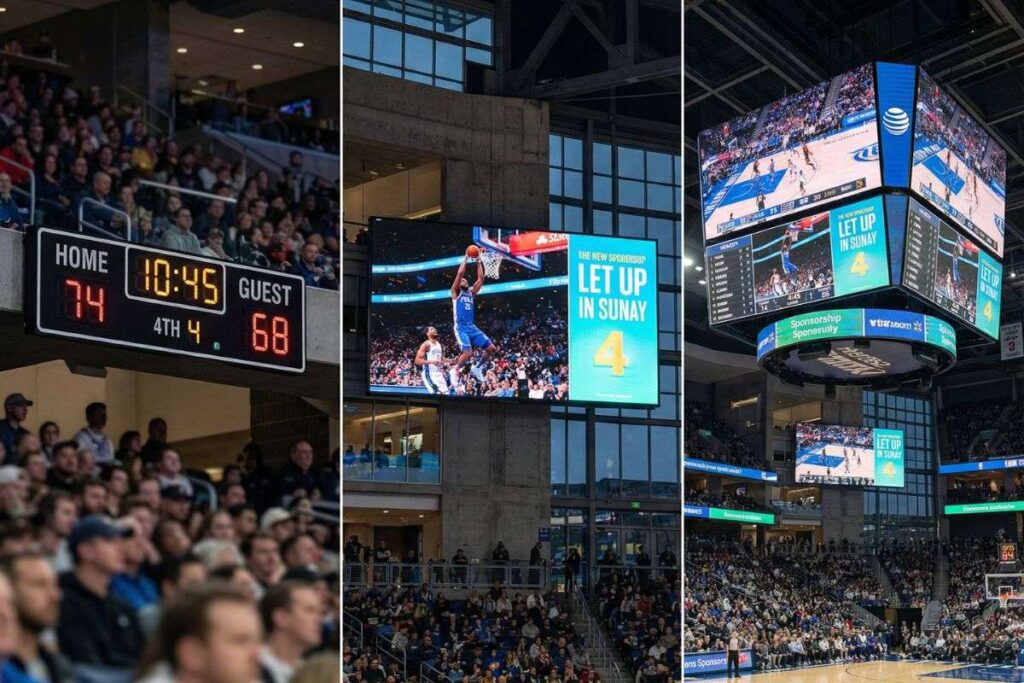
These terms overlap, but they are not identical. A scoreboard focuses on game data such as time, score, fouls, or innings. An LED video board focuses on full-motion content, replay, ads, sponsorship graphics, and live production. A jumbotron often combines both roles in one visual system.
| Term | Main Purpose | Typical Use |
|---|---|---|
| Scoreboard | Game information | Clock, score, stats, fouls |
| LED video board | Dynamic visual content | Replay, ads, branding, live feed |
| Jumbotron | Large-format venue display system | Often combines score, video, sponsorship, and show control |
1.3 Common Types Of Jumbotrons Used In Stadiums
The most common jumbotron formats are end-zone boards, center-hung systems, corner boards, and integrated scoreboard-video combinations. End-zone boards are common in football venues. Center-hung systems dominate many indoor arenas. Some venues add ribbon boards, corner displays, and fascia screens to expand sponsor inventory and improve visibility.
That is also why buyers should not compare a single jumbotron screen to a full venue display package without checking what is actually included.
2. Stadium Jumbotron Price: How Much Does A Jumbotron Cost For A Stadium?
A real stadium jumbotron price usually starts in the mid-six figures and can move into the multi-million-dollar range for large permanent installations.
The reason is simple: once a display becomes large enough for long-distance viewing, all the expensive layers arrive at once—steel, lifting, power, control, weather protection, installation, and maintenance access.
2.1 Typical Price Range For A Stadium Jumbotron
For planning purposes, a stadium jumbotron is rarely a low-cost purchase. A smaller permanent venue board may begin around a few hundred thousand dollars, while college and professional-grade systems can quickly move beyond $1 million. Landmark projects in major leagues sit far above that level.
| Project Type | Typical Budget Range | Notes |
|---|---|---|
| Small indoor/community venue display | $20,000 – $80,000 | Basic LED video wall or mini scoreboard display |
| School or small outdoor sports board | $80,000 – $300,000+ | Depends on size, structure, and control |
| Mid-size stadium video board | $300,000 – $1,500,000+ | Permanent outdoor project with installation |
| Large custom stadium jumbotron | $1,500,000 – $5,000,000+ | Custom steel framing, a large LED display screen area, advanced control systems, and complex on-site installation work |
| Iconic pro-level landmark system | Can exceed $10,000,000 | Often part of a much larger venue technology package |
2.2 Why Jumbotron Pricing Varies So Much
Jumbotron price varies because no two venues buy the same thing. A board that looks similar in a photo may cost dramatically more if it uses tighter pixel pitch, higher brightness, stronger weatherproofing, heavier structural support, or more advanced show-control integration.
Access conditions also matter. A board above an active bowl or attached to a custom steel frame is far more demanding than a simple wall-mounted indoor installation.
2.3 What Is Usually Included In The Cost
The display itself is only one part of the budget. Many buyers underestimate the non-screen costs. In a serious stadium project, the quote may include:
- LED display cabinets and modules
- Steel structure or hanging support
- Power distribution and control hardware
- Video processors and software integration
- Freight, lifting equipment, and on-site installation
- Commissioning, testing, and operator training
- Warranty and future service coverage
3. What Influences Jumbotron Price?
The biggest cost drivers are size, resolution, environment, control complexity, and installation difficulty. If you understand these five areas, you can usually tell whether a quote is realistic before the proposal even arrives.
3.1 Screen Size And Display Resolution
More screen area usually means a higher budget, but higher resolution can raise cost even faster. A physically larger board uses more material, more power, and more structure. Yet two boards of the same size can still land at very different prices if one needs much denser pixels or closer viewing performance.
That is especially true when buyers move from a long-distance outdoor board to an indoor LED screen for closer seating or premium hospitality zones.
3.2 Pixel Pitch And Viewing Distance
Pixel pitch has a direct effect on both image quality and budget. A tighter pitch delivers cleaner visuals at shorter viewing distances, but it also increases LED density and cost.
In many stadium projects, the smartest choice is not the finest pitch available. It is the pitch that matches actual viewing distance. Overspending here is common.
3.3 Brightness, Weather Resistance, And Durability
Outdoor reliability costs money, and it should. A permanent stadium board must survive sun exposure, rain, wind, dust, temperature changes, and long operating hours.
That means higher brightness, sealed cabinets, thermal design, anti-corrosion materials, and stronger protection against water ingress. Cheap outdoor pricing often becomes expensive later through failures and downtime.
3.4 Control Systems, Software, And Content Integration
A modern jumbotron is part display and part operating system. Once a venue wants replay, live camera feeds, sponsor scheduling, instant stats, and multi-zone content layouts, the control layer becomes a major part of the project.
Better software does not just run content. It reduces labor, speeds event operations, and protects the value of the investment.
3.5 Installation Complexity And Structural Support
Installation conditions can change the project price more than buyers expect. A board mounted on an existing façade may be far cheaper than a board requiring new steel, heavy lifting, permits, structural review, and staged overnight work.
In large outdoor venues, structure is often one of the hidden reasons the final jumbotron price climbs.
4. Jumbotron Cost By Venue Type
The right budget depends on the venue, not just the display. The most practical way to estimate jumbotron price is to compare projects by use case.
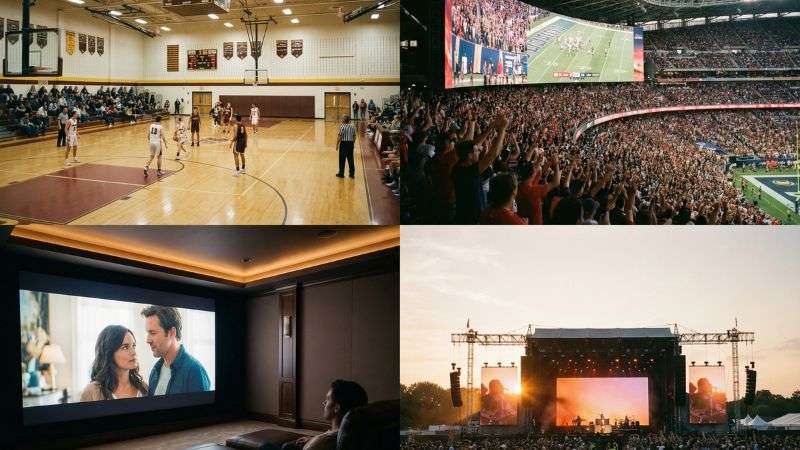
4.1 Mini Jumbotron Price
Mini jumbotron price is much lower than full stadium pricing, but the number still changes a lot depending on whether the product is for home use, small commercial use, or a real community sports venue. In practical terms, buyers often use the phrase “mini jumbotron” for very different products, which is why pricing can look confusing at first glance.
- For home entertainment spaces, budget expectations often start around $3,000 to $15,000, especially when the setup is more about viewing impact than commercial-grade LED performance.
- For small commercial or institutional applications, such as gyms, clubs, churches, or training spaces, projects more often fall into the $20,000 to $60,000 range.
- Once the system includes outdoor durability, scoreboard functions, suspended mounting, or custom framing, mini-board projects can move into the $60,000 to $180,000 range.
| Mini Jumbotron Scenario | Typical Price Range | Main Cost Drivers |
|---|---|---|
| Home entertainment setup | $3,000 – $15,000 | Display size, indoor resolution, room finish, installation quality |
| Small commercial LED display | $20,000 – $60,000 | Brightness, control system, cabinet quality, mounting method |
| Community or school mini board | $60,000 – $180,000 | Structure, outdoor protection, scoreboard features, installation access |
| Rental Scenario | Typical Daily Price Range | Common Use |
|---|---|---|
| Small indoor event screen | $1,500 – $4,000/day | School events, meetings, local promotions |
| Mid-size temporary LED setup | $4,000 – $12,000/day | Tournaments, concerts, fan events |
| Large outdoor jumbotron rental | $12,000 – $30,000+/day | Festivals, stadium activations, major live productions |
Buyers should still check what the quote actually covers. The final rental cost can increase once transport, rigging, overnight labor, control systems, generators, and on-site technical support are added.
5. Famous Stadium Jumbotron Installations
Famous jumbotrons are useful for understanding scale, but they are poor benchmarks for normal buyers. Iconic venue displays attract attention because they push engineering, size, and spectacle far beyond standard commercial projects.
5.1 Examples Of Jumbotrons In Well-Known Stadiums
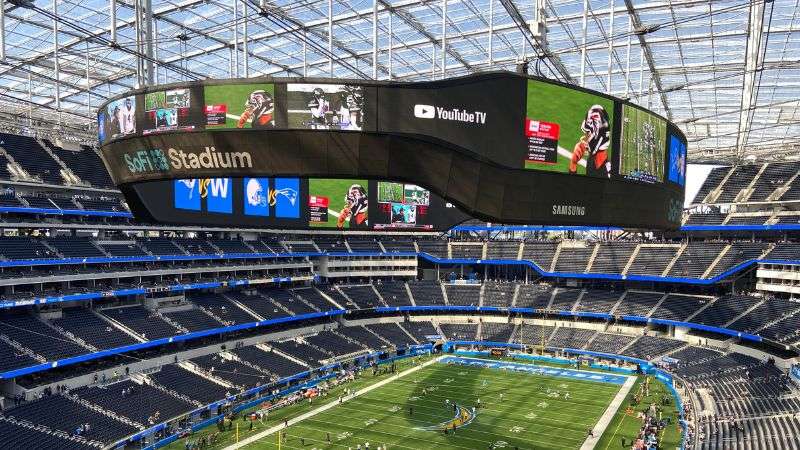
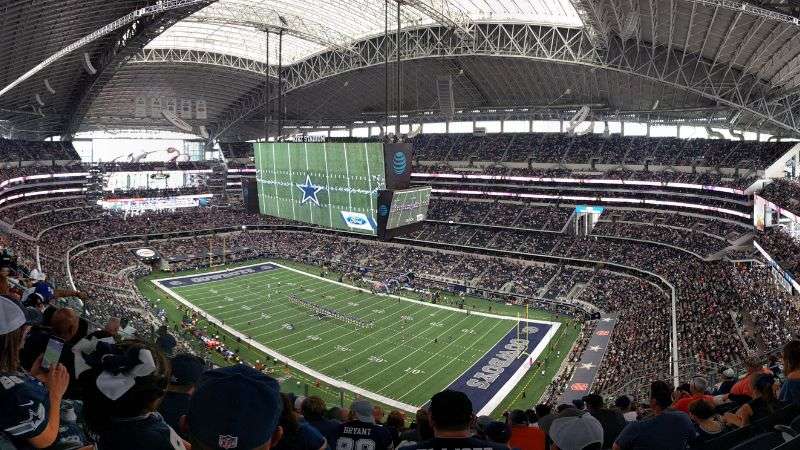
Sofi stadium jumbotron & ATT stadium jumbotron
AT&T Stadium, SoFi Stadium, and Mercedes-Benz Stadium are three of the clearest examples of how big these systems can become.
- AT&T Stadium’s center-hung system became famous not only for its size but also for its reported cost.
- SoFi Stadium’s Infinity Screen is known for its enormous dual-sided LED footprint and massive pixel count.
- Mercedes-Benz Stadium’s halo display showed how an unconventional shape can become part of the venue identity.
You can see the general meaning of the term at Merriam-Webster, and you can review official project language on the SoFi Stadium Infinity Screen announcement.
5.2 What These Installations Reveal About Budget And Scale
These projects show that the upper end of jumbotron price is driven by experience design as much as by display area. The board is not there only to show the game. It is there to shape atmosphere, deliver sponsor value, support premium production, and turn the venue itself into a brand asset.
5.3 Why Famous Stadium Projects Are Not Typical Benchmarks
Most buyers should not use NFL landmark projects as direct pricing references. Those jobs often involve custom geometry, elite production requirements, unique structural conditions, and full venue-wide digital ecosystems.
They are inspiring, but they are not normal procurement models for schools, local stadiums, or regional event venues.
6. 4 Benefits Of Jumbotrons In Stadiums
A jumbotron earns its value by improving visibility, monetization, flexibility, and venue identity. Buyers who only focus on upfront jumbotron price often miss the operational return.
6.1 Improving Visibility And Fan Experience
The first benefit is simple: more people can actually follow the event. Replays, close-ups, stats, and announcements reduce viewing friction, especially in large venues with distant seats.
6.2 Creating More Advertising And Sponsorship Revenue
The second benefit is revenue generation. A video board creates sellable inventory for sponsor loops, branded segments, halftime content, and event promotions. In many venues, this becomes one of the strongest arguments for the investment.
6.3 Supporting Concerts, Events, And Multi-Use Venues
The third benefit is versatility. A venue that hosts sports, concerts, school ceremonies, civic events, and commercial rentals gets far more use from a dynamic LED system than from a static scoreboard.
6.4 Strengthening Venue Branding And Atmosphere
The fourth benefit is identity. Large-format visuals make a venue feel premium, modern, and memorable. In competitive event markets, that matters.

7. Installation And Structural Requirements
The screen only works if the structure and infrastructure are planned correctly. This is where many first-time buyers discover the real complexity behind jumbotron price.
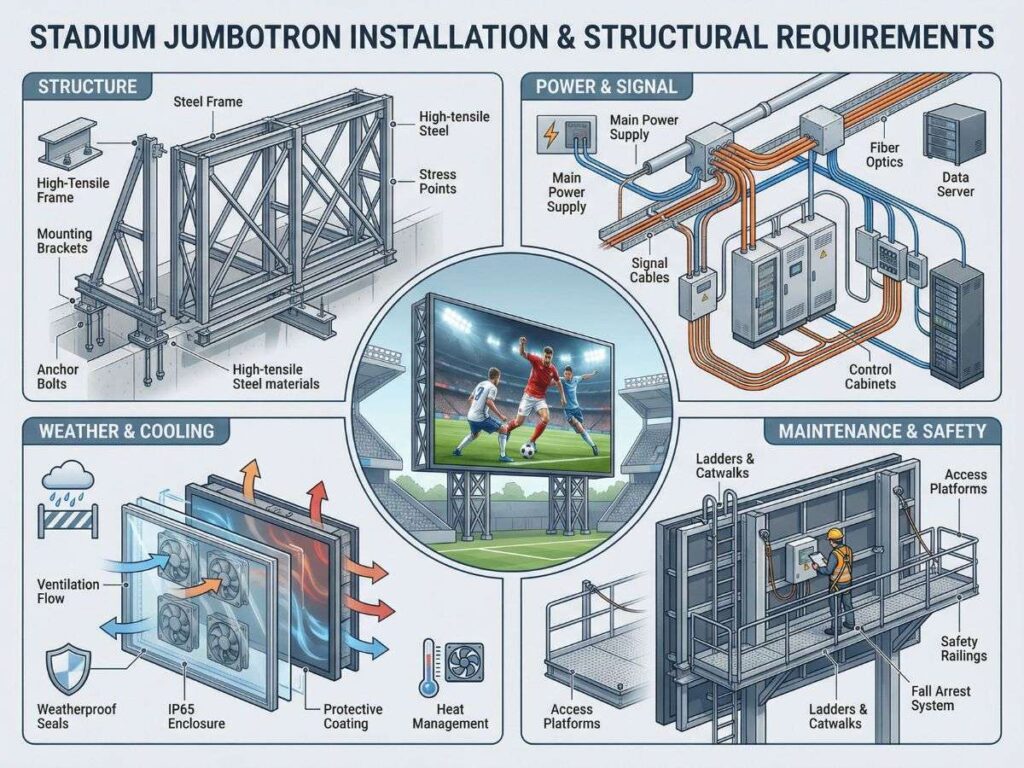
7.1 Steel Structure And Mounting Support
Structural support must be engineered around real loads, not assumptions. Weight, wind, vibration, and maintenance access all matter.
7.2 Power Supply And Signal System Planning
Reliable operation depends on clean power and stable signal distribution. Long cable runs, backup strategies, and content control should be planned before fabrication.
7.3 Weather Protection And Heat Management
Outdoor boards fail early when thermal and weather protection are treated as minor details. Cabinet sealing, ventilation, and material protection are core design issues, not optional upgrades.
7.4 Maintenance Access And Safety Considerations
Safe service access protects both uptime and operating cost. If technicians cannot reach the display easily, every repair becomes slower and more expensive.
8. Renting Vs. Buying A Jumbotron
Renting is best for short-term needs, while buying makes sense when the venue needs permanent revenue and year-round use. The decision should be made on frequency, not emotion.
8.1 When Renting Is The Better Choice
Rent when the event is temporary, seasonal, or experimental. This reduces capital risk and allows format testing before a permanent purchase.
8.2 When Buying Makes More Sense
Buy when the display will be used regularly and tied to venue operations. Permanent installations make sense when sponsorship, branding, and recurring event use can justify the spend.
8.3 Comparing Short-Term And Long-Term Costs
Short-term cost favors rental, but long-term value often favors ownership. The break-even point depends on event count, revenue model, maintenance plan, and financing approach.
9. How To Choose The Right Jumbotron Supplier
The right LED screen supplier is not always the lowest bidder. For a project this visible and this technical, weak support can cost more than a high initial quote.
(1) Checking Manufacturing And Project Experience
Experience with similar venue types matters. Ask for projects with comparable size, use case, and environment.
(2) Evaluating Installation And After-Sales Support
Support quality should be reviewed before the purchase, not after a failure. Local service response, spare parts access, and operator training are worth checking in detail.
(3) Comparing Warranty, Lead Time, And Service Terms
The best quote is the one that stays reliable after handover. Compare what the warranty covers, how long production takes, and how service calls are handled.
(4) Questions To Ask Before Requesting A Quote
A better brief leads to a better price. Before asking for a quote, prepare:
- Venue type and seating capacity
- Screen location and approximate dimensions
- Viewing distance and usage scenario
- Indoor or outdoor environment
- Structural conditions and installation access
- Content needs: live feed, replay, ads, scoreboard, scheduling
- Desired completion timeline
9.1 Why Unit LED Is A Reliable Jumbotron Supplier
Unit LED is a reliable option for buyers who want more than just a screen supplier. In a jumbotron project, what matters is not only product quality, but also whether the supplier can support planning, delivery, installation coordination, and long-term service.
(1) Experience with large-format venue projects: Jumbotron projects are very different from standard indoor LED screens. They usually involve larger viewing distances, more complex structures, and stricter reliability requirements. That is why many buyers prefer a supplier that understands stadium and large venue applications in real project conditions.
https://www.youtube.com/watch?v=ivQNB8lU1J8
Large-format Venue Projects of Unit LED
(2) Better support before production starts: A dependable supplier should help confirm key details early, including screen size, pixel pitch, installation location, structural conditions, and control needs. This kind of planning support can reduce errors, save time, and avoid expensive changes later.
(3) More reliable coordination on manufacturing and delivery: For a project as visible as a jumbotron, consistency matters. Buyers usually need stable product quality, clear communication, and a supplier that can keep production, packaging, and shipment organized throughout the process.
https://www.youtube.com/watch?v=RZrgr1U608U
LED Display Shock Test for Safe Delivery
(5) A more complete product line: A supplier with a broader product line is often easier to trust for jumbotron projects, because different venues may need different cabinet sizes, service methods, and installation structures.
Unit LED is a good example because it can point buyers to different solutions instead of pushing one standard screen for every job. For example:
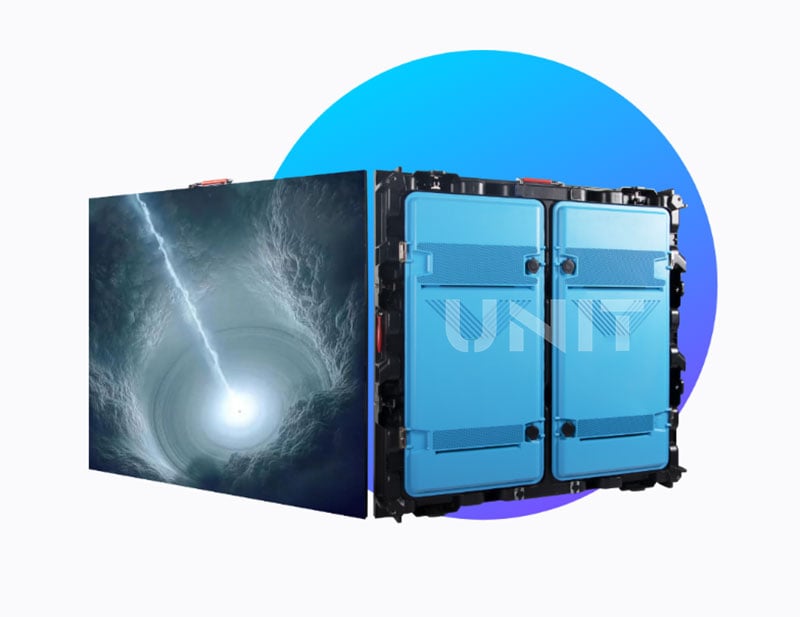
MA960 Pro Series
- 960×960mm standard cabinet
- Magnesium alloy design
- Works for indoor and outdoor projects
- Can be used for fixed installation, rental, and perimeter sports applications
- High flatness and easy installation/disassembly
- Supports front-service and rear-service module options
- Front IP65 protection for outdoor us
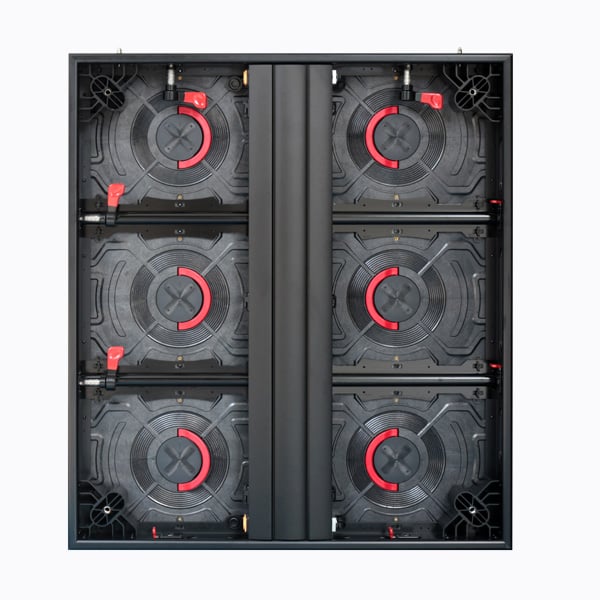
OF800 Series
- 800×900mm and 800×1200mm cabinet options
- Front-service design for easier maintenance
- Also supports rear service
- Suitable for sports LED display and stadium perimeter applications
- High refresh rate up to 3840Hz
- Brightness up to about 5500–6500 nits, suitable for strong outdoor light
- 3-year warranty and spare parts support listed on the page
10. FAQs
The best way to estimate jumbotron price is to match the question to the venue type and project scope. Broad internet numbers are useful for orientation, but serious budgeting needs project details.
How Much Does A Stadium Jumbotron Usually Cost?
Most permanent stadium jumbotrons land somewhere between the mid-six figures and several million dollars. Smaller venues can come in below that, while iconic custom systems go far above it.
How Much Do NBA Jumbotrons Cost?
NBA-style center-hung systems are often seven-figure projects. Indoor pixel density, center-hung steel, multi-face design, replay systems, and premium show control all push the budget upward.
How Much Does It Cost To Build A Jumbotron?
Building a jumbotron costs more than buying LED panels. Budget for the screen, structure, control, installation, testing, and ongoing service together.
How Much Did The Cowboys Jumbotron Cost?
The Cowboys’ famous AT&T Stadium center-hung display was widely reported at about $40 million. That number shows what happens when a venue turns a video board into a landmark engineering statement rather than a standard display purchase.
What Information Should You Prepare Before Asking For A Quote?
You should prepare venue drawings, target dimensions, viewing distance, installation location, usage goals, and timeline. The more accurate your project brief is, the more accurate your jumbotron price estimate will be.
Most permanent stadium jumbotrons land somewhere between the mid-six figures and several million dollars. Smaller venues can come in below that, while iconic custom systems go far above it.
NBA-style center-hung systems are often seven-figure projects. Indoor pixel density, center-hung steel, multi-face design, replay systems, and premium show control all push the budget upward.
Building a jumbotron costs more than buying LED panels. Budget for the screen, structure, control, installation, testing, and ongoing service together.
The Cowboys’ famous AT&T Stadium center-hung display was widely reported at about $40 million. That number shows what happens when a venue turns a video board into a landmark engineering statement rather than a standard display purchase.
You should prepare venue drawings, target dimensions, viewing distance, installation location, usage goals, and timeline. The more accurate your project brief is, the more accurate your jumbotron price estimate will be.
11. Conclusion
In conclusion, the right jumbotron price is not the cheapest number on a spreadsheet, but the number that fits your venue, audience, and operating model. A school field, a municipal arena, and an NFL stadium should never be quoted the same way.
If you want a reliable budget, define the venue, the viewing needs, the content workflow, and the installation conditions first. That is the fastest way to move from a vague “how much is a jumbotron?” question to a realistic buying decision.