OLED vs LED Display: What’s the Difference and Which Is Better?
Choosing between an OLED vs LED display is one of the most common questions buyers face when selecting a TV, monitor, or commercial display system. While both technologies deliver impressive visual performance, they work in very different ways and are suited for different applications.
OLED display wins on picture quality (contrast, black levels, viewing angles). LED display wins on brightness, lifespan, cost, and large-format commercial use. Your ideal choice depends on your use case; we’ll tell you exactly which one that is.
This guide will explain:
- What makes OLED fundamentally different from LED?
- Which display technology wins in specific use cases?
- How do you choose the right one for your budget?
Table of Contents
1. What Is LED Display?
An LED display is a screen technology that uses light-emitting diodes (LEDs) to generate or illuminate images.
Depending on the design, LED displays are generally divided into two main categories: LED-backlit LCD display and direct-view LED display.
The most common type found in televisions and monitors is the LED-backlit LCD display. In this system, LEDs act as the backlight source behind a liquid crystal panel. The liquid crystal layer controls how much light passes through each pixel, while color filters create red, green, and blue sub-pixels that combine to form full-color images.
In contrast, direct-view LED displays generate images directly using thousands or even millions of individual LED pixels. Each pixel contains tiny red, green, and blue LEDs that emit light independently to produce colors and brightness. Because the pixels themselves generate light, these displays do not require a backlight.
Direct-view LED technology is commonly used in large-scale applications such as digital billboards, stadium LED scoreboards, stage backdrops, and commercial video walls. It offers extremely high brightness, flexible screen sizes, and excellent visibility even in outdoor environments.
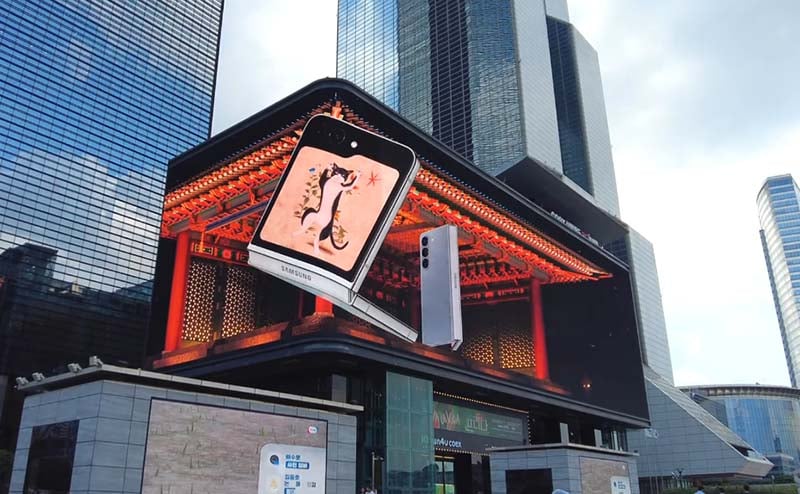
Thanks to their durability, brightness, and scalability, LED displays have become one of the most widely used display technologies across both consumer electronics and professional display systems.
2. What Is an OLED Display?
An OLED display (Organic Light-Emitting Diode) is a screen technology where each pixel produces its own light.
Compared to OLED vs LED, OLED panels do not rely on a separate backlight. Instead, they use organic materials that emit light when electricity passes through them. This self-emissive design allows OLED displays to achieve true black levels, extremely high contrast ratios, and excellent color accuracy.
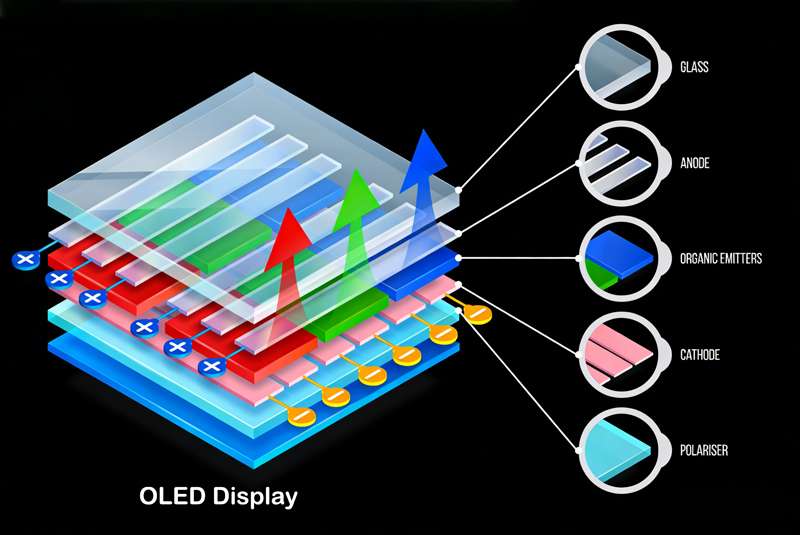
The working principle of an OLED display involves several key steps:
-
Electrical current activates organic materials
When an electric current flows through the display, it passes through thin organic semiconductor layers placed between two electrodes.
-
Organic layers emit light
The organic materials react to the electrical energy and emit light directly. This process is called electroluminescence.
-
RGB sub-pixels generate colors
Each pixel contains red, green, and blue sub-pixels. By adjusting the brightness of these sub-pixels, the display can produce millions of colors.
-
Pixels turn off completely for true black
Because each pixel emits its own light, OLED displays can turn off individual pixels entirely. This creates perfect black levels and infinite contrast.
Thanks to this structure, OLED panels can also be extremely thin, lightweight, and even flexible, making them popular for high-end TVs, smartphones, and premium monitors. However, since OLED pixels use organic compounds, they may gradually degrade over time, which can lead to reduced brightness or potential burn-in under long-term static images.
2.1 Why “LED” Means Two Different Things in This Comparison
One reason the OLED vs LED display topic feels confusing is that the word LED is used for two different product categories. In consumer electronics, LED usually means an LED-backlit LCD TV or monitor. In commercial display projects, LED often means a direct-view LED display built from LED modules and cabinets.
| Display Type | How It Produces Light | Best For | Main Limitation |
|---|---|---|---|
| OLED | Each pixel emits its own light | Movies, premium monitors, dark-room viewing | Higher cost, burn-in risk, limited large-format scalability |
| LED-Backlit LCD | An LCD panel uses an LED backlight | General TVs, office monitors, bright rooms | Cannot match OLED black levels and pixel-level contrast |
| Direct-View LED | RGB LED pixels generate the image directly | Video walls, digital signage, stage screens, outdoor displays | Usually not the first choice for close-up desktop viewing |
So when someone searches for OLED vs LED TV, they are usually comparing OLED with an LED-backlit LCD television. But when a business compares OLED with an LED display wall, the real comparison is often OLED vs direct-view LED. Clarifying that difference early helps buyers avoid the most common mistake in this category.
If you also want the background difference between LCD and LED, read http://wp.luotec.com/lcd-and-led.
3. OLED vs LED Display: 8 Dimensions Comparison
OLED and LED displays are two major display technologies used in televisions, monitors, and professional display systems. While both deliver high-quality images, they differ significantly in contrast, brightness, lifespan, and cost.
The table below provides a quick overview of how OLED display vs LED display compare across eight key performance dimensions.
| Dimension | OLED Display | LED Display |
| Black Levels & Contrast | Perfect black and infinite contrast | High contrast, but depends on display type |
| Peak Brightness | Moderate brightness | Extremely high brightness |
| Color Accuracy | Excellent color reproduction | Excellent color with proper calibration |
| Response Time | Extremely fast | Very fast |
| Viewing Angles | Excellent | Excellent in most direct-view LED displays |
| Burn-In Risk | Possible under static images | No burn-in risk |
| Lifespan | Shorter due to organic materials | Much longer lifespan |
| Price (Same Size) | Usually more expensive | More cost-effective for large screens |
(1) OLED vs LED Display: Black Levels & Contrast
Screen contrast ratio is the single most impactful factor in perceived image quality.
OLED displays are well known for their ability to produce true black levels. Since each pixel emits its own light, OLED panels can completely turn off individual pixels, resulting in an infinite contrast ratio.
LED displays, particularly LED-backlit LCD panels, rely on a backlight and therefore cannot completely eliminate light leakage. However, direct-view LED displays used in commercial applications achieve very strong contrast through high brightness and advanced processing technologies.
(2) OLED vs LED Display: Peak Brightness
What is the difference between OLED and LED in brightness? Peak brightness is one area where LED displays outperform OLED.
High-end LED displays, especially Mini-LED TVs and commercial LED screens, can reach brightness levels of 1,000 to 4,000 nits, and even reach 5000 nits or more in outdoor environments.
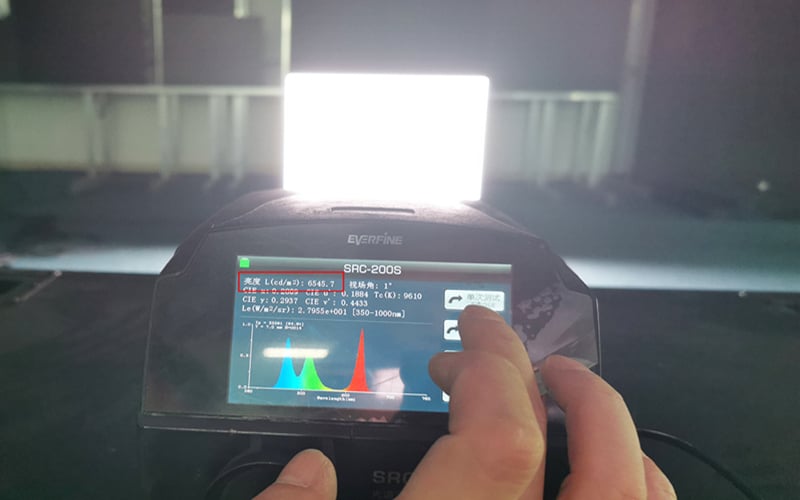
OLED displays usually operate at lower brightness levels, typically around 600–1,000 nits, because higher brightness can accelerate organic material degradation.
For environments such as bright living rooms, retail stores, and outdoor digital signage, LED displays are usually the better choice
(3) OLED vs LED: Color Accuracy
OLED displays are known for their excellent color accuracy and wide color gamut. Since each pixel emits its own light, colors appear more vivid and consistent, especially in darker scenes.
LED displays can also achieve high color accuracy, especially with modern LED driver technology and calibration systems. High-end commercial LED displays support wide color gamuts and HDR content, allowing them to deliver vibrant and dynamic visuals.
(4) OLED Display vs LED: Response Time
Response time refers to how quickly a pixel can change from one color to another.
OLED displays have extremely fast response times, often around 0.1 ms to 1 ms, which helps eliminate motion blur and ghosting during fast-moving scenes. This is why OLED displays are often preferred for gaming monitors, sports broadcasts, and fast action scenes.
LED displays usually have response times between 1 ms and 10 ms, depending on the panel technology. Direct-view LED displays also provide very fast response performance, making them suitable for live broadcasts, sports events, and stage productions where smooth motion is essential.
(5) LED vs OLED: Viewing Angles
OLED displays maintain excellent image quality even when viewed from wide angles.
Similarly, direct-view LED displays offer wide viewing angles, allowing audiences to see clear images from different positions in large venues such as concert halls, stadiums, and exhibition spaces.
(6) OLED vs LED Display: Burn-In Risk
One limitation of OLED technology is the potential risk of burn-in, which can occur when static elements remain on the screen for extended periods.
This issue is especially relevant for displays showing: Static logos, Menu bars, Information dashboards.
LED displays do not suffer from burn-in, making them more reliable for digital signage and 24/7 commercial operation.
(7) For Lifespan
LED displays generally have a longer operational lifespan.
Typical lifespans include:
OLED displays: around 30,000–50,000 hours
LED displays: 80,000–100,000 hours or more
This durability makes LED technology better suited for continuous commercial use.
(8) OLED vs LED Display in Price
What is the difference between OLED and LED in price? When comparing displays of the same size, OLED products are typically more expensive due to their complex manufacturing process.
However, when it comes to large-format displays, LED technology becomes significantly more cost-effective. Direct-view LED screens can be built at virtually any size, making them the preferred solution for large-scale visual installations.
4. What Actually Affects OLED vs LED Display Cost?
When buyers compare OLED vs LED display price, the answer is not determined by panel type alone. In real projects, the better question is: what is driving the total cost?
- Screen size: OLED is common in fixed consumer sizes, while direct-view LED can scale to custom large-format installations.
- Brightness target: Higher brightness requirements usually increase system cost, especially in retail, stage, and outdoor environments.
- Operating hours: A display used for long daily runtime should be evaluated for lifespan, maintenance, and long-term stability.
- Installation environment: A dark home theater, a bright showroom, and an outdoor billboard require very different hardware standards.
- Content type: Static logos, dashboards, and menu layouts may push commercial buyers toward LED because long-term static content changes the risk profile.
For home cinema, OLED may justify its premium with better blacks and more cinematic contrast. For stage screens, digital signage, control rooms, and large video walls, direct-view LED often delivers better long-term value.
4.1 Power Use, Maintenance, and Daily Runtime Matter More Than Many Buyers Expect
When comparing OLED vs LED display price, many buyers focus only on the purchase cost. In real-world ownership, daily runtime, screen brightness targets, content type, and maintenance style often have a bigger impact on long-term value.
| Ownership Factor | OLED | LED-Backlit LCD | Direct-View LED |
|---|---|---|---|
| Power Behavior | Power use changes more with scene brightness and image content | Usually easier to estimate in general home and office use | Depends heavily on brightness target, screen size, and operating schedule |
| Static Content | Needs more caution with fixed UI, logos, and dashboards | Better suited to repeated desktop and office layouts | Well suited to signage, menu boards, and large-format information displays |
| Maintenance Style | Best for finished consumer products with limited servicing expectations | Common and simple for standard TV and monitor replacement cycles | Better for commercial projects that may need module or cabinet-level servicing |
| Long Daily Runtime | Works well in premium indoor use, but must be evaluated carefully for always-on content | Practical for long desktop and general display use | Usually preferred for long-hour commercial operation |
| Expansion Flexibility | Limited to fixed panel sizes | Limited to fixed panel sizes | Can scale to custom aspect ratios and much larger screen sizes |
This is why OLED vs LED display should never be judged by contrast alone. For home cinema, OLED may justify its premium. For commercial environments, the better question is often this: which display is easier to run, maintain, and scale for the way the screen will actually be used?
If image depth is your main concern, it also helps to understand how http://wp.luotec.com/display-screen-contrast-ratio affects perceived picture quality in different environments.
5. OLED vs LED: Which Is Better for Different Use Cases?
| Use Case | Better Choice | Reason |
| Home Theater / Movies | OLED | Perfect black levels and cinematic contrast |
| Gaming | OLED | Ultra-fast response time and excellent motion clarity |
| Bright Rooms | LED | Higher brightness and better visibility |
| Professional Monitors | OLED / LED | Depends on color accuracy and workflow |
| Digital Signage | LED | High brightness and no burn-in risk |
| Outdoor Advertising | LED | Extremely high brightness and weather resistance |
| Large Video Walls | LED | Flexible size and seamless large displays |
| Stage & Event Displays | LED | High brightness and wide viewing angles |
(1) For Home Theater and Movies
Is OLED better than LED for home theater and movies? For watching movies at home, OLED displays are often the preferred choice. Their ability to produce true blacks and infinite contrast creates a more cinematic viewing experience, especially in dark rooms. This makes OLED TVs popular among movie enthusiasts and home theater setups.
(2) OLED vs LED for Gaming
OLED monitors provide extremely fast response times and excellent contrast, which helps reduce motion blur and improve image clarity in fast-paced games. For competitive gaming, OLED displays can deliver a very immersive visual experience.
However, high-refresh-rate LED monitors are still widely used due to their lower cost and strong performance.

(3) For Bright Rooms and Daytime Viewing
Comparing OLED vs LED displays in bright environments, LED displays usually perform better because they can achieve much higher brightness levels. This makes LED TVs and monitors easier to see in rooms with strong ambient light.
(4) For Commercial Displays and Digital Signage
For large-scale commercial applications, LED displays are clearly the better choice.
Direct-view LED technology is widely used in:
- Digital billboards
- Stadium screens
- Retail displays
- Stage backdrops
- Control room video walls
https://youtu.be/GePLadGzqJQ?si=SgviGjrtuDFQv4OT
OLED vs LED display, LED display provides higher brightness, longer lifespan, flexible screen sizes, and no risk of burn-in, making them ideal for 24/7 operation and large-format installations.
For large commercial projects such as video walls, stage LED displays, or outdoor advertising screens, direct-view LED displays remain the most reliable and scalable solution.
6. Mini-LED vs QLED vs OLED vs LED: What’s the Difference?
In addition to traditional LED and OLED displays, several advanced display technologies have emerged in recent years. Technologies such as Mini-LED, QLED, and QD-OLED aim to improve brightness, contrast, and color performance while addressing some limitations of existing display technologies.
6.1 Mini-LED vs LED
Mini-LED is an advanced form of LED backlighting technology. Instead of using hundreds of standard LEDs, Mini-LED displays use thousands of much smaller LEDs behind the LCD panel. This allows for more precise local dimming zones, which improves contrast and reduce the halo effect commonly seen in traditional LED-backlit displays.
Key advantages of Mini-LED include:
- Higher brightness
- Better local dimming control
- Improved HDR performance
However, Mini-LED still relies on an LCD layer, so it cannot achieve the pixel-level control of OLED.
6.2 QLED vs LED
QLED (Quantum Dot LED) is a technology developed primarily for improving color performance in LED-backlit LCD displays.
QLED displays use a quantum dot layer that enhances color accuracy and brightness. When light from the LED backlight passes through the quantum dot layer, it produces more precise red and green wavelengths.
Advantages of QLED displays include:
- Brighter images
- Wider color gamut
- Improved energy efficiency
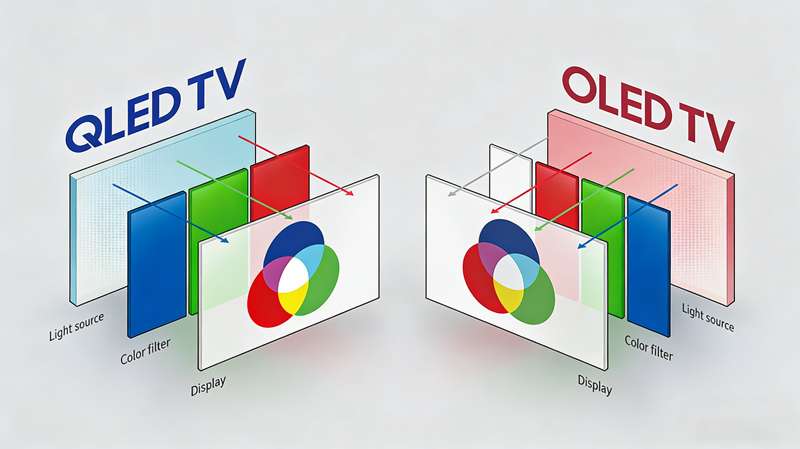
Despite the name, QLED is not self-emissive like OLED. It still relies on LED backlighting.
6.3 QD-OLED vs OLED
QD-OLED (Quantum Dot OLED) is a hybrid display technology that combines the strengths of OLED and quantum dot technology.
Instead of using traditional RGB OLED sub-pixels, QD-OLED uses a blue OLED light source combined with quantum dots to produce red and green colors.
This design offers several improvements over traditional OLED panels:
- Higher brightness
- More accurate color reproduction
- Better color volume
QD-OLED is currently used in some high-end TVs and monitors.
6.4 How These Technologies Compare
| Technology | Core Technology | Key Strength |
| Direct-View LED | Individual RGB LED chips form each pixel; no LCD layer, no backlight | Bright HDR content, bright rooms, large TVs, the best LED-backlit option |
| Mini-LED | LED backlight with thousands of tiny LEDs (instead of hundreds) for much finer local dimming zones | Bright HDR content, bright rooms, large TVs, the best LED-backlit option |
| QLED | LED-backlit LCD with a quantum dot filter layer for wider color gamut (Samsung’s branding) | Wide color gamut content, bright environments, value-premium TVs |
| QD-OLED | OLED panel + quantum dot layer (Samsung Display). Best of both technologies: deep blacks + wide color gamut | Premium monitors, high-end TVs, combine OLED contrast with QLED color volume |
6.5 Which Technology Is Best for Large Displays?
OLED vs LED display, which technology is better for large displays? While OLED and its variants continue to evolve, direct-view LED displays remain the preferred technology for large commercial installations.
Technologies like Mini-LED and QLED are still limited to LCD panel sizes, while LED display systems can be built in virtually any size or resolution, making them ideal for:
- Stadium screens
- Digital billboards
- Retail video walls
- Stage backdrops
For this reason, LED display technology continues to dominate large-scale visual installations and commercial display projects.
7. OLED vs LED, Which is Better for Eyes?
Eye comfort is an increasingly important factor for buyers who spend long hours in front of screens.
Many users wonder whether OLED displays are better for eye comfort compared with LED displays. The short answer is that both OLED vs LED screens can be comfortable for the eyes when used properly, but they differ in several technical aspects that may affect eye strain.
7.1 OLED vs LED: Eye Comfort Comparison
| Factor | OLED Display | LED Display |
| Blue Light Emission | Lower blue light levels | Typically higher blue light |
| Flicker (PWM Dimming) | May use PWM at low brightness | Some models use PWM as well |
| Brightness Levels | Lower peak brightness | Higher brightness capability |
| Contrast | Extremely high contrast | High but lower than OLED |
| Long-Term Viewing | Comfortable in dark environments | Better in bright environments |
7.2 Key Factors Affecting Eye Comfort
① Blue Light Exposure
OLED displays generally produce slightly lower levels of blue light, which may help reduce eye fatigue during long viewing sessions.
② Brightness and Ambient Light
LED displays can achieve much higher brightness, which is beneficial in bright environments but may cause eye strain if the screen brightness is too high for the surrounding lighting conditions.
③ Screen Flicker (PWM)
Some OLED screens use pulse-width modulation (PWM) to control brightness, which may cause subtle flickering that sensitive users can notice.
④ Viewing Environment
Eye comfort depends more on proper brightness settings, viewing distance, and ambient lighting than on the display technology itself.
For large commercial displays such as digital signage, stage screens, and video walls, LED displays are typically designed for visibility at longer viewing distances, which reduces direct eye strain compared with close-up screen usage.
https://youtu.be/JgHkvLvoKjk?si=6q_RlGOd8q1dxHQJ
8. OLED vs LED: Which Is Better? (Quick Answer)
If you don’t want to read the full comparison, here’s the quick answer to the OLED vs LED display debate.
If you’re looking for the short answer, neither OLED nor LED is universally better. The best choice depends on how the display will be used.
| Scenario | Better Choice | Reason |
| Home Theater | OLED | Perfect blacks and cinematic contrast |
| Gaming | OLED | Ultra-fast response time and motion clarity |
| Bright Rooms | LED | Higher brightness performance |
| Professional Work | OLED / LED | Depends on color accuracy needs |
| Commercial Displays | LED | Higher brightness and no burn-in |
| Outdoor Screens | LED | Extremely high brightness and durability |
| Large Video Walls | LED | Scalable size and seamless installations |
Quick Verdict:
Choose OLED if you want the best image quality for movies, gaming, or personal viewing experiences.
Choose LED if you need higher brightness, longer lifespan, and flexible screen sizes.
For large commercial applications such as digital signage, stage displays, and video walls, direct-view LED displays remain the most practical and scalable solution.
Because LED panels can be assembled into virtually any size or aspect ratio, they are widely used in stadium LED screens, retail video walls, control room LED displays, and outdoor billboards.
8.1 A 60-Second OLED vs LED Buying Checklist
If you need a faster answer to the OLED vs LED question, use this simple checklist before buying:
- Choose OLED if you want the best black levels, stronger cinematic contrast, and premium image quality for movies or gaming in controlled indoor lighting.
- Choose LED-backlit LCD if you want a more practical TV or monitor for bright rooms, office use, and lower upfront cost.
- Choose direct-view LED if you need a large commercial screen, custom size, high brightness, long daily runtime, or outdoor visibility.
- Avoid making the decision by contrast alone, because brightness, screen size, runtime, and content type often matter more in real projects.
- If the screen will show static content for long periods, pay extra attention to the risk profile before choosing OLED.
As a simple rule, the closer the viewer sits and the more cinematic the image needs to be, the stronger OLED becomes. The larger the screen, the brighter the space, and the longer the daily runtime, the stronger LED becomes.
9. OLED vs LED: 4 Buyer Mistakes to Avoid
Many buyers choose the wrong display not because they misunderstand quality, but because they compare the wrong things.
-
Comparing labels without clarifying the product type.
An OLED TV and a direct-view LED video wall are not direct substitutes in most projects. The category must be clarified first.
-
Focusing only on picture quality and ignoring operating conditions.
Brightness, daily usage hours, ambient light, and content type can matter more than contrast in real commercial installations.
-
Comparing same-size pricing only.
OLED may look reasonable in consumer sizes, but once the project moves into large-format display territory, LED usually becomes the more scalable option.
-
Ignoring static content risk.
If your screen shows logos, menus, dashboards, or repeated layouts for long periods, long-term usage behavior should be part of the buying decision.
10. FAQs
OLED displays are generally considered better in terms of contrast, black levels, and response time. Because each OLED pixel emits its own light, it can turn off completely to produce true blacks and extremely high contrast ratios.
LED displays, however, offer higher brightness, longer lifespan, and lower cost, making them more practical for many everyday and commercial applications.
.elementskit-card END
Q2. Which lasts longer, OLED or LED?
LED displays typically last longer than OLED displays.
Most LED displays have a lifespan of 50,000 to 100,000 hours, while OLED panels generally last around 30,000 to 50,000 hours, depending on usage.
This difference is mainly because OLED pixels use organic materials, which gradually degrade over time.
For applications that require long daily operating hours, LED displays are often more durable.
.elementskit-card END
Q3. Is OLED worth the extra cost?
For home theater, gaming, and professional creative work: yes, if you can afford the premium. The picture quality improvement over LED is real and visible, especially in controlled lighting. For office work, bright rooms, and commercial applications: no, LED delivers better value and durability.
.elementskit-card END
Q4. Is Mini-LED better than OLED?
Mini-LED and OLED have different strengths.
Mini-LED displays use thousands of small LEDs for backlighting, which improves brightness and local dimming compared with traditional LED displays.
OLED still offers perfect blacks and pixel-level lighting control, which leads to better contrast.
In general:
- OLED is better for cinematic picture quality.
- Mini-LED is better for brightness and HDR performance.
.elementskit-card END
Q5. Can OLED burn-in be prevented?
Modern OLED displays include several technologies designed to reduce burn-in risk, such as:
Pixel shifting
Automatic brightness adjustment
Screen refresh cycles
Logo detection
For normal home use, burn-in is relatively rare. However, displays that show static images for long periods may still experience burn-in over time.
This is why OLED is less commonly used for digital signage or 24/7 commercial displays, where LED technology is generally more reliable.
.elementskit-card END
Q6: Can OLED be used for commercial digital signage?
In limited applications, yes, high-end OLED panels exist for premium retail and hospitality environments.
However, for high-traffic commercial deployments, 24/7 operation, large-format video walls, and outdoor signage, direct-view LED displays are the correct technology: no burn-in risk, higher brightness, longer lifespan, and fully scalable to any size.
.elementskit-card END
Q7. Is OLED better than LED TV?
For movies, contrast, and dark-room viewing, OLED is usually better than a standard LED TV. But for brighter rooms, lower budget, and longer daily use, an LED TV may be the more practical choice.
.elementskit-card END
Q8. Why is LED better for outdoor advertising?
Outdoor advertising requires very high brightness, weather resistance, long operating hours, and large scalable screen sizes. That is why direct-view LED is far more suitable than OLED for billboards and outdoor digital signage.
.elementskit-card END
Q9. Is OLED better than LED in a bright room?
Usually not. In a bright room, higher brightness and stronger full-screen visibility often matter more than perfect black levels, so LED displays are usually the more practical choice.
.elementskit-card END
Q10. Is OLED good for office work and spreadsheets?
It can be, but office users who keep toolbars, windows, and static interface elements on screen for many hours should pay more attention to burn-in prevention and long-term usage habits. For general office work, many buyers still prefer LED monitors for peace of mind.
.elementskit-card END
Q11. Can OLED replace a direct-view LED video wall?
Not in most large-format commercial projects. Once a project requires custom size, seamless large-scale installation, very high brightness, long operating hours, or outdoor visibility, direct-view LED is usually the more practical solution.
.elementskit-card END
11. Conclusion
In the OLED vs LED display comparison, each technology has its own strengths. OLED displays are known for their perfect black levels, high contrast, and fast response times, making them ideal for home entertainment and gaming.
LED displays, however, offer higher brightness, longer lifespan, and greater scalability. These advantages make them better suited for large screens and commercial display applications, such as digital signage, video walls, and outdoor advertising.
While OLED offers excellent picture quality for personal viewing, LED displays remain the preferred choice for large-scale commercial applications thanks to their brightness, durability, and flexible screen sizes.