LED Lobby Display: A Complete Guide 2026
A well-planned LED lobby display turns an entrance from a blank waiting area into a brand, information, and visitor-experience hub. In hotels, offices, hospitals, schools, shopping malls, and public buildings, the lobby is often the first place people judge the quality of the space. A static poster may show one message. A printed sign may guide people in one direction. But a lobby LED display can welcome guests, show real-time updates, play brand films, support events, and make the whole entrance feel more modern.
The real value is not just “a bigger screen.” A good LED display in a lobby should match the viewing distance, lighting conditions, wall size, content style, maintenance plan, and long-term operating needs.
This guide explains what a LED lobby display is, where it works best, what specifications matter, how it compares with other display options, and how to choose a supplier without falling into the cheap quote trap.
1. What Is A LED Lobby Display?
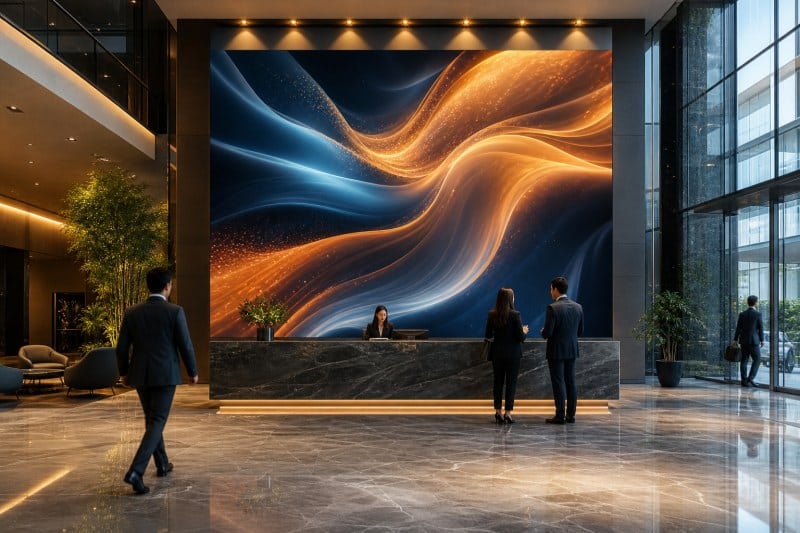
A LED lobby display is a direct-view LED screen installed in an entrance, reception area, atrium, or public interior space to deliver visual content at a large scale. Unlike a TV or projector, a direct-view LED screen is built from LED modules or cabinets that form a seamless digital surface. It can be made small, wide, tall, curved, or even custom-shaped depending on the architecture.
In simple terms, it is a digital communication wall for the first point of contact. It may show a company video in a corporate lobby, room availability in a hotel, wayfinding in a hospital, event schedules in a convention center, or promotional visuals in a shopping mall.
A hotel lobby LED display can also work as a premium design feature, especially when the screen is blended into stone walls, wooden panels, metal frames, or glass architecture.
A typical LED lobby display system includes LED modules, cabinets, receiving cards, power supplies, a control system, video processor, mounting structure, signal cables, power distribution, and a content management method.
For close-view indoor spaces, many projects use fine-pitch LED panels because visitors may stand only one to three meters away from the screen. If you are still comparing indoor display options, an indoor LED screen guide can help you understand brightness, pixel pitch, and installation basics before selecting a lobby-specific solution.
2. Why Lobby Spaces Need LED Displays
Lobby spaces need LED displays because they must welcome, inform, guide, and impress visitors within a few seconds. People do not study a lobby like they study a brochure. They walk in, look around, and quickly decide where to go and what the brand feels like.
That is why dynamic visual communication works so well in entrance areas. A LED display can update content without printing new posters, adjust messages by time of day, and support different visitor needs.
In the morning, it can show welcome content and meeting schedules. During an event, it can show speaker information or sponsor visuals. In an emergency, it can switch to alert information if connected to the right control workflow.
The value is both practical and emotional. Practically, it reduces manual signage updates and gives staff a central channel for announcements. Emotionally, it gives the space a polished, high-end feeling.
In a hotel, a hotel lobby LED display screen can create a warm arrival mood with local scenery, seasonal campaigns, or subtle brand storytelling. In a corporate office, it can show product films, milestones, investor messages, or global team updates.
- First impression: It helps visitors feel that the space is modern, organized, and professional.
- Wayfinding: It can point guests to elevators, reception desks, meeting rooms, counters, or event halls.
- Brand storytelling: It turns the lobby into a visual identity space rather than only a waiting area.
- Real-time updates: It can show schedules, notices, weather, transport information, or live event content.
- Reduced print waste: It replaces repeated poster changes and manual notice boards.
3. Common Types Of Lobby LED Displays
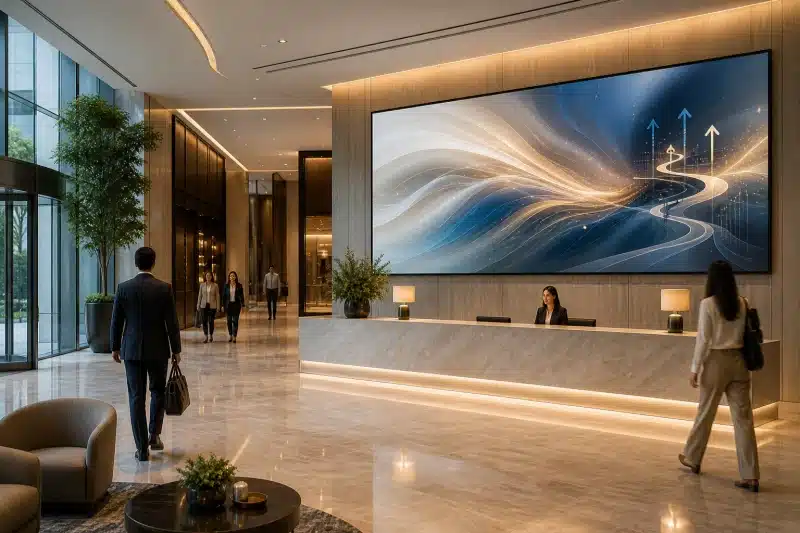
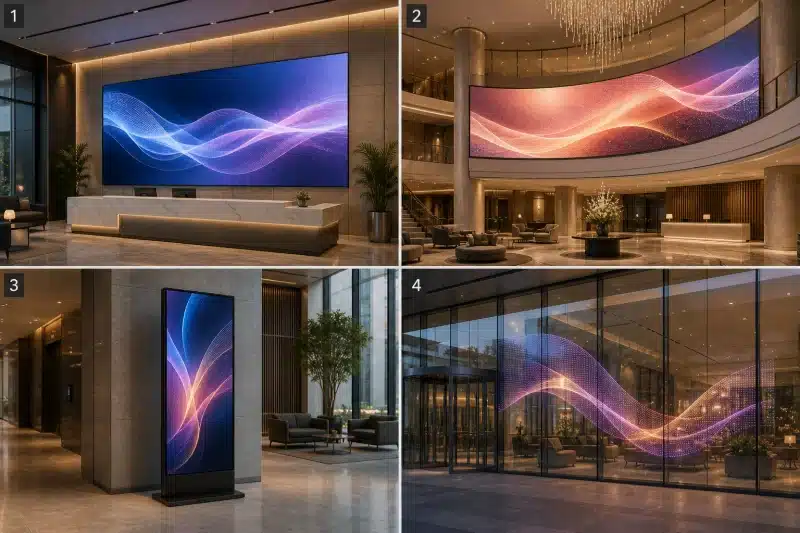
The best type of lobby LED display depends on the building design, viewing distance, content purpose, and installation conditions. Not every lobby needs a giant full-wall screen. Some spaces need a narrow welcome banner, some need a fine-pitch brand wall, and some need a creative installation that becomes part of the interior design.
3.1 Fine-Pitch LED Video Wall
A fine-pitch LED video wall is usually the best choice for close-view reception areas. Pixel pitches such as P1.2, P1.5, P1.8, P2, or P2.5 are common depending on how close visitors stand to the screen. The closer the viewing distance, the smaller the pixel pitch should be.
https://www.youtube.com/watch?v=Kgvo45sucC0
4K LED Screen of Unit LED
3.2 Curved Or Creative LED Display
A curved or creative LED display is useful when the screen needs to match the shape of the architecture.
It can wrap around a column, follow a curved wall, or create a more immersive visual feature in a hotel, museum, showroom, or premium office.
https://www.youtube.com/watch?v=JLN4efdSwhc
Curved LED Display of Unit LED
3.3 LED Poster Display
An LED poster display is a practical option for smaller lobbies that need flexible digital signage without a full construction project.
It can show welcome messages, promotions, event posters, or directory information, and it can often be moved or repositioned when needed.
https://www.youtube.com/watch?v=2vqsLnTYE5A
Foldable LED Poster of Unit LED
3.4 Transparent LED Display
A transparent LED display works well for glass-facing lobbies where the owner wants digital content without fully blocking natural light.
It is often used in malls, car showrooms, hotels, and commercial buildings with large windows.
https://www.youtube.com/watch?v=ZuX35VfjfQw
Transparent LED Screen of Unit LED
3.5 Interactive LED Display
An interactive LED display can support touch, motion sensing, or guided content for premium visitor experiences.
It is useful for exhibition halls, technology showrooms, education centers, and public service spaces where visitors need to explore information instead of only watching content.
4. Best Applications By Industry
Different industries use LED lobby displays for different business goals, but the shared purpose is to make the entrance more useful and memorable.
A hotel wants atmosphere and guest service. A hospital wants direction and calm information flow. A corporate office wants brand confidence. A mall wants attention and commercial value.
| Industry | Common Lobby Use | Best Content Style |
|---|---|---|
| Hotel | Welcome visuals, event schedules, local scenery, guest information | Warm, elegant, seasonal, brand-aligned |
| Corporate Office | Brand films, product demos, company news, visitor greetings | Clean, confident, professional |
| Shopping Mall | Promotions, maps, event ads, entertainment content | Bright, energetic, high-contrast |
| Hospital | Wayfinding, notices, health campaigns, queue guidance | Calm, readable, simple |
| School Or University | Announcements, achievements, campus news, event guidance | Friendly, informative, easy to update |
| Convention Center | Event schedules, sponsor visuals, directions, live content | Fast-changing, modular, event-ready |
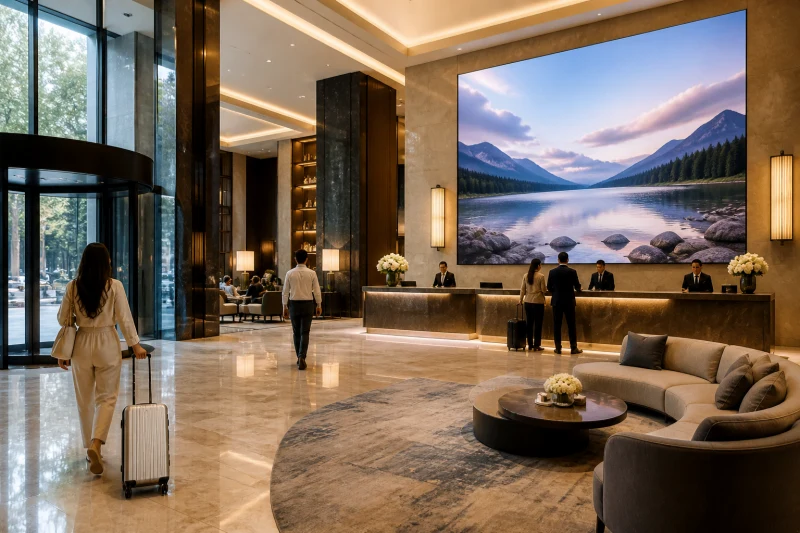
For hotels, the screen should not feel like a loud advertising board. A hotel lobby LED display should support the mood of the space. Slow-motion visuals, elegant brand colors, local culture, spa promotions, wedding hall information, and check-in guidance usually work better than aggressive flashing content.
For corporate buildings, the display can communicate credibility before the visitor reaches the front desk. A short product film, a global office map, case study highlights, or a welcome message for visiting clients can make the space feel prepared and intentional.
5. Key Specs To Consider Before Buying
The right specifications decide whether a LED lobby display looks premium for years or becomes an expensive wall with visible flaws. Lobby screens are often viewed at close range, under mixed lighting, and for long daily operating hours, so small technical choices matter.
5.1 Pixel Pitch
Pixel pitch should be selected according to the closest comfortable viewing distance. For a reception desk or waiting area where people stand very close, P1.2 to P1.8 is often preferred.
For a general lobby with two to four meters of viewing distance, P1.8 to P2.5 is usually enough. For a large atrium where visitors mainly view the screen from farther away, P2.5 to P4 may be more cost-effective.
5.2 Brightness
Brightness should match the actual lobby lighting, not just a catalog number. A dim indoor hallway may need far less brightness than a glass-front hotel lobby with strong daylight. Many indoor lobby projects fall somewhere around 800 to 1,500 nits, while brighter atriums or glass-heavy spaces may need higher brightness.
The screen should also support brightness adjustment so it does not look harsh at night.
5.3 Viewing Angle
A wide viewing angle is important because people rarely stand directly in front of a lobby screen.
They walk from doors, elevators, seating areas, and reception counters. A good LED screen should keep color and brightness consistent when viewed from the side.
5.4 Refresh Rate And Grayscale
A high refresh rate and strong grayscale performance help the screen look smooth in videos and clean in photos.
This matters for hotel marketing content, brand films, event photography, and social media posts taken inside the lobby.
5.5 Front Maintenance
Front-service maintenance is usually the safer choice for built-in lobby installations. If the screen is embedded into a wall, there may be no rear access.
Front maintenance allows technicians to remove modules from the front without opening the wall or disturbing the interior finish.
6. LED Lobby Screen Vs LCD, Projection, And Printed Signage
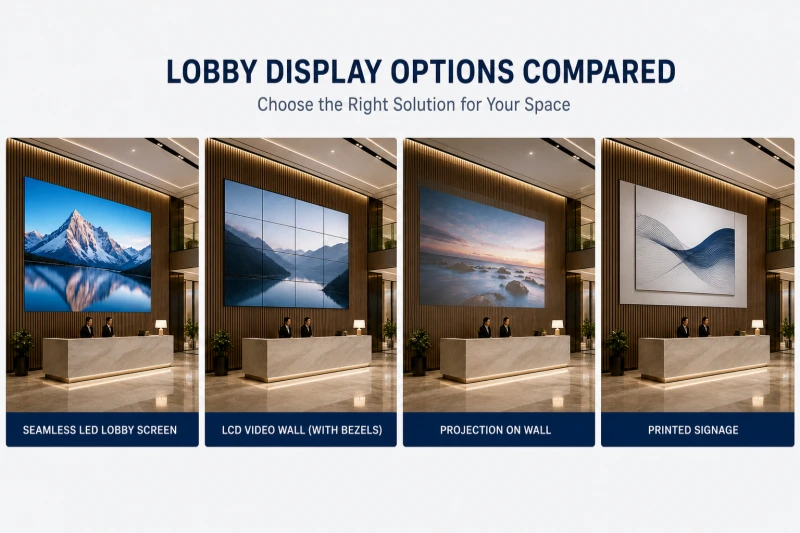
A LED lobby screen is usually the strongest choice when the project needs size flexibility, seamless visuals, high brightness, and long-term content flexibility. LCD, projection, and printed signage can still work, but each has clear limits in large entrance spaces.
| Option | Strength | Limit | Best For |
|---|---|---|---|
| LED Lobby Display | Seamless size, strong brightness, flexible format | Higher upfront cost | Premium lobbies, atriums, brand walls |
| LCD Video Wall | Good detail, familiar technology | Bezels, fixed panel sizes, limited shape flexibility | Control rooms, smaller display walls |
| Projection | Large image at lower initial cost | Needs controlled light, shadows, lamp or projector maintenance | Dark rooms, temporary presentations |
| Printed Signage | Low cost, simple | Static, slow to update, less premium over time | Permanent signs, basic direction boards |
- LCD walls may look sharp at close range, but the bezel lines can weaken the premium look in a main lobby.
- Projection can be attractive in dark spaces, but many lobbies have daylight, reflective floors, and people walking through the beam path.
- Printed signage is reliable, but it cannot change content instantly.
- A LED display is better when the building needs one surface for brand films, welcomes, wayfinding, announcements, and event content.
7. Installation And Maintenance Considerations
A successful lobby LED display installation depends on planning the structure, power, signal, heat, service access, and content workflow before the screen is ordered. Many problems happen not because the LED panels are bad, but because the site conditions were not checked carefully enough.
The wall must support the full weight of the screen, frame, cables, and service access requirements. If the display is mounted in an atrium, suspended structure, or high wall, the installation team should confirm load capacity and safety requirements. For general safety thinking around workplace access and maintenance, building teams can also review resources such as OSHA walking-working surface guidance.
Power planning is just as important. A LED wall needs stable power distribution, proper grounding, surge protection, and clean cable routing. Signal planning should include controller placement, backup access, network control, and the distance between the media source and the screen. Heat should not be trapped inside decorative walls, especially in lobbies where the screen may run 12 to 18 hours a day.
Maintenance should be designed into the project from the beginning. A front-service design, spare modules, accessible power supplies, clear cabinet labeling, and a documented maintenance plan can save a lot of cost later. For seasonal events, exhibitions, or temporary hotel functions, a rental LED display may be a better choice than building a permanent wall, especially when the screen location changes from event to event.
8. How Much Does A LED Lobby Display Cost?
The cost of a LED lobby display depends mainly on pixel pitch, screen size, cabinet quality, control system, installation complexity, and after-sales support. A small LED poster costs far less than a custom fine-pitch wall built into a luxury hotel lobby.
A P1.2 screen also costs more than a P2.5 screen of the same size because it uses more pixels, more components, and more precise manufacturing.
Buyers often focus on the panel price, but the full project cost usually includes much more. A realistic budget should include LED cabinets or modules, controller, processor, sending equipment, receiving cards, power distribution, mounting structure, freight, installation labor, content setup, spare parts, and warranty support.
| Cost Factor | Why It Matters |
|---|---|
| Pixel Pitch | Smaller pitch gives sharper close-view images but increases cost. |
| Screen Size | Larger screens need more panels, stronger structure, and more power planning. |
| Brightness And Refresh Rate | Higher performance improves visual quality in bright or media-heavy spaces. |
| Cabinet Design | Thin, lightweight, front-service cabinets may cost more but simplify installation. |
| Installation Site | High walls, curved surfaces, glass areas, and custom frames increase labor cost. |
| Warranty And Support | Reliable service reduces downtime and long-term maintenance risk. |
The cheapest quote is not always the lowest-cost choice. If a supplier uses weak power supplies, poor calibration, low-grade LEDs, or unclear service terms, the screen may look uneven after a short time.
A better approach is to compare total cost of ownership across five to seven years, including power use, maintenance, spare parts, downtime, and content operation.
For general energy awareness in commercial lighting and display planning, buyers can also review public resources from the U.S. Department of Energy.
9. How To Choose The Right Supplier
The right supplier should help you design a lobby display system, not only sell LED panels by square meter. A lobby screen is part of the building experience, so the supplier needs to understand both technical performance and real installation conditions.
Start by checking whether the supplier asks the right questions. They should ask about viewing distance, lobby lighting, wall size, operating hours, mounting method, content type, maintenance access, control method, and budget range. If a supplier gives a fixed recommendation without asking about the site, the proposal may be too generic.
Next, look for proof of experience. Project photos, cabinet details, calibration methods, certifications, aging tests, packing process, spare parts policy, and warranty response all matter. A reliable LED display manufacturer should also explain why a certain pixel pitch, brightness level, cabinet structure, and control system fit your lobby instead of simply pushing the most expensive option.
Before placing an order, ask for these details:
- Recommended pixel pitch and the viewing distance logic behind it
- Brightness range and whether automatic or manual dimming is supported
- Refresh rate, grayscale, contrast, and color calibration information
- Cabinet size, weight, thickness, and service method
- Power consumption estimate and power distribution plan
- Installation drawing or structural suggestion
- Controller and content management workflow
- Warranty terms, spare modules, and technical support response
A good supplier will not be afraid of these questions. In fact, clear questions usually make the final project smoother because both sides understand what the screen must do after installation.
10. FAQs
Most LED lobby display questions come down to viewing distance, brightness, cost, and maintenance. The answers below cover the issues buyers usually ask before a project moves from idea to quotation.
10.1 What Pixel Pitch Is Best For A Lobby LED Display?
The best pixel pitch depends on how close people stand to the screen.
- For close reception areas, P1.2 to P1.8 is often used.
- For general lobby viewing at two to four meters, P1.8 to P2.5 is usually practical.
- Larger atriums can use P2.5 to P4 if the main viewing distance is farther.
10.2 Is A LED Lobby Display Better Than A TV Wall?
A LED lobby display is usually better for large, seamless, high-impact lobby visuals. TV walls can work for smaller spaces, but bezel lines, fixed panel sizes, and brightness limits often make them less suitable for premium entrances.
10.3 Can A Lobby LED Display Show Real-Time Information?
Yes, a lobby LED display can show real-time information if it is connected to the right content system. Common examples include event schedules, welcome names, weather, transport updates, queue information, meeting room status, and emergency notices.
10.4 How Long Does A Lobby LED Screen Last?
A commercial LED screen can often be rated for tens of thousands of operating hours, but real life depends on product quality, brightness settings, heat control, maintenance, and daily operating time.
Running the screen at suitable brightness and keeping good ventilation can help extend its service life.
10.5 Is A Hotel Lobby LED Display Screen Too Bright For Guests?
A hotel lobby LED display screen should not feel too bright if it is properly specified and adjusted. Brightness should match the ambient light.
In the evening, lower brightness and warmer content usually create a more comfortable guest experience.
The best pixel pitch depends on how close people stand to the screen.
- For close reception areas, P1.2 to P1.8 is often used.
- For general lobby viewing at two to four meters, P1.8 to P2.5 is usually practical.
- Larger atriums can use P2.5 to P4 if the main viewing distance is farther.
A LED lobby display is usually better for large, seamless, high-impact lobby visuals. TV walls can work for smaller spaces, but bezel lines, fixed panel sizes, and brightness limits often make them less suitable for premium entrances.
Yes, a lobby LED display can show real-time information if it is connected to the right content system. Common examples include event schedules, welcome names, weather, transport updates, queue information, meeting room status, and emergency notices.
A commercial LED screen can often be rated for tens of thousands of operating hours, but real life depends on product quality, brightness settings, heat control, maintenance, and daily operating time.
Running the screen at suitable brightness and keeping good ventilation can help extend its service life.
A hotel lobby LED display screen should not feel too bright if it is properly specified and adjusted. Brightness should match the ambient light.
In the evening, lower brightness and warmer content usually create a more comfortable guest experience.
11. Conclusion: Is A LED Lobby Display Worth It?
A LED lobby display is worth it when the entrance needs to do more than hold a reception desk and a few static signs.
It can welcome visitors, guide traffic, support events, tell the brand story, reduce printed updates, and make the space feel more alive. The key is to choose the screen around the real lobby environment: viewing distance, lighting, content style, installation access, maintenance needs, and long-term operating cost.
When planned well, a LED lobby display becomes more than a screen; it becomes the visual center of the building’s first impression.