GOB LED Module & GOB LED Display Screen In Stock!
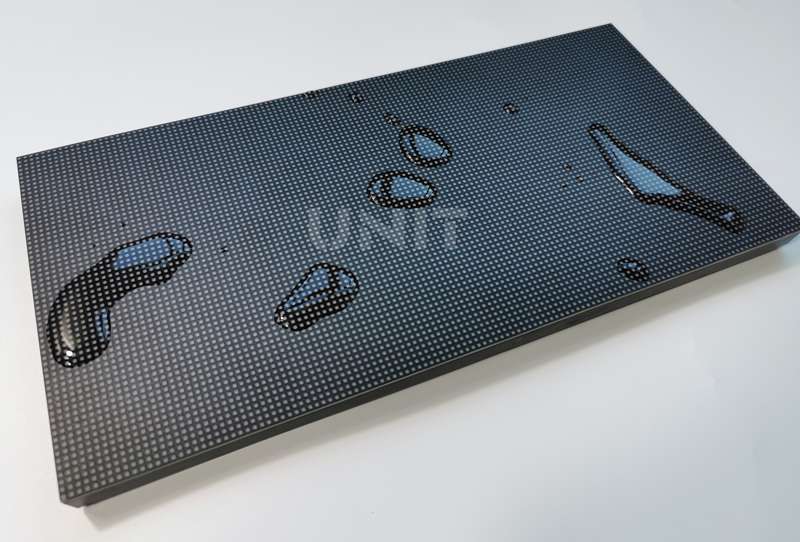
LED Panel
GOB LED Module
- High Waterproof Level
- High Dust-proof
- High Shockproof
- Flexible GOB LED Module
- Suitable for Fine Pixel Pitch
GOB LED Technology
GOB LED technology is an innovative gluing seal on the surface of the module.
It can well protect the LEDs on the LED module from water, dust, and damage.
It is used to form effective protection by using an advanced, new transparent material potted on the lamp surface. This material not only has super high transparency, but also has excellent thermal conductivity.
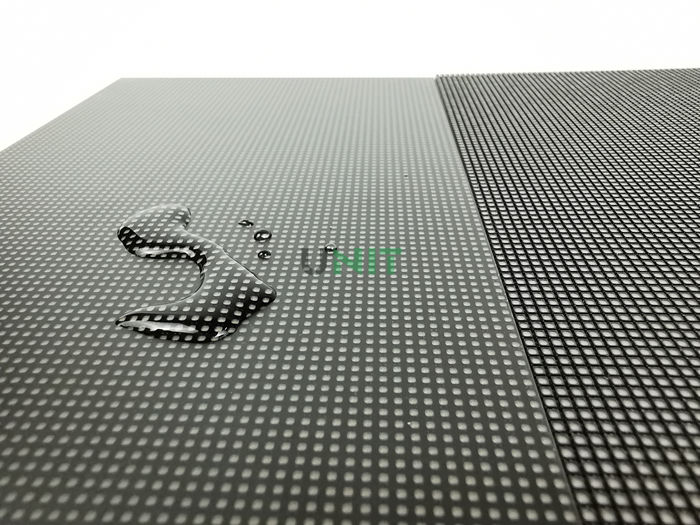
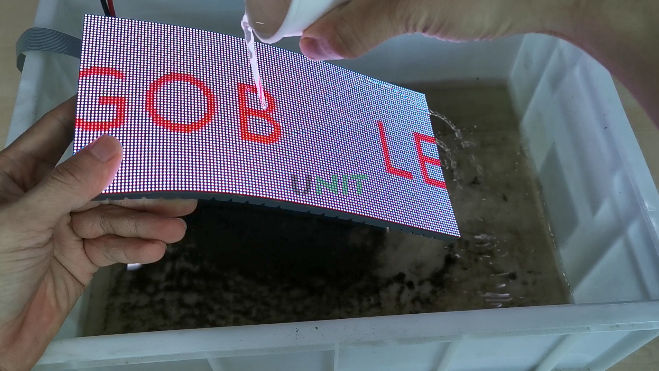
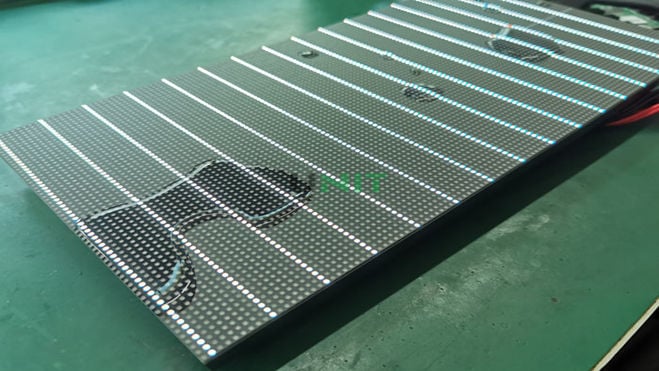
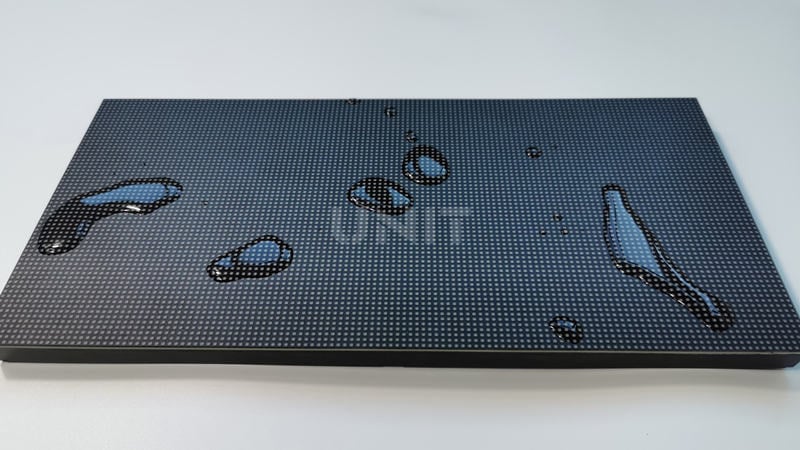
IP68 High Waterproof Level
The GOB LED module is covered with transparent glue on the surface of the module’s PCB.
The special shielding layer protects the LED beads from water vapor interference. Therefore, it has a super high waterproof level.
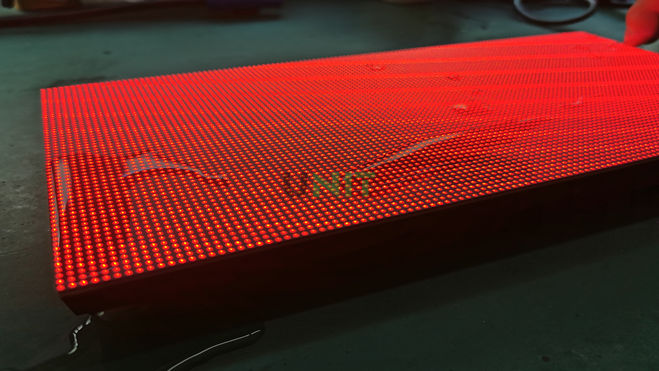
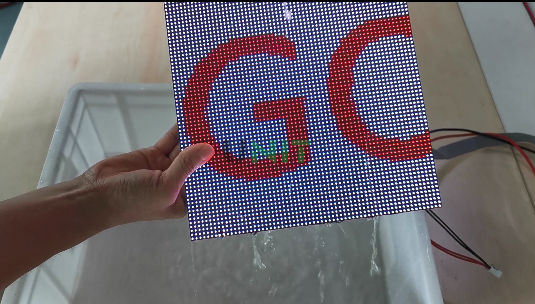
P2.5mm GOB LED Module Front
P2.5mm GOB LED Module Back
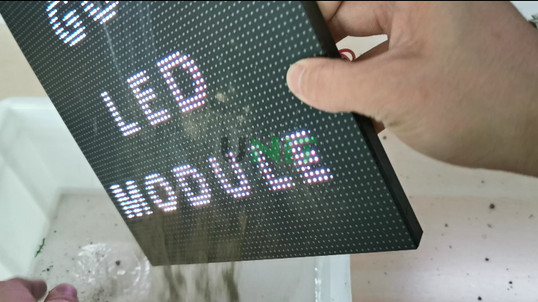
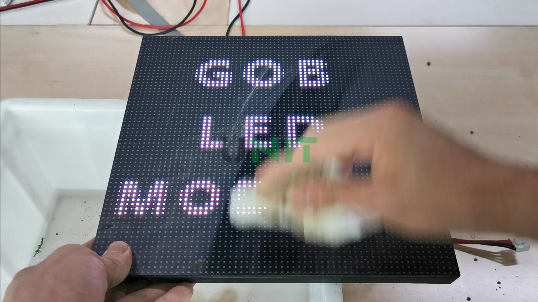
Super Dust-proof
High Dust-proof Level
The surface of the GOB module is coated with a potting coating that makes it good at dust proofing. Compared to SMD LED modules, GOB modules are more suitable for use in windy and sandy environments.
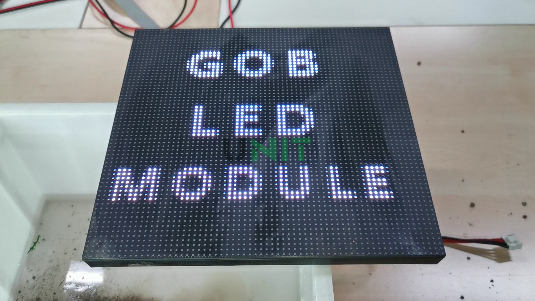
High Shockproof
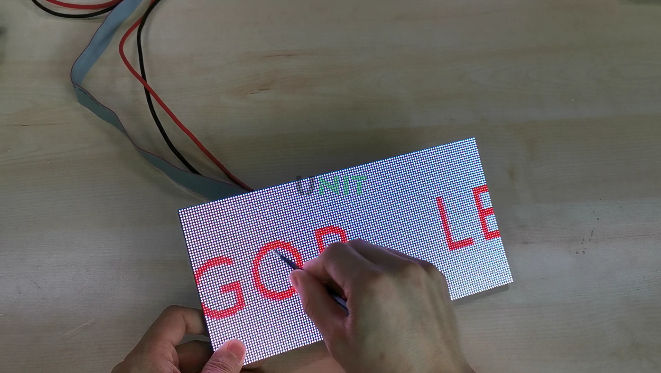
The GOB module has excellent anti-impact and scratch resistance. It can well solve the phenomenon of large batches of dead lamps and bad lights due to impact during transportation.
The surface of the lamps is raised into a spherical surface. Smooth and Hard, Impact and Wear-resistant.
GOB Flexible LED Module
Creative LED Displays
GOB soft modules are extremely flexible. Its bendable nature makes it the first choice for creating creative LED displays.
GOB LED Display Module Specification
| Type | Pixel Pitch | LED | Module Resolution | IC Number | Brightness(Nits) | Module Size(MM) | Driving Mode |
| 320X160 Series | P1.25mm | 1010 (Black LED) | 256*128 | 96 | 600-800 | 320*160 | 1/64Scan |
| P1.538mm | 1010 (Black LED) | 208*104 | 84 | 600-800 | 320*160 | 1/52Scan | |
| P1.667mm | 1010 (Black LED) | 192*96 | 72 | 600-800 | 320*160 | 1/64Scan | |
| P1.839mm | 1515 (Black LED) | 174*87 | 52 | 600-800 | 320*160 | 1/58Scan | |
| P1.86mm | 1515 (Black LED) | 172*86 | 66 | 600-800 | 320*160 | 1/43Scan | |
| P2mm | 1515 (Black LED) | 160*80 | 60 | 600-800 | 320*160 | 1/40Scan | |
| P2.5mm | 2121 (Black LED) | 128*64 | 48 | 800-1000 | 320*160 | 1/32Scan | |
| P3.076mm | 2121 (Black LED) | 104*52 | 42 | 800-1000 | 320*160 | 1/26Scan | |
| 250X250 Series | P2.604mm | 1515 (Black LED) | 96*96 | 54 | 800-1000 | 250*250 | 1/32Scan |
| P2.976mm | 2121 (Black LED) | 84*84 | 54 | 800-1000 | 250*250 | 1/28Scan | |
| P3.91mm | 2121 (Black LED) | 64*64 | 48 | 800-1000 | 250*250 | 1/16Scan | |
| 240*240 Series | P1.875mm | 1515 (Black LED) | 128*128 | 48 | 800-1000 | 240*240 | 1/64Scan |
| P2.5mm | 2121 (Black LED) | 96*96 | 54 | 800-1000 | 240*240 | 1/32Scan | |
| Other Series | P2mm | 1515 (Black LED) | 128*64 | 48 | 800-1000 | 256*128 | 1/32Scan |
| P2.5mm | 2121 (Black LED) | 64*64 | 24 | 800-1000 | 160*160 | 1/32Scan | |
| P3mm | 2121 (Black LED) | 64*64 | 24 | 800-1000 | 192*192 | 1/32Scan |
Download Product Manual
https://youtu.be/HVjGpVWpG3M?si=KNTkRKh0g1z0XrLrhttps://youtu.be/ndgYb_u9vDk?si=LH5MiiCftYq6x-G5
More Details
P1.91 GOB LED moduleP1.95 GOB LED moduleP1.875 soft GOB module
Contact Us
Order GOB led modules? Please feel free to contact us at any time, and we will respond to you within 24 hours.
CONTACT US
Order GOB LED modules? Please feel free to contact us at any time, and we will respond to you within 24 hours.
GOB LED Display: Complete Guide to GOB LED Technology, Modules & Screens
With the development of the times and the advancement of technology, the LED display industry has also undergone earth-shaking changes. From DIP and SMD LED displays to COB and GOB LED displays, the advancement of LED technology provides people with more choices.
As one of the most advanced LED technologies at present, GOB LED has high protection ability and excellent display effects.
What is GOB LED technology? What are its pros and cons? How to choose the most suitable LED display products for different package types? This guide will take you to explain the GOB LED display in detail.
From how GOB LED technology works, to GOB LED module and GOB LED screen. More information? Just read it now!
Table of Contents
1. What is GOB LED Technology?
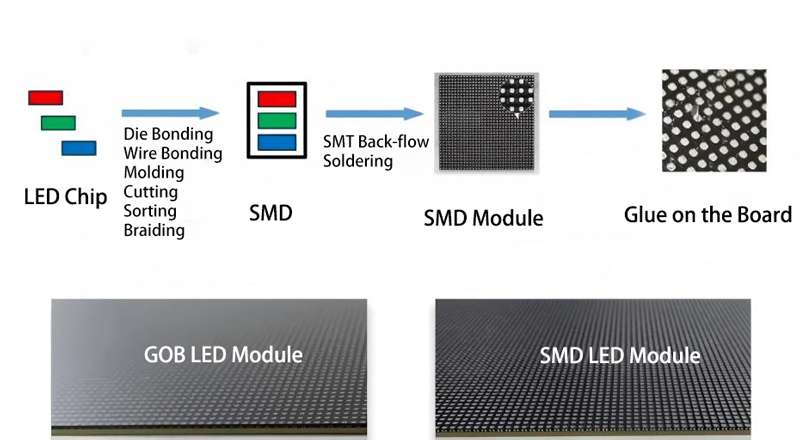
GOB stands for Glue on Board. It is an innovative packaging technology used to improve the protection of LED lamp beads on a surface-mount device (SMD) or integrated matrix.
Traditional LED displays often encounter issues with “pixel loss” or damage resulting from moisture, dust, or physical impact. GOB LED technology addresses these vulnerabilities by applying a transparent engineered epoxy glue over the entire surface of the GOB LED module.
1.1 How Does it Work?
GOB LED technology is applied after the standard SMT (Surface Mount Technology) process. Once the LEDs are mounted onto the PCB, a layer of optically transparent glue is evenly coated across the entire module surface. This glue is then cured under controlled conditions to form a flexible yet durable protective layer.
This layer acts as a “shield,” encapsulating the delicate LEDs and the PCB board into a single, unified structure.
1.2 What Problem Does GOB Technology Solve?
(1) Low Protection Level
With the expansion of the application field of LED display, traditional SMD LED displays cannot meet the requirements of special application scenarios for product quality and display effect.
Some merchants study packaging technology and choose COB LED technology, and some merchants choose to improve SMD technology. GOB technology belongs to the protection process after the improvement of the SMD packaging process.
(2) Damage to the Eyes
The bright glare of the indoor display, the dizziness caused by high-frequency refresh, and the graininess of the surface-mounted lamp beads can easily cause visual fatigue.
It is especially evident in scenarios such as dispatch centers that require close viewing for extended periods. GOB small-pitch technology solves the pain points of customers well.
(3) The Mask Affects the Visual Effect
After a period of use, the SMD LED display may appear yellowish and white on the mask, which is not easy to clean.
The small-pitch SMD LED display is prone to bulging of the mask in a high-temperature environment. It will affect the visual effect.
1.3 GOB vs Traditional LED Protection Technologies
| Technology | Protection Level | Visual Impact | Maintenance | Common Use |
| Traditional SMD | Low | Excellent | Easy | Standard indoor LED |
| Conformal Coating | Medium | Slight haze | Moderate | Semi-protected LED |
| Resin Potting | High | Reduced clarity | Difficult | Outdoor LED |
| GOB LED Technology | High | Excellent | Easy | Fine-pitch & premium LED |
GOB LED technology achieves an ideal balance between protection and display quality, making it especially suitable for fine pixel pitch LED screens.
2. What Is GOB LED Module & GOB LED Display?
A GOB LED module is the basic building block of a GOB LED display. It is manufactured using GOB protection technology and integrates LED chips, PCB, driver ICs, and a protective GOB coating into a single, highly durable display unit. Compared with conventional LED modules, GOB LED modules are designed to offer higher reliability and longer service life, especially in fine-pitch applications.
Main features of a GOB LED module include:
- Sealed LED surface, reducing damage from impact, dust, and moisture
- Stable brightness and color uniformity, ideal for close-viewing environments
- Lower dead pixel rate, improving long-term display consistency
- Easy handling and installation, reducing risk during assembly
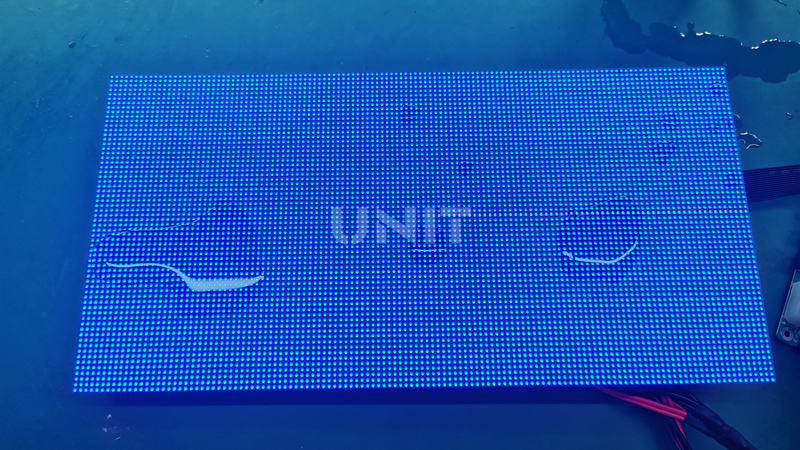
A GOB LED display is a complete display system assembled from multiple GOB LED modules, along with cabinets, power supplies, receiving cards, and control systems. By using GOB LED modules, the entire screen gains enhanced durability and visual stability while maintaining a seamless, high-resolution appearance.
GOB LED displays are widely used in control rooms, conference rooms, retail spaces, and indoor commercial applications where both image quality and reliability are essential. Their modular design also makes future maintenance and upgrades more efficient and cost-effective.
3. Benefits and Drawbacks of GOB LED Screen
As one of the most advanced technologies, GOB technology has solved the pain points in previous market applications for the display industry. Knowing GOB LED module, you can’t ignore its characteristics and shortcomings.
3.1 Benefits of GOB LED Screen
(1) High Protection Ability
GOB technology solves the weather resistance of the display screen, and the ultra-high protection level effectively reduces the phenomenon of dead lights and knocked lights on the SMD LED screen.
The ultra-high protection ability is reflected in the following aspects: waterproof, moisture-proof, anti-collision, dust-proof, anti-corrosion, anti-blue light, anti-salt, and anti-static.
https://www.youtube.com/watch?v=cjVdQHGDlSM&t=55s
(2) Better Visual Effects
The matte effect on the surface of the module improves product contrast, reduces glare and glare, and reduces visual fatigue. Even long-time viewing will not damage eyesight.
(3) Wider Viewing Angle
After surface glue treatment, the surface of the module is smooth. GOB LED display realizes the transformation from a point light source to a surface light source.
The GOB LED screen luminescence is more uniform, greatly improving the viewing angle. Both horizontal and vertical viewing angles can reach 180°.
(4) Wide Range of Applications
High-protection GOB LED can be used in several display products: small-pitch LED displays, rental LED displays, poster LED posters, and shelf LED displays.
Due to its high protection ability and excellent display effect, the application range of the GOB LED screen covers a variety of indoor and outdoor scenes.
(5) High Surface Smoothness
Flatness is a standard for testing LED technology. Good flatness means a better visual experience. At present, the glue-filling process of GOB LED is relatively mature, the thickness of the glue is uniform, and the surface of the module is smooth.
3.2 Drawbacks of GOB LED Screen
(1) Difficult to Maintain
If the lamp bead is damaged and needs to be repaired, professional tools, materials, and maintenance personnel are required. Therefore, the maintenance cost of the GOB LED module is relatively high.
(2) Process Issues
Although GOB LED board can change the protection ability and appearance consistency of the module, there are still some defects in this process.
Such as internal stress release problems, heat dissipation problems, poor colloidal affinity, and other problems. It is undeniable that it will take a long time to solve all the technical problems.
(3) Some Special Cases
There is no reliable outdoor protection or anti-collision ability in outdoor and rental transparent display applications.
4. DIP vs SMD vs COB vs GOB LED Display
As LED display technology has evolved, four main packaging and protection methods have been widely adopted: DIP LED, SMD LED, COB LED, and GOB LED. Each technology has its own characteristics, strengths, and ideal application scenarios. Understanding the differences helps users choose the most suitable LED display solution based on environment, budget, and performance requirements.
Next, let’s understand what DIP, SMD, COB, and GOB are and their differences.
(1) DIP LED Display
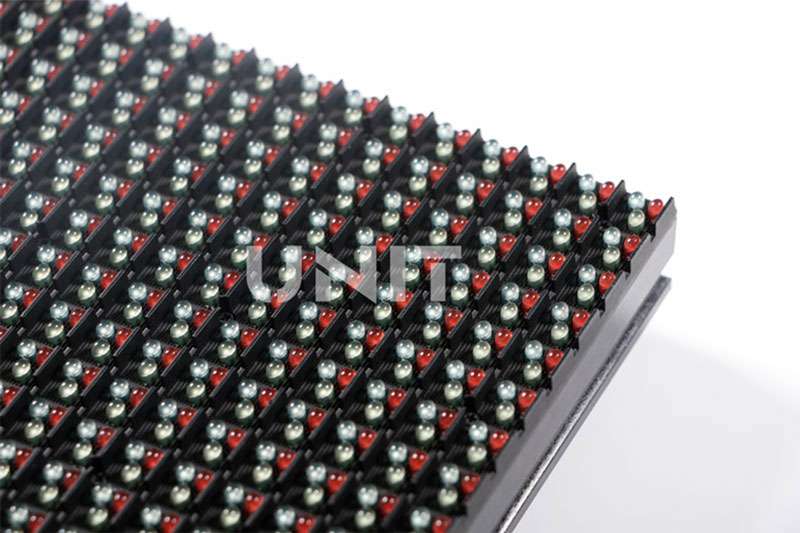
DIP package is the abbreviation of dual-in-line package. The DIP LED display module inserts the red, green, and blue lamp beads on the LED PCB board, and then makes a module through wave soldering.
Affected by the diameter and size of the lamp bead, the DIP LED module can only achieve P6. DIP LEDs do not support smaller pixel pitches. Good protection performance, high brightness, and good heat dissipation make it suitable for outdoor use. At present, the P10 DIP LED module and P20 DIP LED module still have a large market share in outdoor displays.
Pros
① Good protection performance, good adaptability to the outdoor environment
② High brightness, good heat dissipation
Cons
① The angle of view is not easy to fix accurately, generally between 100-110
② High energy consumption, not environmentally friendly
③ The pixel pitch is large and cannot be used indoors
④ The production organization of the DIP LED module is relatively complicated, and it is not easy to realize mechanized production. The quality of modules and screens is limited by the quality of lamp beads. Therefore, it is crucial to identify a high-quality LED module factory.
① Good protection performance, good adaptability to the outdoor environment
② High brightness, good heat dissipation
① The angle of view is not easy to fix accurately, generally between 100-110
② High energy consumption, not environmentally friendly
③ The pixel pitch is large and cannot be used indoors
④ The production organization of the DIP LED module is relatively complicated, and it is not easy to realize mechanized production. The quality of modules and screens is limited by the quality of lamp beads. Therefore, it is crucial to identify a high-quality LED module factory.
(2) SMD LED Display
SMD package is the abbreviation of Surface Mounted Devices.
3 IN 1 technology is a representative type of SMD. It encapsulates SMT lamps packaged with RGB LED lamps in the same colloid at a certain distance.
With the advancement of technology, SMD LED display has gradually occupied more markets and have a wide range of applications both indoors and outdoors. At present, SMD LED display occupies 80% of the market share in the industry, and it is well-deserved to be the current mainstream product.
In recent years, the three-in-one technology and the update of production equipment have reduced the cost of SMD LED display modules a lot.
Pros
① Good flatness. 3 In 1 SMD LED screen has a flatness that is easier to control.
② Excellent visual experience. The surface of the screen has been treated with light diffuse reflection to make the picture not grainy. High color saturation and high color reproduction bring excellent display effects.
③ Energy saving. The power of a single LED light is lower, and the energy-saving LED Display with an energy-saving IC is more friendly to your electricity bill.
④ Low production cost. After years of technical precipitation, the production cost of SMD LED has been reduced. The price of the product is affordable for most customers.
⑤ Wide range of application fields. More pixel pitches are available. From p1.25mm, p2mm to p8mm, p10mm, SMD LED screens can meet the display needs of various indoor and outdoor scenarios.
Cons
The industry pain points solved by the GOB technology mentioned above have already been listed, so we don’t repeat them here.
① Good flatness. 3 In 1 SMD LED screen has a flatness that is easier to control.
② Excellent visual experience. The surface of the screen has been treated with light diffuse reflection to make the picture not grainy. High color saturation and high color reproduction bring excellent display effects.
③ Energy saving. The power of a single LED light is lower, and the energy-saving LED Display with an energy-saving IC is more friendly to your electricity bill.
④ Low production cost. After years of technical precipitation, the production cost of SMD LED has been reduced. The price of the product is affordable for most customers.
⑤ Wide range of application fields. More pixel pitches are available. From p1.25mm, p2mm to p8mm, p10mm, SMD LED screens can meet the display needs of various indoor and outdoor scenarios.
The industry pain points solved by the GOB technology mentioned above have already been listed, so we don’t repeat them here.
(3) COB LED Display
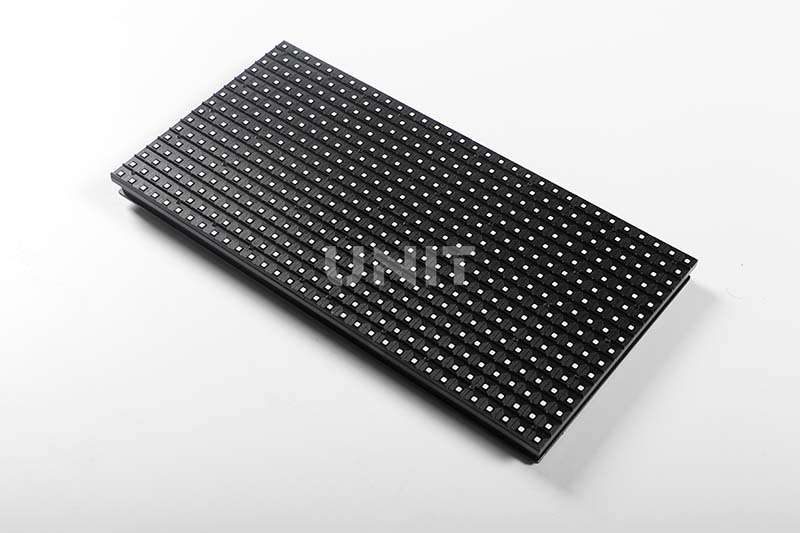
COB is the abbreviation of Chip on Board. As a new packaging technology different from DIP and SMD, it sticks the bare chip on the PCB, then performs wire bonding, and finally encapsulates the chip and bonding wires with glue.
This packaging method integrates upstream and downstream enterprises and simplifies the production process of packaging and display manufacturing.
The COB process needs to go through many processes: wiping the board, dispensing glue, attaching wafers, baking glue, etc.
Compared with DIP and SMD, the COB LED display has the following significant advantages.
Pros
① Ultra thin and light. The thickness of the PCB board is from 0.4mm to 1.2mm.
② Anti-collision and compression resistance. COB LED display directly encapsulates the chip in the concave lamp position of the PCB, and then encapsulates and fixes it with epoxy resin. The surface of the module is smooth and hard, wear-resistant and impact-resistant.
③ Large viewing angle. The viewing angle of the COB LED display screen is more than 175 degrees and close to 180 degrees. The viewing angle of SMD LED is 140-160 degrees, and the viewing angle of DIP LED is smaller.
④ Can be bent. The high flexibility makes it easier for COB modules to make various curved screens and wavy screens. It is an ideal choice for creative LED display projects.
⑤ Strong cooling capacity. The COB LED display quickly dissipates heat through the copper foil on the PCB. Good heat dissipation prolongs the life of the screen and avoids serious light attenuation.
Cons
① High research and development costs. As a new product, COB technology is not as perfect as SMD technology at present and has high technical requirements and high production costs.
② The price of the cob screen is 10-20% higher than that of the LED display with the same dot spacing.
③ The ink color consistency of the screen needs to be strictly controlled.
① Ultra thin and light. The thickness of the PCB board is from 0.4mm to 1.2mm.
② Anti-collision and compression resistance. COB LED display directly encapsulates the chip in the concave lamp position of the PCB, and then encapsulates and fixes it with epoxy resin. The surface of the module is smooth and hard, wear-resistant and impact-resistant.
③ Large viewing angle. The viewing angle of the COB LED display screen is more than 175 degrees and close to 180 degrees. The viewing angle of SMD LED is 140-160 degrees, and the viewing angle of DIP LED is smaller.
④ Can be bent. The high flexibility makes it easier for COB modules to make various curved screens and wavy screens. It is an ideal choice for creative LED display projects.
⑤ Strong cooling capacity. The COB LED display quickly dissipates heat through the copper foil on the PCB. Good heat dissipation prolongs the life of the screen and avoids serious light attenuation.
① High research and development costs. As a new product, COB technology is not as perfect as SMD technology at present and has high technical requirements and high production costs.
② The price of the cob screen is 10-20% higher than that of the LED display with the same dot spacing.
③ The ink color consistency of the screen needs to be strictly controlled.
(4) GOB LED Display
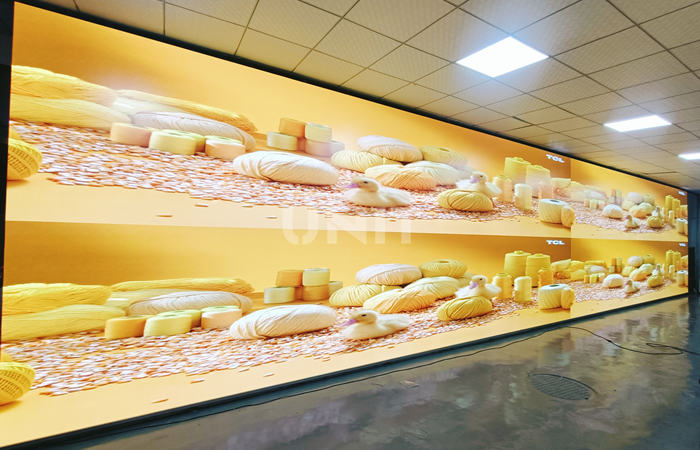
The three major packaging technologies of DIP, SMD, and COB all involve LED chips, while GOB technology does not involve the protection of LED chips. It is a process of protecting the PIN of the bracket of the SMD device with glue on the basis of the SMD module.
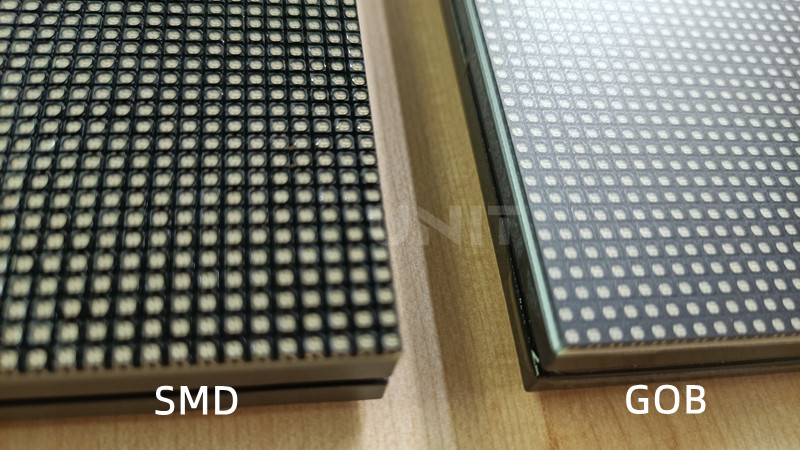
GOB LED features version 1.0 of LED display panel integration technology:
- Single lamp bead discrete package device
- Standoff packaging technology
- Display panel integration technology after packaging
- Industrial chain form: upstream (led chip) + midstream (packaging) + downstream (display factory)
Therefore, GOB technology is not an LED chip-level packaging technology; it is an LED panel protection treatment process performed after the SMT process is completed.
(5) DIP vs SMD vs COB vs GOB LED Comparison Table
| Feature | DIP LED | SMD LED | COB LED | GOB LED |
| LED Packaging | Individual lamps | Integrated RGB package | Chips directly on PCB | SMD + protective glue |
| Pixel Density | Low | Medium to High | Very High | High |
| Viewing Distance | Long | Medium to Short | Very Short | Short |
| Brightness | Very High | High | Medium | High |
| Protection Level | Excellent | Low | Excellent | High |
| Impact Resistance | Very High | Low | Very High | High |
| Moisture & Dust Resistance | Excellent | Low | Excellent | High |
| Visual Uniformity | Medium | Good | Excellent | Very Good |
| Maintenance & Repair | Easy | Easy | Difficult | Easy |
| Cost Level | Low–Medium | Medium | High | Medium |
| Typical Applications | Outdoor billboards | Indoor & outdoor displays | Control rooms, studios | Fine-pitch indoor displays |
5. Applications of GOB LED Display Screens
With enhanced durability, stable image quality, and low maintenance requirements, GOB LED screens are widely used in a variety of indoor commercial and professional environments. Compared with traditional LED displays, GOB LED screens are especially suitable for applications that require close viewing distances and high reliability.
(1) Immersive Scene
GOB LED display is a good choice for creating immersive scenes. In some interactive scenarios, the LED screen is not only a carrier for information display but also a platform for people to interact.
Immersive scenes have high requirements for the flatness of the screen body. The GOB display screen does not feel grainy to the touch, and the interactive experience is better than traditional LED displays.
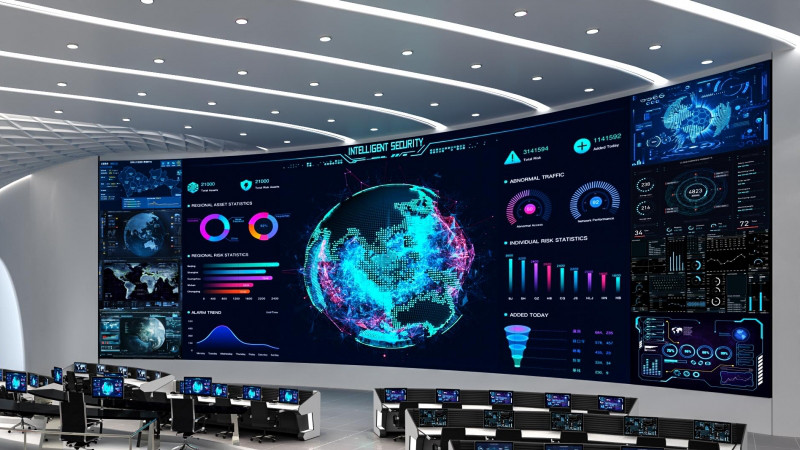
(2) Small-pitch GOB LED Display
The high protection ability of the small-pitch GOB LED screen protects the lamp beads from damage. Good visual effects will not cause visual fatigue.
The feature of being friendly to human eyes makes it the darling of big data centers and scheduling intelligence centers.
With the construction of smart cities and infrastructure construction, small-pitch products combined with GOB technology will gain more room for development.
(3) Creative LED Display
Soft flexible GOB LED module has super high flexibility and excellent waterproof and scratch resistance. The bendable feature makes the soft GOB module suitable for various creative LED displays.
Moisture-proof, waterproof, and scratch-resistant GOB soft modules create more durable and creative display projects for you. Such as cylinder LED screens, spherical LED screens, wave screens, and so on.
(4) GOB Floor LED Display
Traditional floor tile screens use PC masks and acrylic panels to protect the lamp surface from being stepped on. It may cause protruding screw points and obvious seams.
GOB floor LED screen has a more transparent display while strengthening the screen protection.
Cooperate with interactive games to achieve different human-screen interaction requirements, making the LED screen more dynamic.
(5) Retail Industry
Shelf LED display and GOB poster LED display for the retail industry can withstand the impact of use.
Even if you accidentally spill a drink on the screen, there is no need to worry.
6. How to Get High-quality GOB LED Module?
How to manufacture high-quality GOB LED display modules? Strict workmanship standards and high-quality raw materials are key.
(1) High-quality Raw Materials
Raw materials include LED module components and packaging materials.
First of all, the packaging materials of the modules must meet the production standards of the GOB process. This material needs to have the following characteristics: strong adhesion, high transparency, strong tensile and vertical impact, antistatic, high-temperature resistance, yellowing resistance, etc.
Secondly, it is necessary to ensure that the hardware facilities of the module pass the test. High-quality components are the guarantee to ensure that the module will not have dead lights, caterpillars, or deformation of the light board.
For example, the PCB circuit must be more than 1.6mm thick, the solder paste must be high-temperature solder paste, and the lamp beads must be Nationstar and Kinglight series.
(2) Strict Process Standards
The high-standard production process is responsible for product quality and customers. The GOB process needs to pay attention to several aspects:
Packaging process. The transparent material needs to completely cover the surface of the lamp and fill the gaps. Make sure there will not be any air bubbles, white spots, or air holes.
Uniform Glue Thickness. The thickness of the transparent adhesive layer must be uniform. This is also to ensure the flatness of the module.
Sufficient aging time. It is necessary to ensure more than 24 hours of aging test before the lamp surface is glued. This is to ensure that the electronics can work properly. It is difficult to maintain after glue filling.
7. How to Choose the Right GOB LED Screen?
Selecting the right GOB LED display requires balancing visual performance, installation conditions, and long-term reliability. Since GOB LED screens are often used in close-viewing and professional environments, careful evaluation of the following factors is essential.
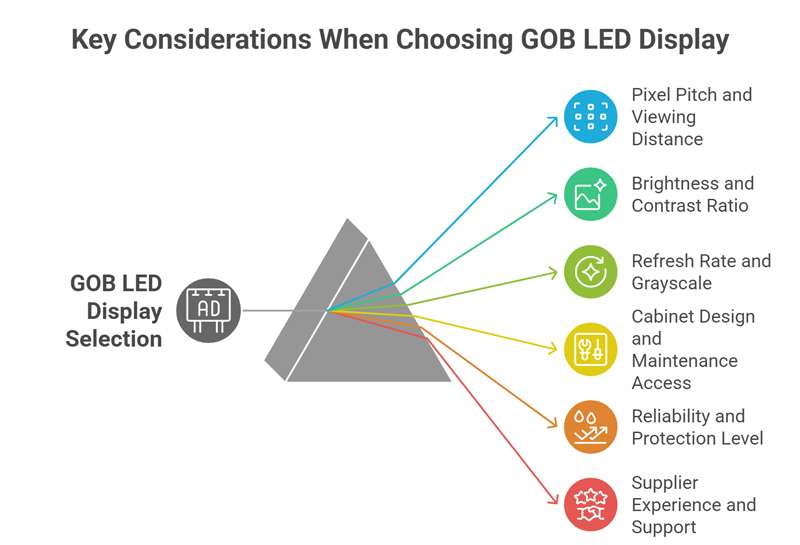
Key considerations when choosing a GOB LED display include:
① Pixel Pitch and Viewing Distance
Choose the pixel pitch based on the minimum viewing distance. Fine-pitch options such as P0.9–P1.5 are ideal for control rooms and conference rooms, while P1.8–P2.5 suits larger indoor spaces.
② Brightness and Contrast Ratio
Ensure the display provides sufficient brightness for the ambient lighting environment. GOB LED displays with high contrast ratios deliver better image depth and readability.
③ Refresh Rate and Grayscale
For professional applications, select a refresh rate of 3840Hz or higher and high grayscale performance to ensure smooth images and accurate color reproduction.
④ Cabinet Design and Maintenance Access
Front-maintenance cabinets are recommended for wall-mounted installations, while modular designs simplify future servicing and upgrades.
⑤ Reliability and Protection Level
Verify the quality of the GOB coating, as it directly affects impact resistance, moisture protection, and long-term stability.
⑥ Supplier Experience and Support
Choose an LED display manufacturer with proven experience in GOB LED technology, stable production quality, and reliable after-sales support.
8. How to Repair GOB LED Module?
Compared with ordinary LED modules, the maintenance of GOB LED modules is not easy. But with the right tools and materials, the repair method is not complicated.
How to Repair GOB LED Display Module Lamp?
If the lamp beads of the GOB LED display module are dead, then we need to replace the new lamp beads. Here are the brief steps:
The video below shows you the maintenance process. For more technical videos, please subscribe to the Youtube channel of UNIT LED.
Preparation tools: heat gun, solder paste, glue, lamp beads
(1) Confirm the position of the dead light
(2) Use a hot air gun to melt the glue on the surface, and then remove the broken lamp beads
(3) Apply solder paste to the bottom of the new lamp bead, and then place the lamp bead in the correct position (note the positive and negative poles)
(4) After the lamp beads are fixed, clean up the impurities around the lamp beads
(5) Re-seal the lamp beads with glue and wait for the glue to dry.
https://www.youtube.com/watch?v=GtMVFHVFQ3s
How to Fix a Broken Lamp in a GOB LED Module?
In this tutorial, we will go through the steps to repair a broken LED in a GOB LED module.
Please make sure to follow safe operating procedures when making repairs.
Required tools and materials:
– GOB LED module
– Receiving card
– Flat cable,
– Power supply
– New LED lamp
– Soldering tool
– Glue
– UV curing lamp
– Sandpaper
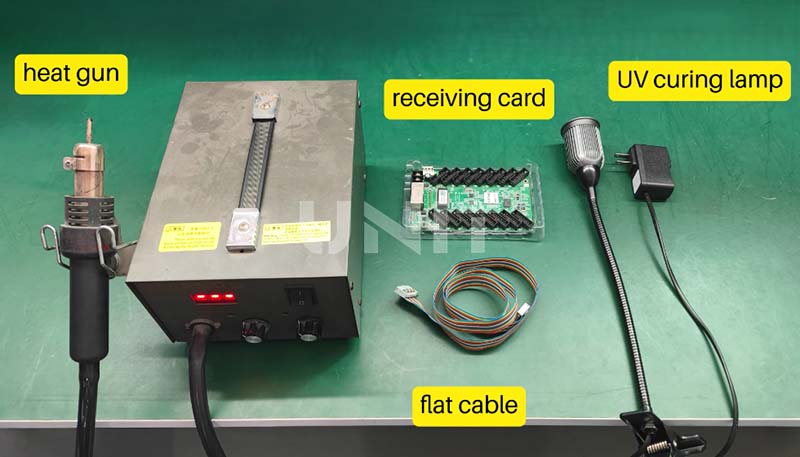
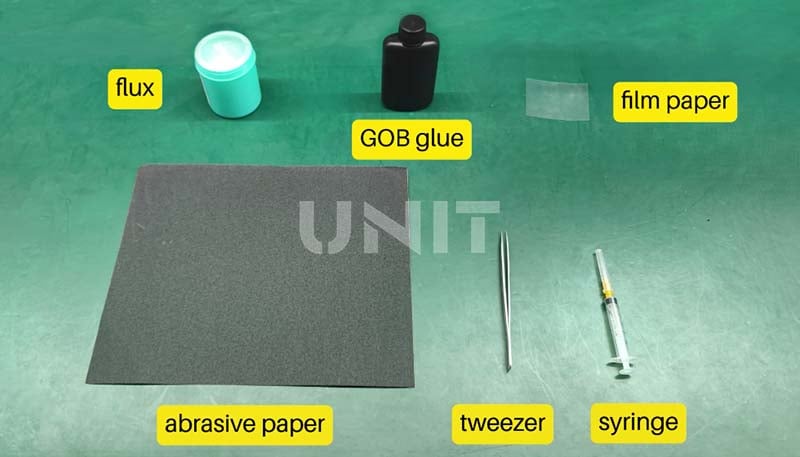
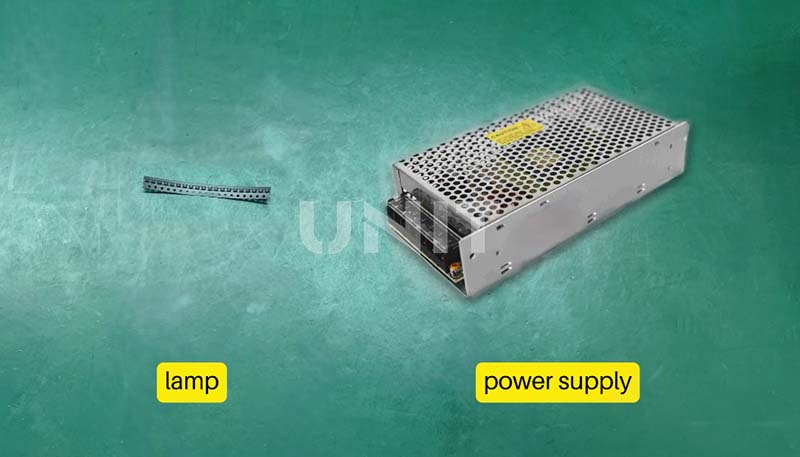
Tools you need to prepare
Repair steps:
Step 1. Connect the Module
First, connect the GOB LED module with the wires, receiving card, and power supply. Make sure the connections are firm to avoid malfunctions during testing.
Step 2. Light Up the Module and Test
Turn on the power and light up the module. Check the red, blue, green, and white LEDs to confirm which ones have problems.
Observe whether the LEDs light up and find the broken ones.
Step 3. Replace the Broken LED
Once you have found the broken LED, carefully remove it. Use the soldering tool to solder the new LED to the module, making sure the soldering is good to avoid short circuits.
Step 4. Test Again
After the replacement is completed, light up the module again to test and ensure that the new lamp beads can display normally.
Check whether each color is working properly to ensure that there are no missed problems.
Step 5. Sealing Treatment
Use glue to seal the new lamp beads to protect them from the external environment. Use a UV curing lamp to dry the glue to ensure that it is firmly bonded.
Step 6. Sanding Excess Glue
Use sandpaper to gently sand the excess glue to ensure the flatness of the module.
Make sure to sand evenly and do not damage the lamp beads.
Step 7. Finishing the Repair
After the above steps, your GOB LED module should be working properly. Check the status of the module regularly to ensure its long-term stable operation.
https://www.youtube.com/watch?v=UR0sQCwxZl8
I hope this tutorial is helpful to you! If you have any questions, please contact us.
9. FAQs
GOB LED stands for Glue on Board LED. It is a technology where a transparent protective glue layer is applied over the LED module surface, improving durability, moisture resistance, and impact protection while maintaining high image quality.
.elementskit-card END
Q2: What are the main advantages of GOB LED screens?
GOB LED displays offer enhanced physical protection, stable brightness and color uniformity, lower dead pixel rates, easy cleaning, and reduced maintenance costs compared to traditional SMD LED displays.
.elementskit-card END
Q3: Are GOB LED displays suitable for outdoor use?
GOB LED displays are primarily designed for indoor applications. While the GOB coating provides moisture and dust resistance, it is not a full replacement for outdoor LED displays with high IP ratings.
.elementskit-card END
Q4: How does GOB LED compare with COB LED?
COB LED offers higher integration and uniformity but comes at a higher cost and is more difficult to repair. GOB LED provides a balanced solution with strong protection, good visual performance, easier maintenance, and more competitive pricing.
.elementskit-card END
Q5: Can GOB LED displays be cleaned directly?
Yes. GOB LED modules have a smooth, sealed surface that can be wiped gently with a soft cloth, making them ideal for public and high-traffic environments.
.elementskit-card END
Q6: What applications are best suited for GOB LED displays?
GOB LED displays are widely used in control rooms, conference rooms, retail spaces, exhibition halls, and other indoor commercial environments that require close viewing and high reliability.
.elementskit-card END
Q7: Do GOB LED screen displays affect image quality?
No. High-quality GOB coating maintains high light transmittance and wide viewing angles, ensuring excellent brightness, contrast, and color accuracy.
.elementskit-card END
10. Conclusion
In this post, we discussed the technical characteristics, application fields, and maintenance methods of the GOB LED display module.
It has super high waterproof, dustproof, and anti-scratch ability. High-definition pictures, a wide viewing angle, and uniform color performance make it widely used in various indoor and outdoor scenes.
UNIT LED Provides various types of GOB LED displays and GOB LED modules. Contact us to get the most competitive quotation!