What Is Screen Contrast Ratio? Definition & Why It Matters
Screen contrast ratio refers to the difference between the brightest white and the darkest black that a display can produce. A higher contrast ratio means deeper blacks and brighter whites, resulting in better image clarity and visual depth. In LED displays, contrast ratio plays a key role in improving visibility and image quality.
In this blog, we’ll explore everything you need to know about contrast. From what contrast means to how it affects display performance, and even how to improve it.
Let’s dive in and uncover the magic behind those vivid blacks and dazzling whites!
Table of Contents
Quick Answer: What Is a Good Contrast Ratio for an LED Display?
A good LED display contrast ratio usually starts around 3,000:1 for general indoor commercial use. For fine-pitch LED walls, control rooms, studios, premium retail displays, and cinema-style LED screens, 5,000:1 or higher is often more suitable.
However, contrast ratio should not be judged as a single number.
In real LED display projects, brightness, ambient light, surface reflection, pixel pitch, calibration, and LED packaging type can all affect how deep the blacks look and how vivid the image appears.
1. What is Screen Contrast Ratio?
1.1 Definition of Display Contrast Ratio
The contrast ratio refers to the difference between the brightest white and the darkest black a display can produce. The higher the screen contrast ratio, the more obvious the difference between light and dark areas on the screen.
This can enhance image clarity and detail, making subtle differences in an image or video easier to see.
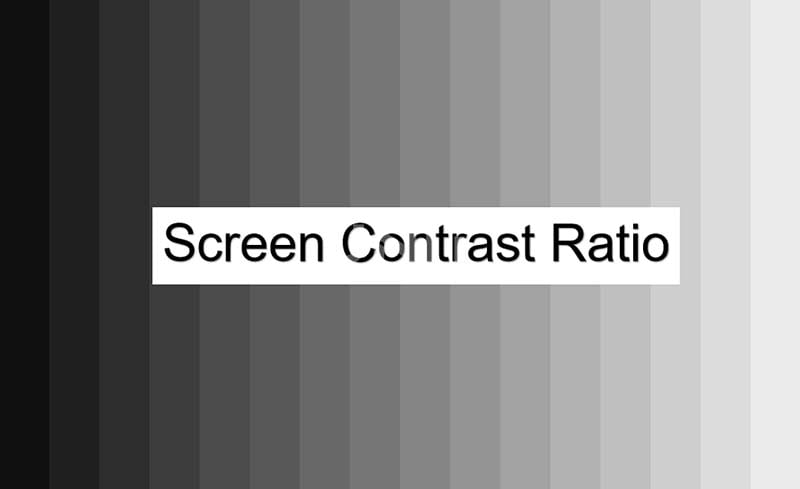
For example, an LED display with a high contrast ratio will display deep, true blacks and bright whites, resulting in a more vivid and lifelike picture.
On the other hand, a lower contrast ratio can make the image look washed out or less sharp.
1.2 How Is It Expressed?
Screen contrast ratio is usually expressed as a ratio, such as 1000:1 or 3000:1. This number indicates how many times brighter the brightest white is than the darkest black.
1000:1 means that the brightest white is 1000 times brighter than the darkest black the display can produce.
3000:1 means that the difference between white and black is more obvious, with white being 3000 times brighter than black.
The higher the display contrast ratio, the more vivid and detailed the image. However, the actual viewing experience may depend on other factors, such as screen technology and ambient lighting.
1.3 LED Display Contrast Ratio vs LED-Backlit LCD Contrast Ratio
For LED display buyers, it is important to understand that a direct-view LED display is different from an LED-backlit LCD screen. A direct-view LED display creates images with LED pixels themselves, while an LED-backlit LCD still depends on an LCD panel and a backlight system.
This difference matters because contrast performance is not only about the black and white numbers on a specification sheet. It is also affected by how the screen emits light, how much light is reflected by the surface, and whether the display can keep dark areas from looking gray in real installation environments.
| Display Type | How It Produces Light | Contrast Performance | Common Use |
|---|---|---|---|
| Direct-view LED display | Each LED pixel emits light directly | High brightness and strong perceived contrast, especially with black SMD or COB technology | Commercial LED walls, stages, outdoor screens, control rooms |
| LED-backlit LCD | LEDs are used as a backlight behind an LCD panel | Black levels are limited by backlight leakage | TVs, office monitors, meeting room displays |
| OLED | Each pixel emits light and can turn off independently | Excellent black level and very high perceived contrast | Premium TVs, cinema displays, consumer screens |
2. How Does Contrast Ratio Affect Display Quality?
When evaluating display performance, one of the most critical factors is the screen contrast ratio. It determines how well a screen can distinguish between the brightest whites and the darkest blacks, directly influencing image clarity, depth, and overall viewing comfort.
2.1 Visual Impact on Clarity and Detail
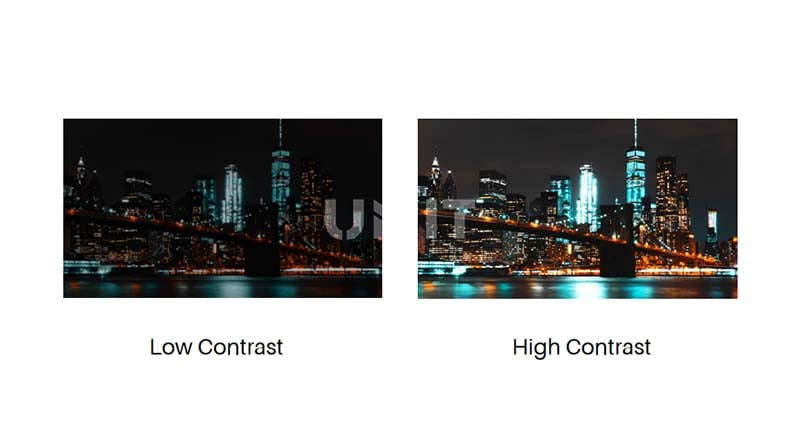
A higher display contrast ratio improves image clarity and detail, especially in dark scenes.
A screen with a high contrast ratio can display deep blacks and bright whites, making details in shadows or highlights more distinct. This is especially important in content such as movies or video games, where dark areas must be sharp without losing detail.
A display with a lower contrast ratio may have difficulty displaying fine details in shadows, making the image appear blurry or too dark.
On the other hand, a display with a higher screen contrast ratio will display more texture and depth in these areas, improving the overall viewing experience.
2.2 Color Accuracy and Richness
Contrast also affects the vividness and accuracy of colors. Accurate color representation is essential for visual appeal.
A higher contrast ratio allows for more variation between light and dark tones. The colors appear richer and more realistic.
For example, bright reds, blues, and greens will appear more vivid and lifelike on a display with a higher contrast ratio.
2.3 Viewing Experience in Different Environments
In a well-lit room, a display with a higher contrast ratio will still maintain its visual quality. You can see details in both bright and dark areas.
Conversely, a display with lower contrast may struggle to maintain detail and clarity in bright environments.
When used in a dimly lit room, high screen contrast ensures that blacks appear truly black. This enhances the sense of depth and realism of the image.
3. Types of Contrast Ratios
Not all contrast ratios are measured the same way, and understanding their differences is essential when comparing display specifications. From static to dynamic contrast ratios, each type represents a unique method of evaluating brightness and darkness levels, which can significantly impact how LED display perceive image quality.
3.1 Static Contrast Ratio
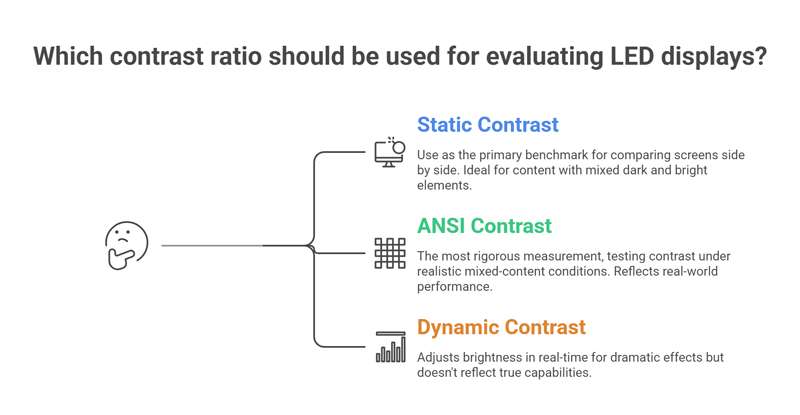
The static contrast ratio (also called native contrast ratio) is the difference between the brightest white and the darkest black that a monitor can display without any adjustments. It is the most reliable number for comparing LED display quality. It is a stable, unchanging value that reflects the true image quality of the screen.
For example, a 1000:1 static contrast ratio means that the brightest white is 1000 times brighter than the darkest black. The higher the number, the better the monitor handles dark and light areas. Sharper details and more vivid colors will show. This type of contrast is ideal for activities where clarity is important, such as watching a movie or editing photos.
How It Is Measured:
Set the display to its default or calibrated picture mode with no dynamic adjustments active.
Display a split-screen test pattern: one half is a full white field (100% luminance), the other half is a full black field (0% luminance).
Use a calibrated luminance meter (e.g., a colorimeter or spectrophotometer) to measure the brightness of the white region (Lwhite) in candela per square metre (cd/m²).
Without changing any settings, measure the brightness of the black region (Lblack) in cd/m².
Calculate: Native Contrast Ratio = Lwhite ÷ Lblack. If Lwhite = 800 cd/m² and Lblack = 0.16 cd/m², the native contrast ratio is 5,000:1.
When to Use It:
Use native contrast as your primary benchmark when comparing screens side by side.
It is the most meaningful metric for content that mixes dark and bright elements simultaneously, such as subtitles over a dark scene, white text on a black background, or high-contrast photography.
Indoor LED displays, conference room screens, and cinema LED walls should all be evaluated primarily on native contrast.
Typical native contrast ranges for LED displays: 1,000:1 to 3,000:1 for standard SMD panels; 3,000:1 to 10,000:1 for premium indoor SMD screens; 5,000:1 to 25,000:1+ for COB LED displays.
3.2 ANSI Contrast Ratio
ANSI contrast, short for American National Standards Institute contrast, is the most rigorous and industry-respected measurement. Instead of using a split-screen with two separate zones, it uses a 16-block checkerboard pattern, with 8 white squares and 8 black squares alternating across the display simultaneously. This tests contrast under realistic mixed-content conditions.
How It Is Measured:
Display the standardised ANSI checkerboard test pattern: 4 columns × 4 rows of alternating black and white squares.
Measure luminance at the center of each of the 8 white squares and record the average (Lwhite_avg).
Measure luminance at the center of each of the 8 black squares and record the average (Lblack_avg).
Calculate: ANSI Contrast = Lwhite_avg ÷ Lblack_avg.
Conduct the measurement in a darkened room to eliminate ambient light contamination.
Why ANSI Contrast Is often Lower than Static Contrast
When white squares are displayed on screen, the light they emit scatters across the panel surface. This is called optical crosstalk or light leakage.
This scattered light lands on the adjacent black squares, raising their luminance measurement and reducing the measured contrast ratio. ANSI contrast, therefore, reflects the real-world performance of the display surface, including its anti-reflection properties and the quality of its black mask.
On a well-engineered LED display, static contrast might be 5,000:1 while ANSI contrast is 3,000:1. On a lower-quality panel with poor light isolation, static contrast might be 4,000:1, but ANSI drops to only 800:1.
3.3 Dynamic Contrast Ratio
Dynamic contrast ratio compares the brightest white the display can produce on one frame to the darkest black it can produce on a different frame.
Dynamic contrast ratio adjusts based on the content on the screen. It changes the brightness and darkness in real-time, making bright scenes brighter and dark scenes darker. For example, in a bright scene, the monitor might increase the brightness. Whereas in a dark scene, it dims the lights to show a deeper black.
While this makes the picture look more dramatic, it does not truly reflect the capabilities of the monitor.
In short, the static contrast ratio shows the true performance of the monitor. Whereas dynamic contrast ratio adds a little extra effect by adjusting the brightness as needed. Both have their uses, but static contrast is more reliable for consistent quality.
How It Is Measured:
Display a full white screen (100% brightness) and measure peak luminance.
Display a full black screen and dim the backlight or driving current to its absolute minimum. Measure the darkest achievable black luminance.
Calculate: Dynamic Contrast = Peak White Luminance ÷ Minimum Black Luminance (different frames).
3.4 Ambient Contrast Ratio (ACR)
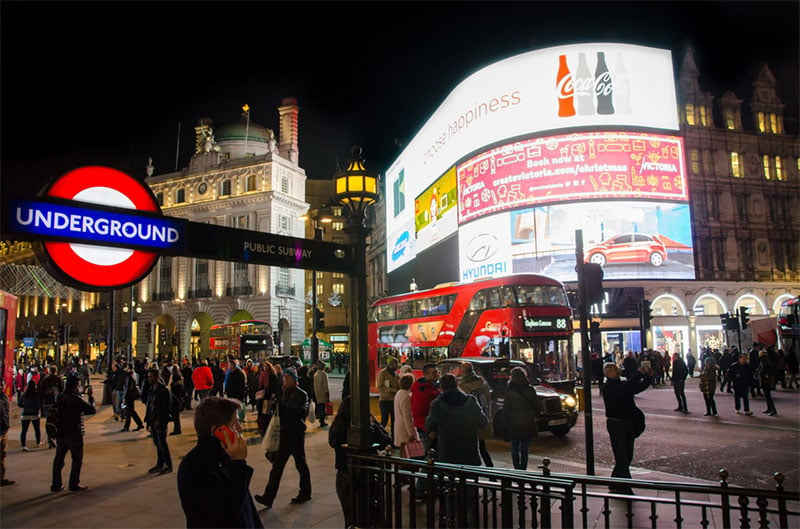
Ambient Contrast Ratio (ACR) describes how well a display preserves visible contrast in a real installation environment with surrounding light. This is especially important for outdoor LED billboards, window-facing displays, and commercial screens installed in bright public spaces.
Even if two LED displays have the same native contrast ratio, they may look very different in practice. That is because reflected sunlight, room lighting, and surface reflectance can raise the apparent black level and make the image look flatter.
In other words, a higher native contrast specification does not always guarantee better real-world contrast. For outdoor projects, buyers should evaluate brightness, anti-reflection performance, and ambient contrast together.
As a practical rule, native contrast tells you how the panel performs under controlled conditions, while ACR tells you how the screen is likely to look in the real world.
4. Factors That Influence Contrast Ratio
As mentioned above, the display screen contrast ratio has a significant impact on the displayed image, so how can we get the best contrast?
Next, we need to understand what factors affect the screen contrast ratio.
4.1 Display Technology
Different display technologies affect the contrast ratio in different ways. For example:
OLED display: It has excellent contrast. OLED screens can completely turn off individual pixels, resulting in true black.
Conversely, LCDs have lower contrast. Because LCD screens use backlights, black may look more like dark gray.
As can be seen, the type of screen technology has a huge impact on the depth or richness of black and white.
4.2 Brightness Level
Higher LED screen brightness can make whites look brighter. But if the screen can’t produce deep blacks, the screen contrast ratio will still be affected.
Similarly, if the screen is too dim, even if the blacks are deep, the contrast may be harder to notice.
The best monitors balance high brightness and deep blacks to get the best contrast.
https://youtu.be/DlP8AwwAJZU
LED Display Brightness Test
4.3 Ambient Light
The environment in which you view the screen can also affect your perception of contrast.
In a bright room, a display with a higher contrast ratio will still look sharp. A display with a lower contrast ratio may have difficulty showing clear details in light and dark areas.
In a dark room, high screen contrast ratio can better bring out details in shadows. Therefore, viewers can get a better viewing experience.
4.4 Screen Calibration
Calibration can improve the accuracy of contrast. Sometimes, the factory settings make the monitor look too bright or too dark, affecting the display of black and white.
Proper screen calibration ensures that both dark and light areas of the image are balanced for more accurate contrast.
In summary, contrast is affected by the type of monitor, brightness setting, ambient lighting, and screen calibration. Each factor determines the vividness and details of the image.
4.5 Contrast Ratio vs Brightness vs HDR
These three terms are often discussed together, but they do not mean the same thing. Contrast ratio describes the difference between the brightest white and the darkest black. Brightness determines how well the screen stays visible in bright environments. HDR improves how highlights, shadows, and colors are reproduced across a wider dynamic range.
In simple terms, brightness helps a display stay visible, contrast ratio improves depth and black-level performance, and HDR helps content look more realistic and detailed.
- Brightness: Best for improving daytime visibility and combating strong ambient light.
- Contrast Ratio: Best for deeper blacks, clearer shadow detail, and a more immersive picture.
- HDR: Best for richer highlight detail, smoother tonal transitions, and more lifelike image reproduction.
If you are evaluating an LED display for a real project, these three factors should be considered together rather than in isolation. You can also read our guide to LED screen brightness to understand how brightness affects viewing performance in different environments.
5. Contrast Ratio of Different Display Technologies
5.1 LED Screen Contrast Ratio
LED screens, especially those using LED backlights, have good contrast ratios. But they are somewhat limited compared to OLED.
The contrast ratio of LED display screen depends on several factors, such as the type of backlight used and the screen’s ability to control light in darker areas.
Typically, LED screens have contrast ratios ranging from 1000:1 to 5000:1. But true blacks aren’t as deep as OLED, because LED screens rely on a backlight that can’t be turned off at the pixel level.
However, high-end full-array local dimming (FALD) LED screens can achieve better contrast ratios. This is because it can dim or turn off parts of the backlight in dark scenes.
5.2 LCD Screen Contrast
LCD screens generally have lower contrast ratios compared to OLED and LED, primarily because they use a constant backlight.
As a result, blacks often look more like dark gray, which limits contrast ratios.
Most standard LCD screens have contrast ratios of around 800:1 to 1500:1.
However, advances in IPS (In-Plane Switching) technology have improved contrast and color accuracy, making them better suited for professional tasks.
Even so, contrast is still not as good as OLED displays.
5.3 OLED Screen Contrast
OLED (Organic Light Emitting Diode) screens offer the best contrast among modern display technologies.
Unlike LED or LCD, OLED screens do not rely on a backlight.
Instead, each pixel generates its light, which allows individual pixels to be turned off completely. This results in true blacks and noticeably higher contrast.
The contrast of OLED screens can be infinite, as there is no backlight to interfere with true black levels.
This makes OLEDs ideal for high-quality movie viewing, gaming, and any occasion where deep blacks and vibrant colors are required.
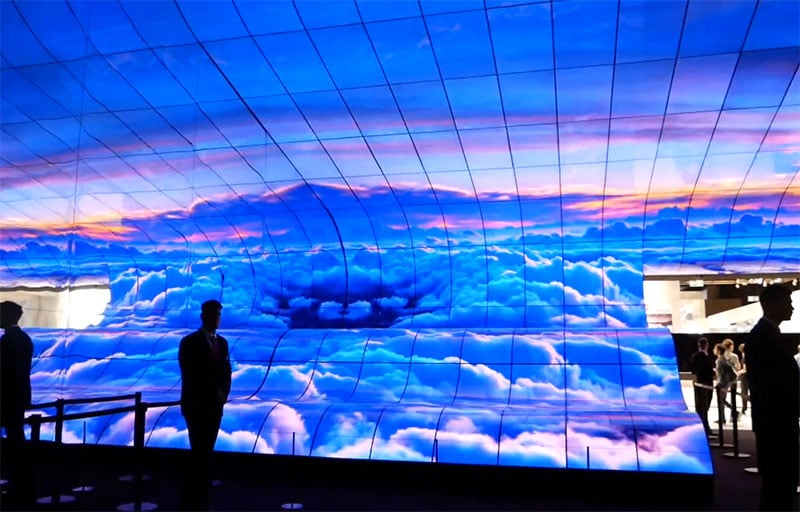
OLED Video Wall
6. Recommended LED Display Contrast Ratio by Application
There is no single best contrast ratio for all LED display applications. The optimal figure depends on ambient light levels, viewing distance, content type, and the use case’s tolerance for image quality trade-offs.
The recommended contrast ratio by application table below, only for reference:
| Application | Ambient Light | Minimum Contrast | Recommended Contrast | Ideal Contrast | Recommended Technology | Key Priority |
| Indoor Advertising / Retail Signage | Medium (200–500 lux) | 1,500:1 | 3,000:1 – 5,000:1 | 8,000:1+ | Black-body SMD or COB | Brand colour accuracy |
| Conference Room / Meeting Room | Medium–High (300–800 lux) | 1,000:1 | 2,000:1 – 4,000:1 | 5,000:1+ | SMD fine-pitch P1.2–P2.5 | Wide viewing angle |
| Control Room / Command Centre | Low–Medium (50–300 lux) | 2,000:1 | 5,000:1 – 10,000:1 | 15,000:1+ | COB fine-pitch P0.9–P1.5 | Detail in low light |
| Cinema LED / Home Theater | Very Low (< 50 lux) | 3,000:1 | 8,000:1 – 15,000:1 | 20,000:1+ | COB or Mini LED with FALD | Deep blacks in dark room |
| Live Events / Concert Stage | Variable (stage lighting) | 1,200:1 | 2,000:1 – 3,500:1 | 5,000:1+ | Rental SMD, black-body | High brightness & fast refresh |
| Outdoor Advertising Billboard | Very High (10,000–100,000 lux) | 1,500:1 | 2,500:1 – 4,000:1 | 5,000:1+ | Outdoor SMD P4–P10 | Brightness over contrast |
| Sports Venue (Stadium Scoreboard) | High (daylight or bright arena) | 1,200:1 | 2,000:1 – 3,000:1 | 4,000:1+ | Outdoor SMD P6–P16 | Fast motion rendering |
| Virtual Production (XR / LED Volume) | Controlled (studio) | 3,000:1 | 8,000:1 – 15,000:1 | 20,000:1+ | COB fine-pitch P0.9–P1.8 | Camera-accurate reproduction |
| Church / Worship Space | Low–Medium (100–400 lux) | 1,500:1 | 3,000:1 – 6,000:1 | 8,000:1+ | SMD P2–P3 or COB | Legibility & colour warmth |
Note: Recommended contrast values refer to static contrast ratio measured under controlled conditions. Always request a demo in your actual installation environment, as ambient light has a greater effect on perceived contrast than the panel specification alone.
For outdoor applications, the ambient contrast ratio (ACR), which accounts for reflected sunlight on the screen surface, is often more meaningful than native contrast. ACR is calculated as: ACR = (Panel Luminance + Ambient Reflected Luminance) ÷ Ambient Reflected Luminance.
7. How To Choose The Right Contrast Ratio For Your LED Display Project
The right contrast ratio is not always the highest one. In commercial LED display projects, the better choice depends on where the screen will be installed, what content it will show, and how demanding the viewing conditions are.
7.1 Indoor Retail And Advertising
For indoor retail, showroom, and advertising displays, a contrast ratio around 3,000:1 to 5,000:1 is usually a strong target. This range helps products, brand colors, and promotional videos look more vivid without pushing the budget too far.
7.2 Conference Rooms And Meeting Spaces
In meeting rooms, clear text, charts, and presentation backgrounds matter more than extremely deep blacks. In many cases, 2,000:1 to 4,000:1 is already practical, especially when the screen also has suitable brightness and a wide viewing angle.
7.3 Control Rooms And High-End Fine-Pitch Projects
Control rooms, studios, and premium fine-pitch installations benefit from a higher native contrast ratio because operators need to distinguish more shadow detail and subtle grayscale transitions. In these applications, 5,000:1 and above is often worth pursuing.
7.4 Simple Buying Rule
- If you mainly show text, slides, and business content, moderate contrast is often enough.
- If you mainly show brand videos, premium visuals, or dark scenes, higher contrast becomes more valuable.
- If the screen will be used in bright ambient light, check brightness and reflectance, not contrast ratio alone.
- If the project is fine-pitch, cinema-grade, or camera-facing, native contrast deserves much more attention.
8. Contrast Ratio Vs Brightness Vs HDR: What Matters Most?
These three display specifications are related, but they solve different problems. Many buyers compare them together when choosing an LED display, yet they should not be treated as interchangeable.
| Metric | What It Tells You | Why It Matters | Most Important For |
|---|---|---|---|
| Contrast Ratio | The gap between the brightest white and the darkest black | Improves depth, shadow detail, and black-level performance | Indoor premium displays, cinema, control rooms, dark-scene content |
| Brightness | How visible the screen stays in strong ambient light | Improves readability in daylight or bright rooms | Outdoor billboards, stadium screens, window-facing displays |
| HDR | How well highlights, shadows, and tonal range are reproduced | Makes content look more realistic and layered | High-end video playback, premium visual presentation |
9. 3000:1 vs 4000:1 vs 5000:1 LED Screen Contrast Ratio
When you are shopping for an LED display screen, you may see different contrast ratios: 3000:1, 4000:1, and 5000:1.
Let’s break down what these ratios mean from a practical perspective.
9.1 3000:1 Contrast Ratio
A 3000:1 contrast ratio is pretty good for most general purposes. It provides sharp details in both bright and dark scenes.
However, the image may appear slightly gray in dark scenes, especially in a brightly lit room.
This ratio is usually found in mid-range LED screens.
9.2 4000:1 Contrast Ratio
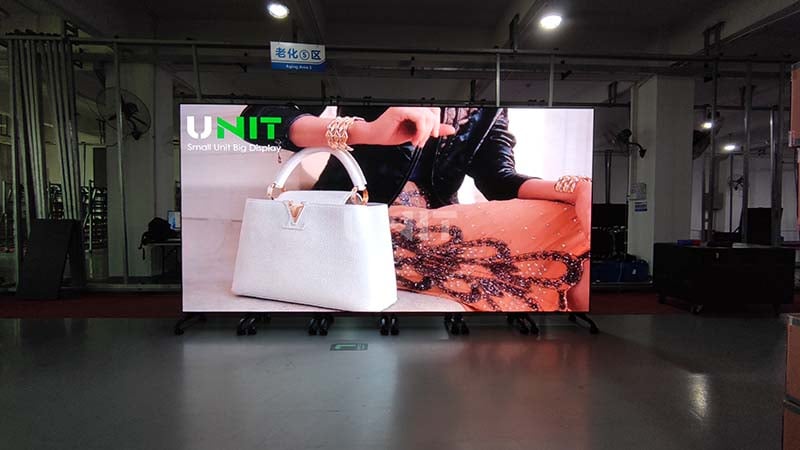

4000:1 high contrast LC60S LED Poster Display
A 4000:1 contrast ratio is a significant improvement over 3000:1.
With this ratio, blacks appear darker, and details in shadows are clearer, especially in movies or games with higher contrast.
It is better suited to handling dimly lit scenes and provides a more immersive viewing experience.
A 4000:1 contrast ratio will give you sharper contrast and more lifelike images.
The difference between bright whites and deep blacks will be more noticeable, giving images a more realistic depth.
https://youtu.be/3GFyZ4gtsV0
9.3 5000:1 contrast ratio
A 5000:1 contrast ratio is excellent and is often found in high-end LED displays.
At this level, blacks appear deep and true, making dark scenes look rich and full of detail. Bright whites are very clear and vivid, giving the entire image more clarity and depth.
This contrast ratio is ideal for areas such as professional work, gaming, or home theater where image quality is critical.
The visual difference between 4000:1 and 5000:1 is often subtle, especially for the average user.
9.4 Which One Should You Choose?
3000:1 is great for everyday use and casual viewing.
4000:1 offers better contrast for a richer, more immersive experience, especially in medium lighting conditions.
5000:1 offers top-tier contrast and is best suited for high-end viewing experiences. Deep blacks and vivid whites are critical, such as home theater or professional content creation.
In darker environments and with high-contrast content, such as movies or games with dark scenes, the contrast difference becomes more noticeable.
But for typical uses, 3000:1 and 4000:1 ratios will still provide good results.
10. How to Improve LED Display Contrast Ratio?
Improving the contrast ratio of LED displays can significantly improve image quality, resulting in sharper visuals, more vivid colors, and deeper blacks.
The following initiatives may inspire:
10.1 Use Higher-quality LED Modules
Invest in LED modules with advanced technologies, such as smaller pixel pitch and high dynamic range (HDR).
These features improve the display’s ability to display deeper blacks and brighter whites, thereby improving contrast.
10.2 Optimize Brightness Settings
Adjusting the brightness can enhance perceived contrast. Make sure the brightness is balanced – high enough to achieve vivid whites, but not so high that dark areas are washed out.
Automatic brightness adjustment can help optimize performance based on ambient light.
10.3 Improve Black Levels
Reducing light leakage in LED screens is key to achieving deeper blacks.
Use technologies such as full-array local dimming or advanced coatings on LED modules to minimize unwanted light.
10.4 Enhance Calibration
Properly calibrating an LED screen can optimize its contrast ratio.
Adjust gamma, brightness, and color levels to achieve the best balance between light and dark areas.
Professional calibration tools or software can ensure accurate settings.
10.5 Add Anti-reflective Coating
Ambient light reflections reduce perceived contrast, especially in bright environments.
Using anti-reflective coatings on the screen surface reduces glare and improves visibility, making contrast clearer.
10.6 Choose Advanced Processing Technology
Modern LED screens with HDR or dynamic contrast enhancement use advanced image processing to improve contrast.
These technologies optimize brightness and black levels in real-time, creating more vivid visuals.
10.7 How to Verify Contrast Ratio Before Buying
When suppliers claim a high contrast ratio, always ask how the value was measured. A single number without test conditions can be misleading, especially when comparing products from different manufacturers.
- Ask whether the figure is static, ANSI, or dynamic contrast ratio.
- Ask under what ambient light conditions the test was performed.
- Ask what brightness setting was used during the measurement.
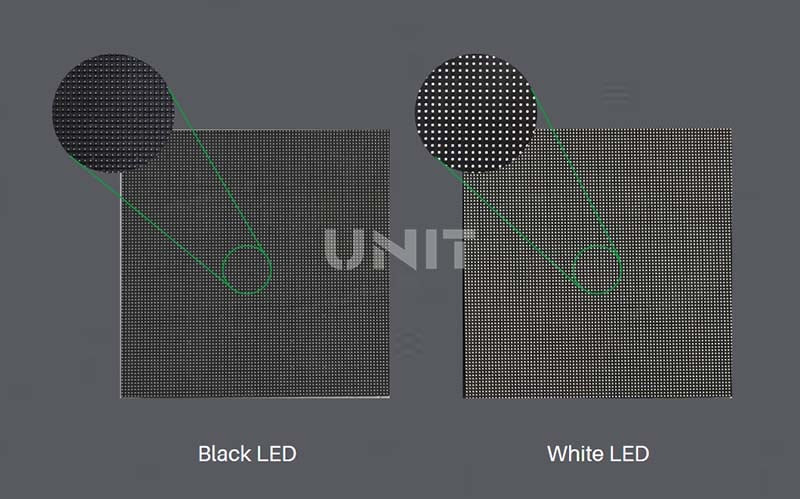
- Ask whether the panel uses white-body SMD, black-body SMD, or COB packaging.
- Ask for a real demo, checkerboard test, or on-site video in a similar installation environment.
For practical project evaluation, a believable and repeatable test setup is usually more valuable than an aggressive contrast figure in a specification sheet.
11. COB vs SMD LED Contrast Ratio Comparison
The packaging technology used to mount and protect LED chips is one of the most decisive factors in contrast ratio performance. COB (Chip-on-Board) and SMD (Surface-Mounted Device) represent two fundamentally different approaches to LED encapsulation, and their optical consequences are significant.
11.1 SMD LED Structure
In an SMD LED, individual red, green, and blue chips are packaged inside a discrete lamp component – a small housing with a white or off-white reflective cup that surrounds the chips and focuses their light forward.
These pre-packaged lamp beads are then soldered to a PCB substrate. The substrate surface between lamps is often a white-coloured solder mask.
11.2 COB LED Structure
In COB packaging, the LED chips are mounted directly onto the PCB without a pre-formed lamp housing. The chips are then encapsulated under a single continuous layer of black epoxy that covers the entire module surface.
Continue learning more differences between SMD vs COB LED.
11.3 Contrast Ratio Performance Gap
| Attribute | White-Body SMD | Black-Body SMD | COB |
| Surface Material | White/silver reflective cups + white PCB | Black lamp cups + black PCB substrate | Full-coverage black epoxy encapsulant |
| Ambient Light Reflection | High — 15–25% reflectance | Medium — 6–12% reflectance | Low — 2–5% reflectance |
| Typical Native Contrast (dark room) | 800:1 – 2,000:1 | 1,500:1 – 5,000:1 | 5,000:1 – 25,000:1 |
| Perceived Contrast Under 500 lux Ambient | Low — blacks appear gray | Medium — blacks appear dark gray | High — blacks appear genuinely black |
| Pixel Pitch Range (Common) | P1.5 – P10 and above | P1.2 – P6 | P0.7 – P2.5 |
| Physical Durability (Impact Resistance) | Lower — exposed lamp cups can fracture | Similar to white SMD | High — chips protected under epoxy |
| Viewing Angle | 140° – 160° | 140° – 160° | 160° – 180° |
| Relative Cost (same pixel pitch) | Lowest | Low–Medium (+10–20%) | Higher (+25–50%) |
| Recommended Applications | Outdoor billboards, budget rental | Indoor advertising, retail, events | Cinema, control rooms, VR/XR, fine-pitch indoor |
12. FAQs
1. What is a good contrast ratio for a screen?
For general use, a contrast ratio of at least 1000:1 is acceptable. High-end displays, like OLED screens, can achieve ratios above 1,000,000:1, delivering exceptional image quality.
2. What is the difference between static and dynamic contrast ratio?
Static contrast ratio measures the difference between white and black at the same time. Dynamic contrast ratio measures brightness levels over time by adjusting the backlight. Static contrast is considered more reliable for real-world performance.
3. Is higher contrast ratio always better?
Generally yes, but numbers can be misleading. Some manufacturers exaggerate dynamic contrast values. It’s best to look for real-world reviews or check static contrast ratios.
4. How does contrast ratio affect eye comfort?
A good contrast ratio reduces eye strain by providing clearer visuals and better text readability. Low contrast ratios make images look washed out and harder to view for long periods.
5. LCD vs. LED: which has better contrast ratio?
LED displays, especially OLED and Mini-LED, typically offer higher contrast ratios compared to standard LCDs, thanks to better control over brightness and darker black levels.
6. How does HDR relate to contrast ratio?
HDR (High Dynamic Range) enhances contrast by displaying a wider range of brightness and color, improving the viewing experience in both dark and bright scenes.
7. Why can two LED screens with the same contrast ratio look different?
Because the published number does not tell the whole story. Real-world image performance also depends on brightness, surface reflectance, black-level control, packaging technology, calibration, and ambient light. Two screens with the same claimed contrast ratio may still look very different after installation.
8. For outdoor LED displays, which matters more: brightness or contrast ratio?
In most outdoor applications, brightness usually comes first because the screen must remain readable under strong daylight. After that, contrast ratio and anti-reflection performance help improve image depth and black-level visibility. The best outdoor result comes from balancing all three factors together.
9. Is 3000:1 contrast ratio good for an LED display?
Yes, 3000:1 is good for many general indoor LED display applications. It is often enough for retail, presentations, and standard commercial video use. However, for premium fine-pitch displays, dark-scene content, or high-end control room applications, a higher contrast ratio may deliver a more refined result.
10. What is more important for outdoor LED displays: brightness or contrast ratio?
For outdoor LED displays, brightness usually comes first because the screen must remain visible in direct sunlight or strong ambient light. After that, contrast ratio, anti-reflection performance, and screen surface quality help improve image depth and readability.
11. Does COB LED have better contrast ratio than SMD LED?
In many indoor fine-pitch applications, COB LED can deliver better contrast because its black surface helps reduce reflected light and improve black-level performance. That said, final results still depend on module design, calibration, brightness settings, and the real installation environment.
11. Conclusion
Now that you’re a contrast expert, you can see why this little number holds so much power in the world of display technology.
We shared practical tips for boosting performance. They’re also what you should consider when picking a screen.
The next time you’re mesmerized by a stunning display, take a moment to appreciate all the important roles screen contrast ratio plays. After all, it’s what makes a good screen truly spectacular!
Related Posts
wp:paragraph
/wp:paragraph