The Comprehensive Guide to LED Screen Components
LED screen components are essential parts of LED display devices. From smartphones to large outdoor billboards, LED displays are everywhere.
They provide sharp images, vibrant colors, and energy efficiency, which is why they are so popular in various applications.
In this article, we will break down the key components of an LED screen, helping you understand how they work and why they are so effective.
Table of Contents
What is an LED Screen?
An LED screen is a type of flat panel display that uses Light Emitting Diodes (LEDs) to create images and videos.
LED screens rely on tiny diodes to emit light, which creates bright and clear visuals.
These diodes are arranged in a grid. When powered on, they light up to produce different colors and shades.
The main benefit of LED screens is their ability to produce high-quality images with low power consumption.
They are also thinner, lighter, and more durable than older display technologies.
In short, LED screens are not just efficient; they are versatile and can be used in a wide range of environments.
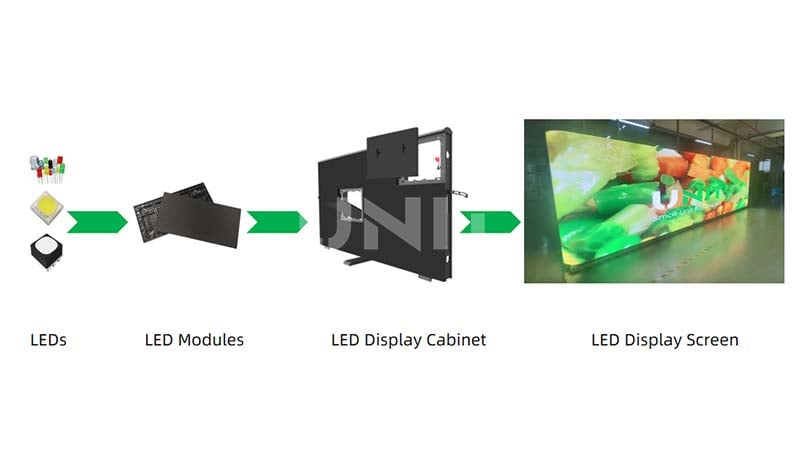
In the following sections, we will explore the individual LED display components. Then, you will understand what makes these displays so effective.
LED Display Modules Components
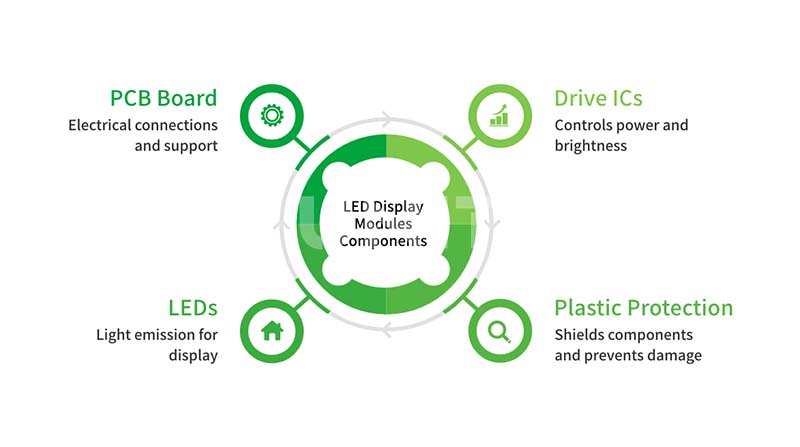
LED screen modules are the building blocks of LED screens.
Each module is made up of several essential components that work together to create high-quality visuals.
Here are the key components of an LED module:
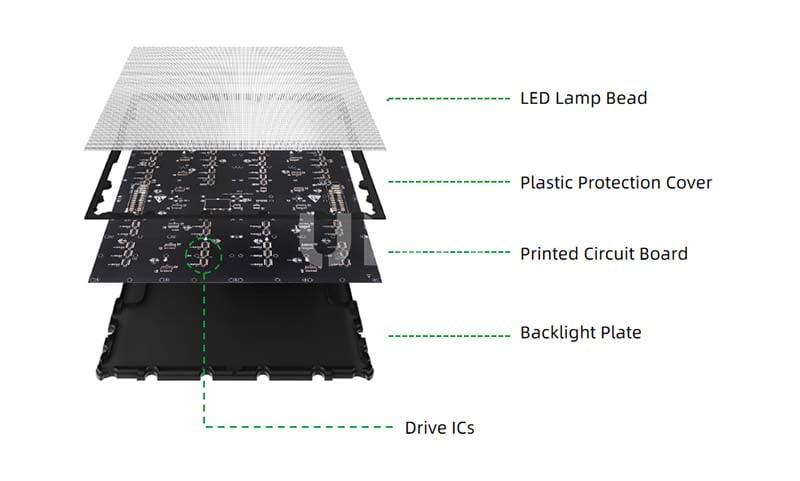
PCB (Printed Circuit Board)
The PCB serves as the foundation for an LED display module.
It provides the necessary electrical connections between all the components, allowing them to function as a cohesive unit.
The PCB is typically made of a durable material like fiberglass or aluminum, ensuring it can withstand the heat and stress generated during operation.
LEDs
LEDs (Light-Emitting Diodes) are the most crucial part of any LED module. They emit light when powered on.
LEDs are typically arranged in a grid on the PCB, representing a single pixel on the screen.
The color and brightness of the LED display screen depend on the LEDs used and how they are controlled.
RGB (Red, Green, Blue) LEDs produce full-color visuals for modular LED display panels.
The common LED lamp bead brands include NationStar, Kinglight, and HongSun. Common SMD LED lamp bead models:
SMD1010, SMD1515,SMD2121 (indoor )
SMD1415, SMD1921, SMD2525, and SMD3535 (outdoor)
Drive ICs (Integrated Circuits)
The Drive ICs are responsible for controlling the LEDs. These small chips regulate the power supplied to each LED lamp and ensure the correct colors and brightness are displayed.
They receive signals from the display’s main controller and translate them into the proper electrical output for each individual LED.
Common drive IC models: ICN2038S ,ICN2153, FM6124, FM2153, MBI5124, MBI5153, ICN2037
Plastic Protection Cover
The plastic protection cover helps prevent dust, moisture, and physical damage from affecting the module.
Additionally, it offers insulation and protects against electrical short circuits.
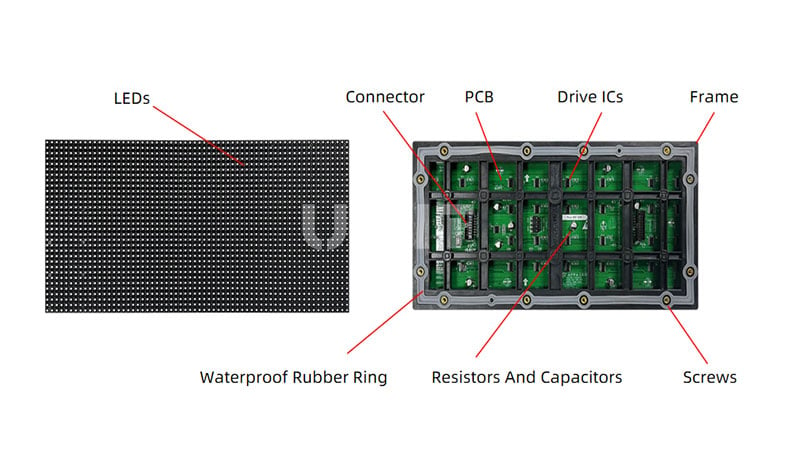
Each of these components plays a vital role in the performance of an LED screen.
Together, they make LED modules an efficient and reliable solution for modern displays.
LED Display Cabinet Components
LED Modules
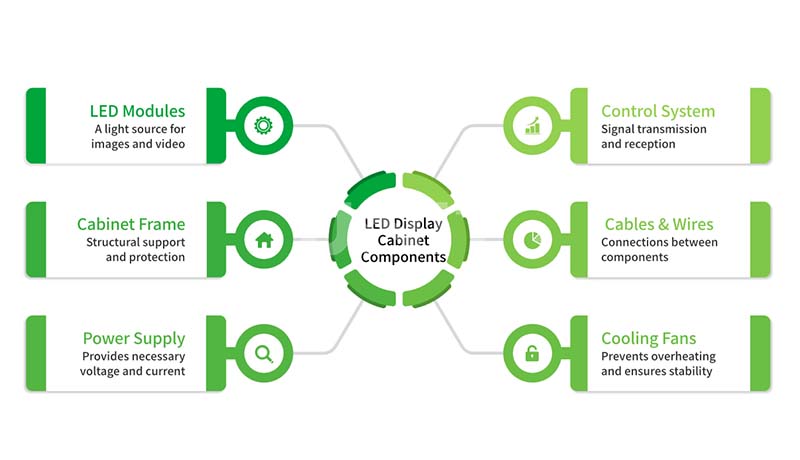
LED modules are the heart of the display. They contain the LEDs that produce light, forming the images and video on the screen.
These modules are typically arranged in grids and work together to create high-resolution visuals.
As key LED display components, they define the clarity and brightness of the display.
Cabinet Frame
The cabinet frame provides the structural foundation for all the components. It ensures stability and protection for the LED modules and other internal parts.
Made from durable materials, the frame keeps everything in place, maintaining the display’s integrity and reliability.
Power Supply
The power supply provides the necessary voltage and current for the entire LED system.
It distributes power to the LED modules and other components, ensuring smooth operation.
A reliable power supply is crucial for consistent performance and is one of the most important LED screen components.
Common LED display screen panel power supply brands include: MeanWell, Chuanglian Power Supply, Megmeet, G-energy, etc.
Control System
The control system includes sending and receiving cards.
The sending card transmits signals from the LED display controller board to the modules, while the receiving card processes and distributes these signals.
Together, they synchronize the display, ensuring accurate content presentation across all LED display components.
Cables
Cables are essential for connecting all components within the cabinet.
Power cables deliver electricity from the power supply to the modules.
Signal cables transmit data from the control system to the LED modules.
Flat cables connect the various components within the cabinet, such as the LED modules, power supply, and control cards.
These cables ensure that the components communicate effectively, enabling the proper functioning of the display.
Cooling Fans
Cooling fans prevent overheating by maintaining the ideal temperature inside the cabinet.
They ensure the LED display components stay cool, which is vital for long-term performance and preventing damage.
The fans help extend the lifespan of the LED modules and other sensitive parts.
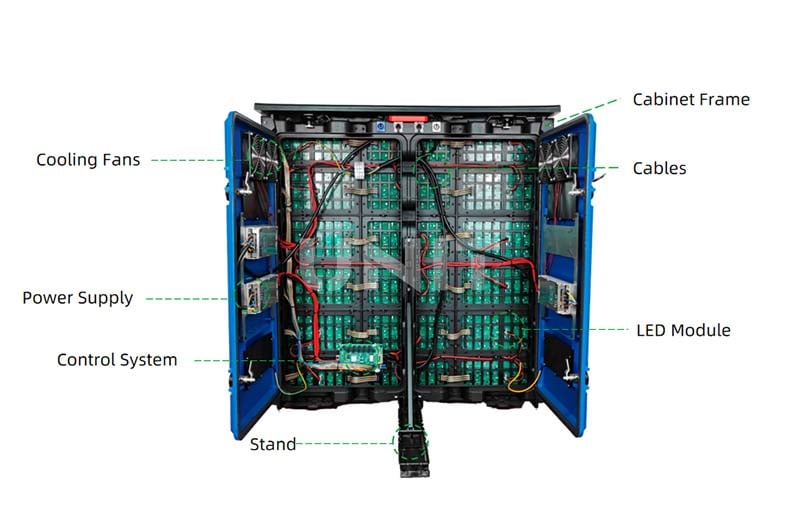
Each of these components plays a vital role in the performance and durability of an LED display.
They form a system that delivers bright, clear visuals with reliable, long-lasting operation.
Types of LED Display Screen Cabinet
LED display cabinets can be categorized based on various standards, depending on the application, size, installation method, and functionality.
Here are some common classification standards:
By Application Type
- Indoor LED Cabinets
Indoor LED screen cabinets have finer pixel pitches for high resolution. They are used in shopping mall LED displays, control rooms, and corporate offices.
- Outdoor LED Cabinets
These cabinets are built to withstand harsh weather conditions. They have higher brightness levels for better visibility in sunlight.
By Cabinet Material
- Aluminum LED Cabinets
Known for their lightweight and durable nature, aluminum LED screen cabinets are often used in high-end displays.
They offer efficient heat dissipation and are ideal for both indoor and outdoor applications.
- Steel LED Cabinets
Steel cabinets are heavier and more robust, providing additional protection in outdoor or rugged environments.
They offer high durability but may not be as efficient in heat management as aluminum cabinets.
- Magnesium Alloy LED Screen Cabinet
Magnesium alloy LED screen cabinets are lightweight and highly durable. So they are perfect for rental LED displays.
These cabinets offer enhanced structural strength while reducing the overall weight of the display.
- Iron LED Screen Cabinet
Iron LED screen cabinets offer excellent protection for the internal components with robust construction.
They are ideal for outdoor installations by providing strong resistance against harsh weather conditions.
LED Iron cabinets are slightly heavier but highly durable. It is a reliable choice for long-term use.
By Maintenance Methods
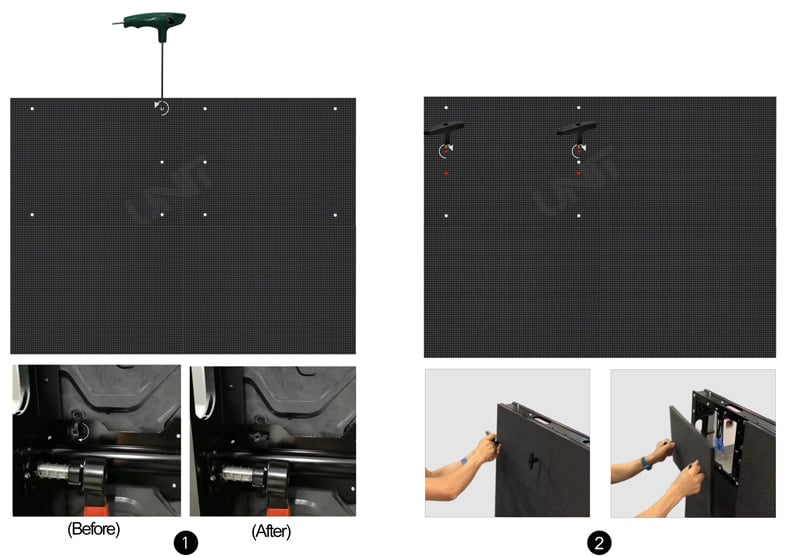
- Front Maintenance LED Cabinets
These cabinets are designed for easy access and maintenance from the front side.
Ideal for indoor installations where space constraints require front serviceability.
- Rear Maintenance Cabinets
Rear maintenance cabinets require access from the back for maintenance.
Rear-service LED displays are often used in larger installations where space and accessibility allow for rear servicing.
https://youtu.be/L06nqZL4eR0?si=Z3JTiigeUHCSdoJ8
By Size and Shape
- Standard Size LED Cabinets
These are the typical rectangular cabinets used in most LED displays.
Standardized dimensions help in modular setups for large-scale installations.
- Custom LED Cabinets
Some applications, especially in creative displays, require custom-shaped cabinets (curved, spherical, or irregular shapes) to create unique designs or fit specific spaces.
By Flexibility
- Fixed LED Cabinets
Fixed cabinets are designed for permanent installations, where the LED screen is not intended to be moved.
- Rental LED Cabinets
LED rental cabinets are designed for quick setup and easy transportation.
They are modular and typically used for events, exhibitions, and temporary installations.
https://youtu.be/0kShqC6qvi0
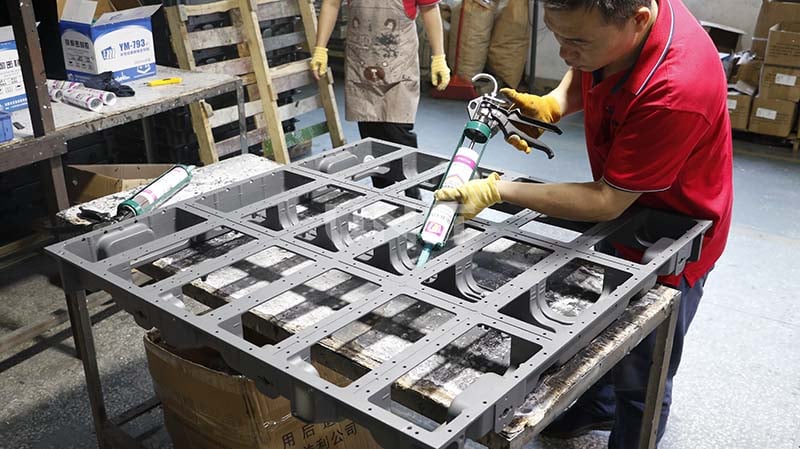
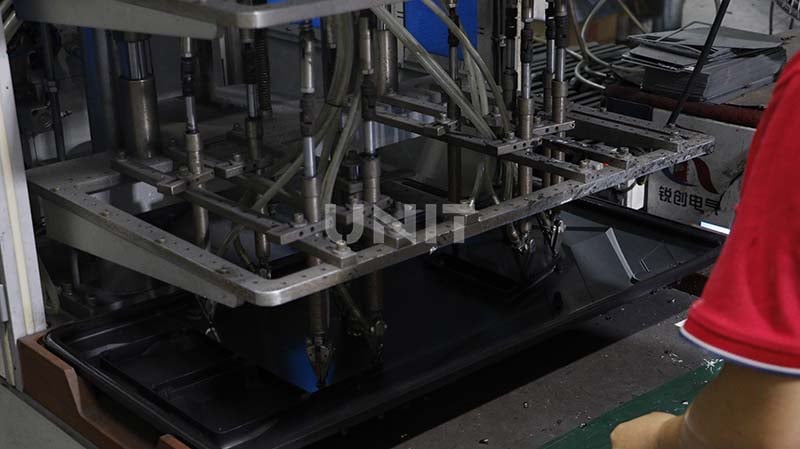
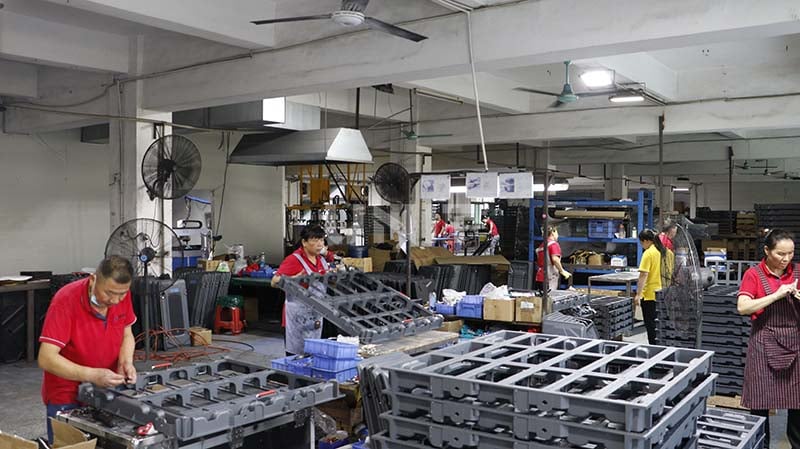
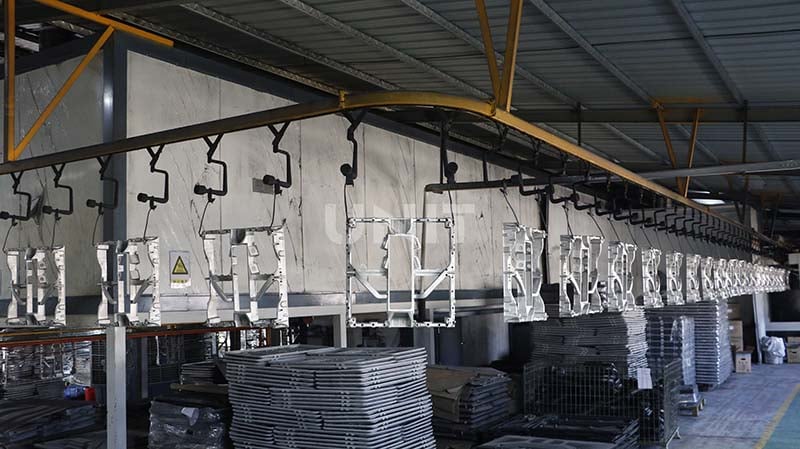
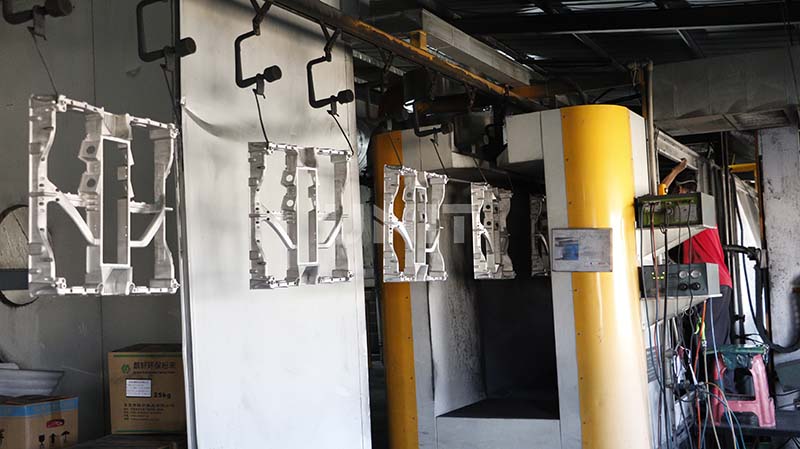
UNIT-LED-Cabinet-Factory
https://youtu.be/vy0GSFJUqT0?si=qiVSudzbzvha-kf2
Special LED Display Cabinet
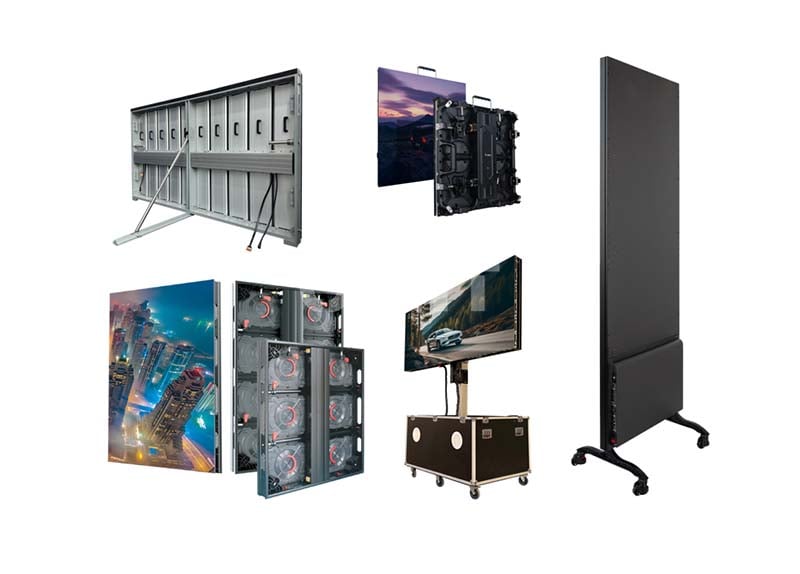
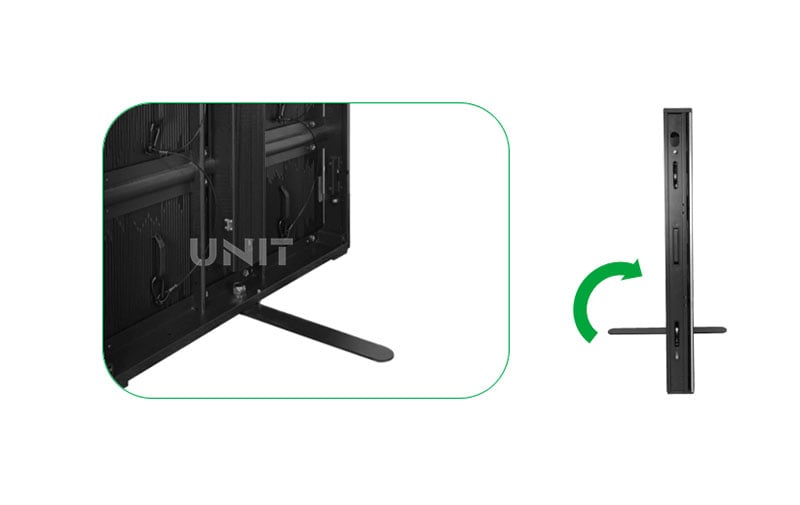
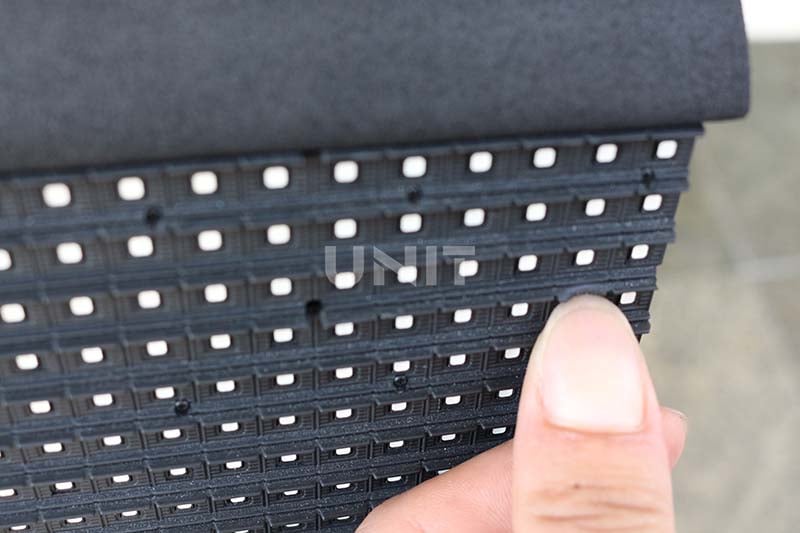
- Sports Perimeter LED Display
Unlike conventional LED cabinets, sports perimeter LED displays feature soft protective masks and reinforced cushioning to absorb impacts from balls or players.
The cabinets come with tilt-adjustable brackets, allowing the screen to be angled for optimal visibility to both stadium audiences and TV cameras.
Designed for outdoor stadium environments, these cabinets are fully waterproof, dustproof, and UV-resistant, ensuring reliable performance in rain, snow, or extreme heat.
- Transparent LED Display Cabinet
Transparent LED displays feature glass-like visibility, allowing light and background elements to pass through while still displaying crystal-clear visuals.
Thanks to a frameless or mesh design, these cabinets weigh far less than traditional LED cabinets, making them ideal for glass facades, storefronts, and stage applications.
LED transparent cabinets can be installed on glass windows without blocking natural light, enhancing aesthetics without compromising advertising impact.
https://www.youtube.com/watch?v=Ag0FBKV7RA4&source_ve_path=OTY3MTQ
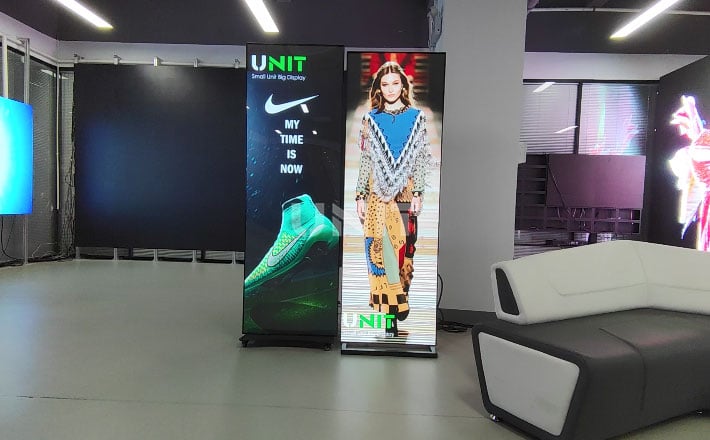
- Poster LED Display
Poster LED displays are integrated, self-contained units that can be powered on and used instantly.
With a sleek, lightweight design and built-in wheels, poster LED cabinets can be easily moved, making them perfect for retail stores, exhibitions, and events.
Most poster LED screens support Wi-Fi, USB, or cloud-based control, allowing users to update content remotely without complex setups.
Digital poster LED displays can be seamlessly connected to create larger video walls for dynamic presentations.
- Mobile LED Trailer
Mobile LED trailers are mounted on vehicles. They are perfect for outdoor advertising, political campaigns, and live event broadcasting.
Equipped with built-in generators or battery packs, these displays can function without external power sources.
Mobile LED billboards feature hydraulic lifts for height adjustments and 360-degree rotation for maximum audience reach.
- Simple LED Cabinet
The main features of the simple cabinet are: sealed on all sides, without a back door.
Advantages: lighter than sealed cabinets of the same specifications, easy to install and maintain, and good heat dissipation.
Disadvantages: The cabinet has no back door and cannot be installed alone for outdoor use. It must be equipped with auxiliary equipment (edge wrapping).
- Sealed LED Cabinet
The main features of the sealed LED cabinet are: sealed on all sides and with a back door.
There are air inlets and air outlets on the back door, and a stainless steel dustproof net in the air inlet, which can effectively prevent debris from entering the box and damaging the electronic components in the box.
Sealed boxes are divided into two types: indoor and outdoor.
The difference is:
(1) In addition to the waterproofing of the module surface, the outdoor cabinet has a waterproof eaves and a leaking hole in the box.
(2) The parts behind the outdoor cabinet must be waterproof and can be spray tested, but the indoor cabinet cannot.
https://youtu.be/Vc2v33tZhMg
Simple LED cabinets are all internal wiring, and sealed LED cabinets are divided into internal wiring and external wiring.
(1) Internal Wiring
The number of network cable entrances for the entire screen is the same as the number of sending cards.
The receiving card and power supply of the cabinet and the adjacent box are directly connected from the inside of the cabinet through wires (through the wire grooves on the side of the cabinet).
The advantage is that the signal and power transmission are stable during use, but there are requirements for the arrangement of the boxes when installing the screen.
(2) External Wiring
Each cabinet of the entire screen has a signal and power aviation head. The LED cabinets can be arranged arbitrarily when installing the screen, without considering the arrangement of the boxes.
Only exists in sealed boxes or rental LED cabinets. Due to the increase in parts, the price is relatively more expensive than internal wiring.
LED Display Screen Structure
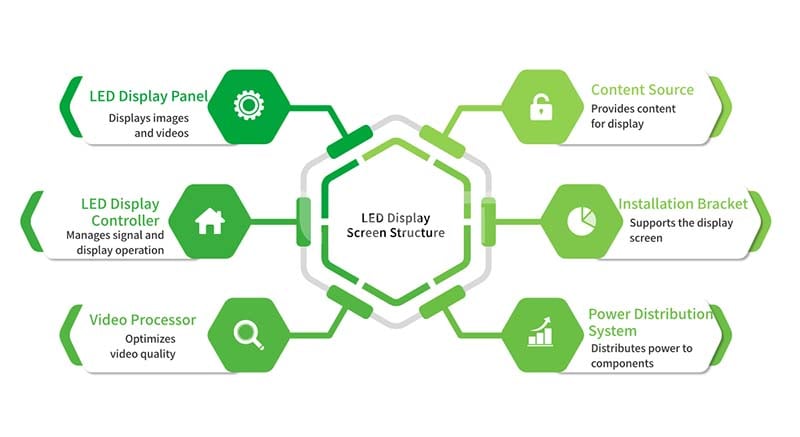
LED Display Panel
The LED display panel is the main visual component. It consists of LED modules that emit light to create images and videos.
As one of the primary LED display components, it plays a crucial role in visual performance.
LED Display Controller
The LED display controller manages the operation of the entire system. It processes the input signals from the content source and sends them to the LED display panel.
This controller ensures the smooth operation of all LED screen components.
Video Processor (Optional)
A video processor improves the visual quality by enhancing and optimizing the video signal.
It adjusts brightness, contrast, and color, ensuring the content looks sharp and vibrant.
While not always necessary, it can be valuable to high-end LED display screen components, especially for advanced video applications.
Content Source
The content source is the device that provides the material to be displayed. This could be a computer, media player, or any other system that outputs video or graphics.
The content source sends data to the LED display controller, which then transmits it to the LED display panel for viewing.
Installation Bracket
The installation bracket securely holds the LED display panel in place.
This component is crucial for proper setup and easy installation of the LED display components, especially for large or complex installations.
Power Distribution System
The power distribution system supplies power to all the components. It ensures each part receives the correct voltage and current.
Without a reliable power system, the LED display panel and other LED screen components would not function properly. It is essential for smooth operation and durability.
Assembly Process of LED Screens
The assembly process of LED screens involves a series of precise steps.
Individual components are carefully integrated to create a functional and high-performance display.
Here’s how the components work together:
https://youtu.be/_BoPO4QpZ8Q?si=3qrNIAJkPuD0246V
How to Assemble An LED Display Cabinet?
- Step 1: Frame and Cabinet Preparation
The process begins with the cabinet frame, which provides the structure for the entire display.
The frame is designed to securely hold all the other components. During assembly, it is inspected for defects, and the LED modules are mounted onto it.
Precision is essential to ensure that the frame is level and properly aligned, as any misalignment can impact the display’s quality and resolution.
- Step 2: LED Module Installation
The LED modules are placed on the cabinet frame.
These modules must be positioned carefully to ensure that the pixel pitch and alignment are uniform across the display.
This step directly influences the resolution and visual performance of the screen.
A small misalignment could cause visual distortions or color inconsistencies.
Quality control is crucial here. Each module is tested for brightness, color accuracy, and uniformity before it’s installed.
- Step 3: Wiring and Cable Connection
Once the LED modules are installed, the next step is connecting the necessary cables for power and signal transmission.
These cables include power cables that deliver electricity and signal cables that transmit data between the LED display controller and the LED modules.
Special attention is given to avoiding loose connections, as poor wiring can lead to signal disruptions or power failures.
- Step 4: Installation of the Control System
LED display controller acts as the brain of the system. It receives signals from the content source and distributes them to the LED modules.
In large displays, sending and receiving cards are used to ensure that the signals are correctly transmitted to each section of the display.
These cards are placed and connected with precision to maintain synchronization across the entire display.
- Step 5: Power Supply Integration
The power supply is integrated into the system, ensuring that each LED module receives the required voltage.
This is a crucial component, as it powers the entire display.
Power distribution systems are installed to ensure an even and stable power flow to all parts of the display.
Quality control checks are essential at this stage to avoid overloading or instability, which could affect performance.
- Step 6: Final Quality Control and Testing
Once all LED screen components are installed, the display undergoes rigorous quality control checks.
This includes testing for uniformity in brightness, color accuracy, refresh rate, and resolution.
Each LED component is individually tested to ensure that it functions properly and meets performance standards.
https://youtu.be/oYCpiNJ5YrY?si=M_-CNv9LYXXQv1z5https://youtu.be/EusbUD1Z_Fo?si=8CKhqAooIYdXfU17
Importance of Precision and Quality Control
Precision is vital in the assembly process to ensure that all components are aligned perfectly within the cabinet.
Any misalignment can cause display issues, such as poor resolution, uneven brightness, or color distortion.
Additionally, the wiring and connections must be precise to avoid signal interference or power issues.
Quality control ensures that each part of the LED screen functions correctly, from the LED modules to the power supply.
Rigorous testing ensures that all components are fully operational and meet industry standards for performance and safety.
By focusing on quality control, LED screen manufacturers can prevent defects and ensure the end product provides optimal visual performance and longevity.
In conclusion, the assembly process of LED screens is a complex sequence of steps where each component is carefully integrated.
The LED modules, controller, power supply, and other parts work together to create a functional, high-performance display.
Precision and quality control are essential throughout the process to ensure the final product meets the highest standards.
Conclusion
In this post, we introduce the LED module, LED display cabinet and LED display screen structure in detail.
As you can see, the LED screen components play a key role in creating stunning visuals. Now, Do you have a deeper understanding of LED display?