Direct LED vs Edge LED: Key Differences and Which Is Better?
Edge LED vs direct LED can have a bigger impact on picture quality, thickness, HDR, and price than many buyers expect. Two displays may look similar on paper, but their backlight design can create a very different viewing experience.
Put simply, edge lit LED vs direct lit LED is about where the LEDs are placed. That single difference affects contrast, brightness uniformity, cabinet depth, and overall value, which is why it matters when choosing the right display.
Table of Contents
1. What Is Edge LED?
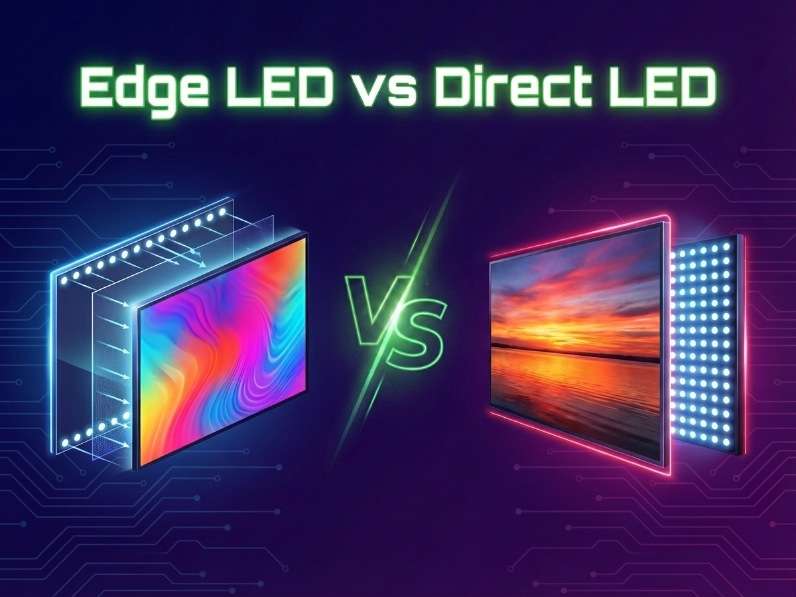
Edge LED is a slimmer and usually more affordable backlight design within the LED-backlit LCD family. In an edge-lit display, the LEDs are placed around the edges of the panel instead of across the full back of the screen. Their light is then guided inward through optical layers such as a light guide plate and diffuser to illuminate the LCD surface.
- This design became popular because it makes thin displays easier to build. By moving the LEDs to the edges, manufacturers can reduce cabinet depth and keep the product lighter and cleaner in appearance. That is one reason edge-lit TVs became so common in mainstream and mid-range models. Sony’s official explanation of Edge LED backlighting describes the same principle: the LEDs are positioned along the edge of the panel, which helps reduce overall thickness.
- The biggest advantage of Edge LED is balance. It offers a practical mix of lower cost, thinner design, and solid everyday picture quality. In bright living rooms, offices, classrooms, and other normal viewing environments, many buyers are perfectly happy with a good edge-lit display because its weaknesses are less noticeable in those conditions.
- The main drawback is reduced lighting precision. Since the light starts at the perimeter and has to spread across the screen, it is harder to control as accurately as a stronger rear-lighting system. In real use, that can mean flatter dark scenes, weaker black levels, more visible blooming, and less even brightness, especially on larger screens or in darker rooms.
- In simple terms, Edge LED works best when slim design, cost efficiency, and everyday usability matter more than maximum picture control. It is not the most advanced backlight option, but it remains a practical and effective choice for many buyers.
2. What Is Direct LED?
Direct LED provides a stronger foundation for light control because the LEDs are placed behind the panel instead of only around the edges. In a direct-lit LCD display, light comes from the rear of the screen, which usually helps create more even brightness and gives the display a better base for stronger contrast.
- This rear-lighting structure is one reason Direct LED is often linked to better picture performance. Even a basic direct-lit display can look more uniform than an edge-lit one, especially on larger screens. When local dimming is added, the advantage often becomes easier to see because the system has more control over how light is distributed across the panel.
- At the same time, Direct LED does not automatically mean a premium display. A simple direct-lit TV with limited dimming is still very different from a full-array model with much better zone control. That is why buyers should not treat the word “Direct” as a guarantee of high-end quality. It describes the lighting structure, but it does not tell the whole story by itself.
- The trade-offs are fairly straightforward. Direct-lit products usually need more space behind the panel, which often makes them thicker and more expensive. However, when contrast, HDR, and dark-room viewing matter, that added complexity is often what allows the picture to look more convincing.
- In simple terms, Direct LED is usually the better choice when picture quality matters enough to justify a stronger backlight system. It is not always the cheapest or thinnest option, but it often gives buyers a better path to more consistent and more impressive image performance.
3. What Are The Differences Between Direct LED And Edge LED?
The biggest difference between Direct LED and Edge LED is where the LEDs are placed, and that directly affects picture quality, thickness, and cost.
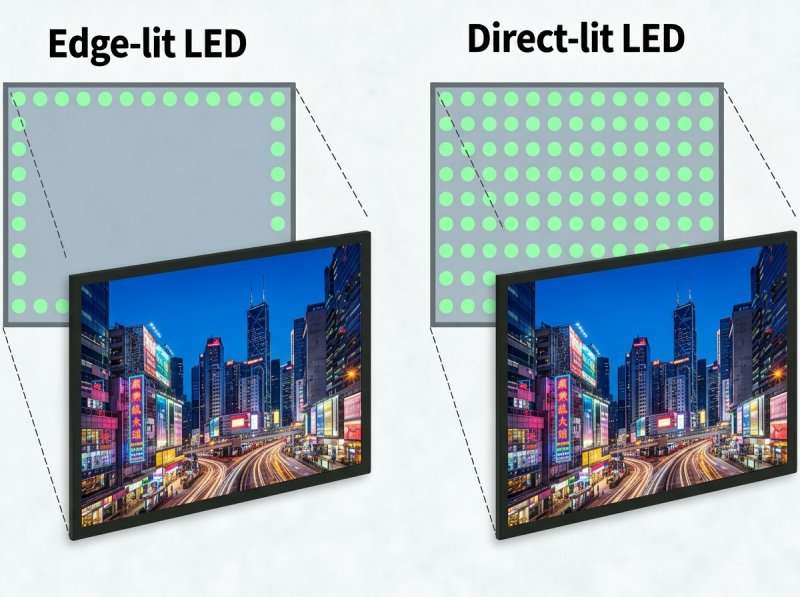
In an edge-lit display, the LEDs sit around the edges of the panel and the light is guided inward. In a direct-lit display, the LEDs are placed behind the screen, so the light comes from the rear more directly. Samsung’s explanation of edge type and direct type LED BLU reflects this same distinction.
3.1 Difference In Backlight Structure
Edge LED uses side lighting, while Direct LED uses rear lighting. In Edge LED, light must travel from the perimeter across the panel through optical layers.
Sony’s official explanation of Edge LED backlighting notes that this structure helps reduce thickness. Direct LED, by contrast, places the light source behind the screen, which gives the display a stronger base for more even illumination.
3.2 Difference In Picture Quality
Direct LED usually offers better picture performance, especially in darker scenes. Because the light comes from behind the panel, it is generally easier to control brightness and contrast.
Edge LED can still look good for everyday viewing, but it is usually less precise, especially on larger screens or in dim rooms where blooming and uneven brightness are easier to notice.
| Factor | Edge LED | Direct LED |
|---|---|---|
| Brightness Uniformity | Usually less even | Usually more even |
| Contrast Potential | More limited | Stronger |
| HDR Performance | Moderate | Usually better |
3.3 Difference In Local Dimming And Design
Direct LED is usually better for local dimming, while Edge LED is usually better for thin design.
Rear lighting gives Direct LED more room to control light across the screen, which is why it is often a better base for stronger HDR and contrast. Samsung’s guide to LED, OLED, QLED, and Neo QLED also shows how stronger LCD performance depends on more advanced light control. Edge LED, however, remains attractive because it allows slimmer, lighter displays.
3.4 Difference In Cost And Use Cases
Edge LED is usually more affordable, while Direct LED is usually the better choice for buyers who care more about picture quality.
Edge-lit designs are common in budget and mid-range products because the structure is simpler and cheaper to build. Direct-lit designs usually cost more, but they often deliver better results for movies, HDR content, and larger screens.
- Choose Edge LED for lower cost, thinner design, and everyday viewing.
- Choose Direct LED for better contrast, more even brightness, and stronger dark-room performance.
3.5 Quick Summary
In simple terms, Edge LED is usually the value-first option, while Direct LED is usually the picture-quality-first option. The right choice depends on whether you care more about slim design and price, or about stronger lighting control and better image performance.
4. Common Points Of The Two Technologies
Edge LED and Direct LED share the same LCD foundation, which means they have more in common than many comparison pages admit. Before focusing only on differences, buyers should understand the similarities that keep both technologies in the same wider family.
- Both are LED-backlit LCD systems. Neither one is self-emissive like OLED.
- Both can support modern resolutions. You can find edge-lit and direct-lit products in Full HD and 4K, and the resolution itself is determined by the LCD panel rather than by where the LEDs sit.
- Both can support HDR formats. The gap is usually in how convincingly they render HDR, not whether they can carry the label.
- Both appear in major brand lineups. Samsung, Sony, and other mainstream brands use multiple backlight strategies at different price tiers.
- Both can be smart purchases. A good edge-lit display can absolutely be the right buy in the right room and at the right budget.
The takeaway is that edge LED vs direct LED is not a fight between “obsolete” and “modern.” It is a design trade-off inside the same larger technology ecosystem.
5. Edge LED vs Direct LED: Comparison Table
Edge LED vs direct LED becomes much easier to judge once the trade-offs are laid out side by side. In most real buying situations, Direct LED wins on picture control, while Edge LED wins on slim design and cost efficiency.
| Factor | Edge LED | Direct LED | Typical Advantage |
|---|---|---|---|
| LED Placement | Around the edges of the panel | Behind the panel | Depends on design goal |
| Cabinet Thickness | Thinner | Thicker | Edge LED |
| Brightness Uniformity | Usually less even | Usually more even | Direct LED |
| Black Level / Contrast Potential | More limited | Stronger | Direct LED |
| Local Dimming Potential | Limited | Better foundation | Direct LED |
| HDR Impact | Moderate | Usually stronger | Direct LED |
| Power Use | Often lower | Often higher | Edge LED |
| Price | Usually lower | Usually higher | Edge LED |
| Best Fit | Everyday viewing, bright rooms, thin installs | Movies, HDR, larger screens, critical viewing | Depends on use case |
If you want a one-line answer to edge lit LED vs direct lit LED, it is this: edge-lit is usually the value-first route, while direct-lit is usually the quality-first route.
6. Cost Considerations of the Two Technologies
Price is shaped by more than just backlight type, but backlight architecture still influences how much a buyer ends up paying. Displays get more expensive not only because the LEDs are placed differently, but because better lighting usually comes with stronger dimming control, better processing, and a higher overall product tier.
In general, Edge LED costs less because the light structure is simpler and usually requires fewer materials behind the panel. Direct LED costs more because the rear-lighting system is more substantial, and the better versions often add more sophisticated dimming control.
That said, backlight type is only one layer. Screen size, refresh rate, processor quality, HDR tier, gaming features, speakers, and brand positioning all affect the final price. This is why two direct-lit displays can still sit far apart in price.
6.1 Main Factors That Influence Price
The main drivers of price are hardware complexity, panel size, processing, and product tier. Backlighting matters, but it never works alone.
| Price Factor | How It Raises Or Lowers Cost | Why It Matters |
|---|---|---|
| Backlight Structure | Direct-lit and full-array systems usually cost more than edge-lit systems | More hardware and more control raise manufacturing cost |
| Local Dimming Quality | Better dimming usually raises price clearly | It improves contrast and HDR performance |
| Panel Size | Larger sizes usually increase price quickly | More materials and more light output are required |
| Refresh Rate | 120Hz models often cost more | Gaming and motion performance improve |
| Processing Hardware | Premium processors add cost | They improve upscaling, tone mapping, and picture management |
| Panel / Color Technology | QLED and Mini LED tiers usually cost more | They target stronger brightness, color, and dimming performance |
| Brand Tier | Premium brands often charge more | Build quality, software support, and processing can justify part of the premium |
6.2 Official Model Examples By Lighting Tier
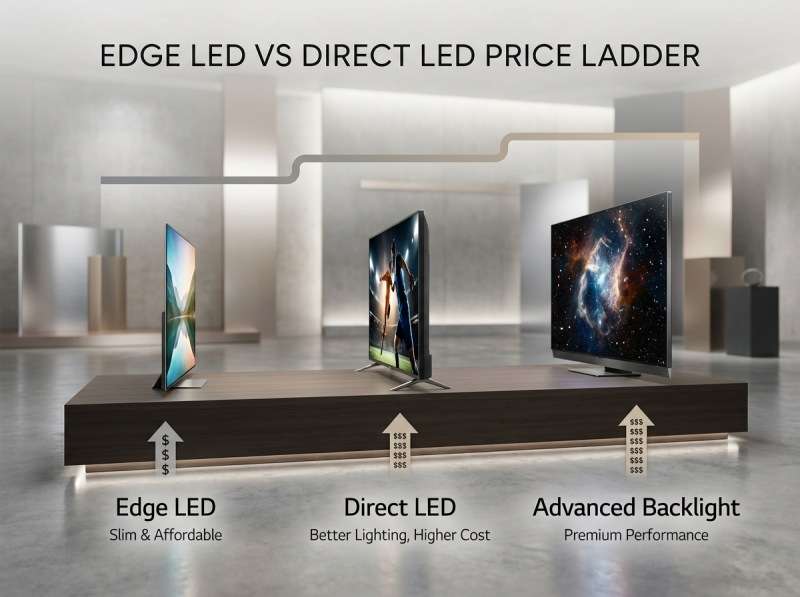
Official model examples are easier to compare by lighting tier than by a strict Edge LED vs Direct LED match-up. That is because brands do not always use the same labeling system on current product pages.
For buyers, these examples are most useful because they show how prices usually increase as backlight systems become more advanced. In general, simpler lighting tiers cost less, stronger rear-lighting systems cost more, and premium Mini LED models sit at the top end.
| Brand | Model | Size | Official Lighting Term | Example Official Price | Tier Position |
|---|---|---|---|---|---|
| Samsung | QE1D | 55″ | Dual LED | $999.99 | Mid-tier lighting |
| Samsung | Q80D | 55″ | Direct Full Array | $1,199.99 | Stronger rear-lighting tier |
| Samsung | QN90D | 55″ | Quantum Matrix with Mini LEDs | $1,599.99 | Premium advanced backlight tier |
| Sony | BRAVIA 3 K-55S30 | 55″ | Direct LED | $599.99 | Mainstream rear-lit tier |
| Sony | BRAVIA 7 K-55XR70 | 55″ | Mini LED QLED | $1,399.99 | Premium advanced backlight tier |
The key takeaway is that buyers are usually paying for lighting sophistication, dimming capability, and overall product tier, not just for a label on the box.
In real products, the most useful comparison is often between simpler lighting systems, stronger rear-lighting systems, and premium Mini LED tiers rather than a forced model-by-model Edge LED versus Direct LED matchup.
7. Which Is Better, Edge LED Or Direct LED?
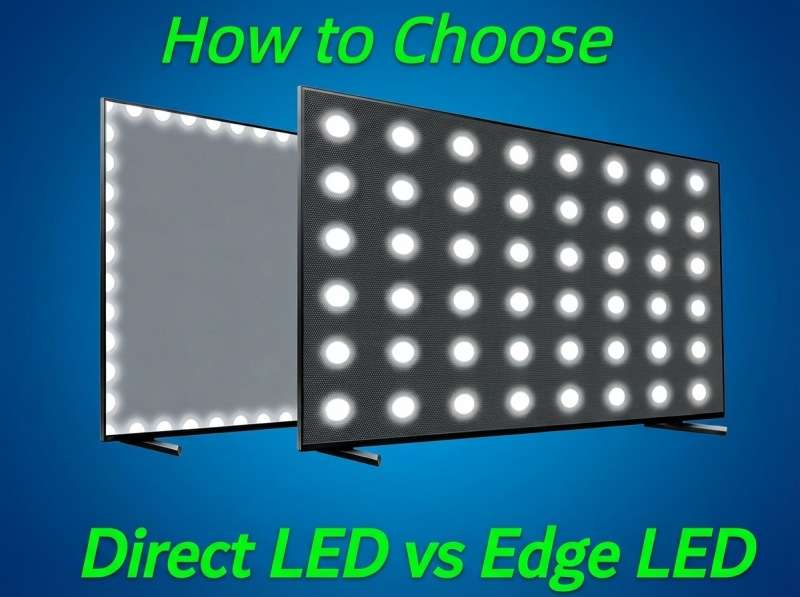
Direct LED is better for picture performance, while Edge LED is often better for value. That is the clearest honest answer because the “better” technology depends on which compromise matters less to you.
If you mainly want a thinner display for everyday use at a lower price, Edge LED can be the smarter choice. If you want deeper blacks, stronger HDR, and more even illumination, Direct LED is usually the better investment.
7.1 When To Choose Edge Lit
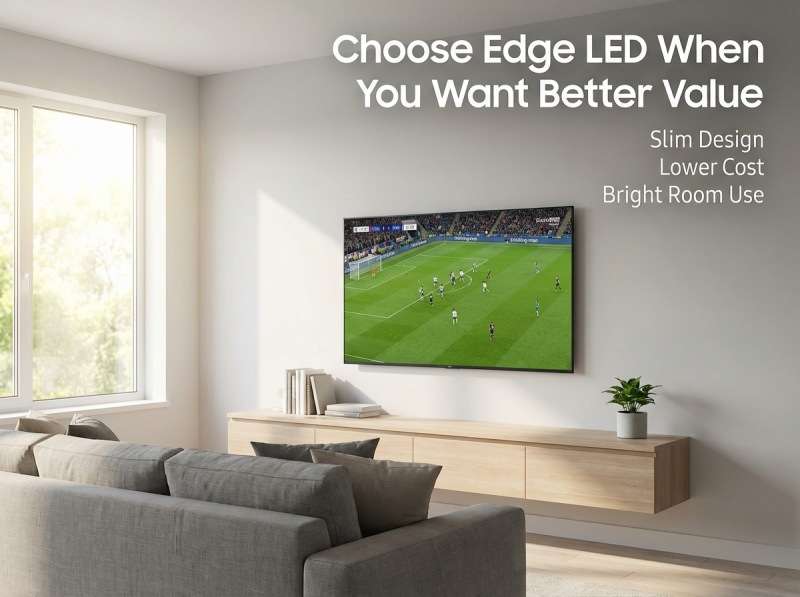
Choose Edge LED when slim design, lower cost, and practical everyday viewing matter more than maximum contrast and dimming precision.
- Your room is bright most of the time.
- You mostly watch sports, news, general streaming, or live TV.
- You want a thinner product for wall mounting or cleaner interior design.
- You are buying multiple displays and need stricter budget control.
- You do not want to pay extra for picture improvements you may barely notice in your normal setup.
7.2 When To Choose Direct Lit
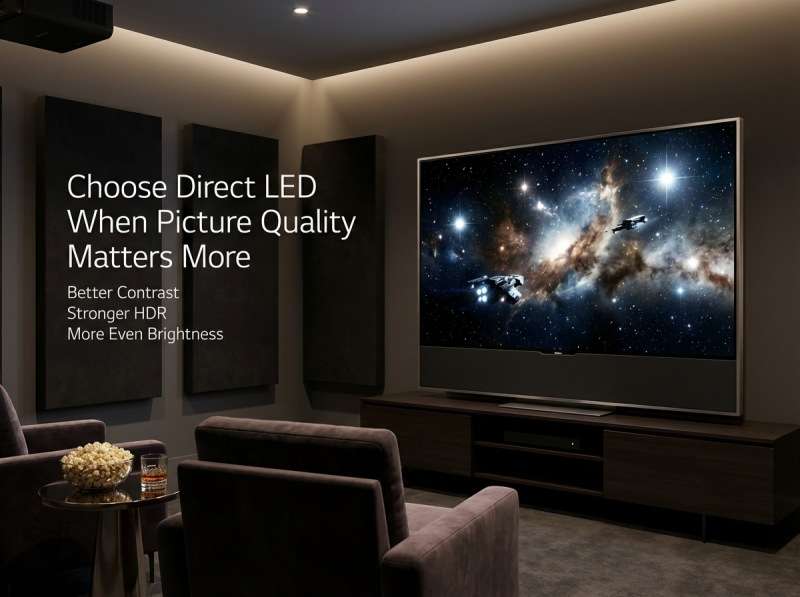
Choose Direct LED when picture quality matters enough that you will actually notice stronger contrast, better dark-scene handling, and more even brightness.
- You watch films in dim or dark rooms.
- You care about HDR looking more dramatic and less washed out.
- You want a better base for local dimming and premium LCD performance.
- You prefer larger screens where lighting weakness shows more easily.
- You use the display for more critical visual work.
8. Comparison Of Common Applications
Application decides the winner faster than theory does. The right answer for a meeting room is not the same as the right answer for a dark gaming room or a movie-focused TV setup.
8.1 Direct LED vs Edge LED For Commercial
Commercial buying usually rewards the solution that best matches ambient light, budget, and deployment scale.
For straightforward office displays, conference rooms, and cost-sensitive indoor signage, Edge LED often remains the practical choice because it is thin, affordable, and usually bright enough for ordinary business content.
Direct-lit LCD screens become more attractive when consistency matters more. Larger-format LCD signage, long operating hours, premium retail visuals, and more demanding content can expose uneven lighting more quickly, which is where direct backlighting starts to justify its extra cost.
If your project moves from standard LCD signage into a dedicated indoor LED screen plan, the buying framework changes. At that point, you are no longer simply comparing direct LED backlight vs edge inside a conventional LCD product.
| Commercial Scenario | Better Fit | Main Reason |
|---|---|---|
| Meeting Rooms | Edge LED | Lower cost and sufficient clarity for presentations |
| Budget Indoor Signage | Edge LED | Thin design and cost efficiency |
| Premium LCD Signage | Direct LED | Better uniformity and more stable visual performance |
| Long-Hour Critical LCD Display | Direct LED | Rear illumination is usually more consistent |
8.2 Direct LED vs Edge LED For Gaming
Direct LED is usually better for immersive gaming, while Edge LED is often enough for competitive gaming on a tighter budget. The deciding factor is whether you care more about image depth or about getting acceptable performance at the lowest total cost.
Single-player RPGs, horror titles, and dark open-world games benefit from stronger contrast and better shadow control. Fast competitive games, by contrast, depend much more on refresh rate, response time, and input lag than on the backlight structure alone.
| Gaming Priority | Better Fit | Main Reason |
|---|---|---|
| Competitive Multiplayer | Edge LED | Budget can go toward refresh rate and other gaming features |
| Immersive Single-Player Gaming | Direct LED | Better contrast and stronger dark-scene presentation |
| Mixed Gaming And Movie Use | Direct LED | More balanced overall picture quality |
8.3 Direct LED vs Edge LED For TV
For TV use, Direct LED is usually the better home-theater answer and Edge LED is usually the better everyday-value answer. The room itself changes how visible the difference becomes.
In a bright family room, ambient light reduces the visible contrast gap, so the cheaper and thinner option often performs well enough. In a dim room, the strengths of rear lighting become easier to notice, especially for movies and HDR-heavy streaming.
| TV Use Case | Better Fit | Main Reason |
|---|---|---|
| Bright Family Room | Edge LED | Value and slim design matter more, contrast gap is less obvious |
| Dark-Room Movies | Direct LED | Better blacks, contrast, and HDR presentation |
| Mixed Everyday TV | Depends On Budget | Either can work if overall implementation is strong |
9. Comparison of Popular Models
9.1 Direct LED vs Edge LED Samsung
Samsung is a useful example because it usually describes backlighting by product tier, not simply as edge-lit or direct-lit. So buyers should check Samsung’s official lighting terms instead of assuming all Samsung LCD TVs perform the same way.
At the 55-inch level, Samsung’s lineup shows a clear upgrade path. The QE1D uses Dual LED, the Q80D uses Direct Full Array, and the QN90D uses Quantum Matrix with Mini LEDs. As the lighting system improves, the price usually goes up as well.
The key takeaway is simple: do not judge a Samsung TV only by whether it is QLED. Pay attention to the lighting tier, because that often has a bigger impact on contrast, dimming, and overall picture quality.
| Samsung Model | Official Lighting Term | 55″ Example Price | What It Suggests |
|---|---|---|---|
| QE1D | Dual LED | $999.99 | Balanced mid-tier lighting, not a top-tier dimming system |
| Q80D | Direct Full Array | $1,199.99 | Clear step up in contrast foundation and rear-lighting control |
| QN90D | Quantum Matrix with Mini LEDs | $1,599.99 | Premium Samsung LCD path with more advanced light precision |
9.2 Direct LED vs Edge LED Sony
Sony is useful here because its official specifications clearly describe different backlight tiers. That makes it easier to see how Sony scales from standard rear lighting to more advanced systems.
The BRAVIA 3 K-55S30 is listed as Direct LED, the XR-55X90L as Direct (Full Array LED), and the BRAVIA 7 K-55XR70 as a Mini LED QLED model. Together, they show a clear progression from mainstream rear lighting to more advanced light control.
| Sony Model | Official Lighting Term | 55″ Example Price | Tier |
|---|---|---|---|
| BRAVIA 3 K-55S30 | Direct LED | $599.99 | Mainstream |
| X90L XR-55X90L | Direct (Full Array LED) | See official Sony page | Upper-mid |
| BRAVIA 7 K-55XR70 | Mini LED QLED | $1,399.99 | Premium |
10. Comparison Of Other LED Technologies
Edge LED and Direct LED only explain part of the display landscape. Buyers get better results when they understand how these two backlight layouts relate to Full Array, OLED, QLED, and Mini LED.
10.1 Direct LED vs Edge LED vs Full-Array LED Display
Full-Array LED is usually the better performance tier because it builds on rear lighting and adds more serious zone-based control.
Not every direct-lit display is full-array, but full-array systems sit above simpler direct-lit systems in picture-quality potential.
| Technology | Backlight Layout | Picture Performance | Typical Position |
|---|---|---|---|
| Edge LED | LEDs on the edges | Basic to moderate | Entry to mid-range |
| Direct LED | LEDs behind the panel | Better overall control | Mid-range |
| Full-Array LED | Rear LEDs with better zone control | Stronger contrast and HDR | Upper-mid to premium |
10.2 Direct LED vs Edge LED vs OLED
OLED usually wins on black levels because it does not rely on a separate backlight at all. Each pixel emits its own light, which gives OLED a natural advantage in dark-room contrast.
The trade-off is that OLED often costs more and is not always the most practical answer for every budget or every usage pattern.
| Technology | Light Source | Main Strength | Main Trade-Off |
|---|---|---|---|
| Edge LED | Edge backlight | Thin and affordable | Weaker contrast |
| Direct LED | Rear backlight | Better uniformity and contrast | Thicker, often pricier |
| OLED | Self-emissive pixels | Best black levels | Higher cost |
10.3 Direct LED vs Edge LED vs QLED
QLED is not the opposite of Edge LED or Direct LED because QLED usually refers to a quantum-dot-enhanced LCD system that still relies on some form of LED backlighting underneath.
Samsung’s own broader explanation of LED vs OLED vs QLED vs Neo QLED is useful here, because it shows that QLED and Neo QLED describe wider product categories rather than a simple one-word replacement for edge-lit or direct-lit architecture.
| Technology | What It Refers To | Main Strength | Key Note |
|---|---|---|---|
| Edge LED | Backlight layout | Thin design, lower cost | Uses LEDs on the edges |
| Direct LED | Backlight layout | Better rear illumination | Uses LEDs behind the panel |
| QLED | Quantum-dot LCD category | Stronger brightness and color | Can still use different backlight types |
10.4 Edge LED vs Direct LED vs Mini LED
Mini LED is the more advanced LCD-backlight path because it uses many smaller LEDs for finer control.
In practice, Mini LED usually improves dimming precision, HDR performance, and highlight-to-black separation beyond what basic edge-lit or simpler direct-lit systems can usually achieve. The obvious trade-off is price.
| Technology | Backlight Precision | Performance Level | Typical Cost |
|---|---|---|---|
| Edge LED | Low | Basic to moderate | Lower |
| Direct LED | Medium | Better overall picture control | Mid-range |
| Mini LED | High | Advanced HDR and dimming | Higher |
10. FAQs
(1) Is Direct LED Better?
Yes, Direct LED is generally better for picture control, especially for contrast, uniformity, and HDR-oriented viewing. It is not always the better value, but it is usually the better image-quality foundation.
(2) Do Edge-Lit TVs Last Long?
Yes, Edge-lit TVs can last a long time in normal use. Longevity depends more on overall build quality, thermal management, and usage patterns than on edge lighting alone.
(3) Is QLED Better Than Edge LED?
Usually yes in overall picture potential, but not automatically. QLED improves the color and brightness side of LCD performance, yet the final result still depends heavily on the underlying backlight design and product tier.
(4) Is D LED Better Than OLED?
No, Direct LED is usually not better than OLED for black levels and pixel-level contrast. It can still be the better practical buy if budget, size, or LCD-specific brightness behavior matters more to you.
(5) Can Edge LED Use Local Dimming?
Yes, but it is usually more limited. Because the LEDs sit around the edges instead of behind the full panel, dimming precision is often weaker than on better rear-lit full-array systems.
(6) Which Is Better For A Bright Room?
In many bright rooms, Edge LED can already be enough because ambient light reduces the visible contrast difference. If you still want stronger HDR and more stable contrast, Direct LED remains the higher-performance option.
Yes, Direct LED is generally better for picture control, especially for contrast, uniformity, and HDR-oriented viewing. It is not always the better value, but it is usually the better image-quality foundation.
Yes, Edge-lit TVs can last a long time in normal use. Longevity depends more on overall build quality, thermal management, and usage patterns than on edge lighting alone.
Usually yes in overall picture potential, but not automatically. QLED improves the color and brightness side of LCD performance, yet the final result still depends heavily on the underlying backlight design and product tier.
No, Direct LED is usually not better than OLED for black levels and pixel-level contrast. It can still be the better practical buy if budget, size, or LCD-specific brightness behavior matters more to you.
Yes, but it is usually more limited. Because the LEDs sit around the edges instead of behind the full panel, dimming precision is often weaker than on better rear-lit full-array systems.
In many bright rooms, Edge LED can already be enough because ambient light reduces the visible contrast difference. If you still want stronger HDR and more stable contrast, Direct LED remains the higher-performance option.
11. Conclusion
Edge LED vs direct LED is mainly a question of priorities. If you want a display that is thinner, more affordable, and efficient enough for everyday viewing, Edge LED remains a very practical choice.
Direct LED is usually the better investment when picture quality matters more. It typically offers better contrast, stronger HDR, and more even illumination, especially as rear lighting moves into Full Array or Mini LED territory.
So do not judge by the label alone. When comparing edge LED vs direct LED, think about your room, your content, your screen size, and whether better light control will actually improve your viewing experience.